Shipping channels serving the Port of Virginia run past 50 feet deep, described as the deepest on the U.S. East Coast. Depth is the whole game in container shipping. The largest vessels afloat draw more water than many American harbors can take, and a channel that floats them fully loaded is a physical edge a competing port cannot simply decide to match.
A deep channel rewrites the math for the biggest ships. Vessels built for the main trade lanes need more water than many East Coast harbors can offer without constant, costly dredging, and a port that already carries that depth can take a fully laden ship on an ordinary tide instead of waiting on the weather. For the Port of Virginia that means fewer limits on which ships can call and how heavy they arrive, and that feeds straight into the cost of moving each container.
Everything else the Port of Virginia does sits on top of that one fact.
The port is run by the Virginia Port Authority, an agency of the Commonwealth of Virginia, so this is public infrastructure operated as a state asset rather than a private terminal chasing quarterly numbers. That ownership shapes what the site is and who it answers to, and it is worth holding in mind while reading the rest.
Container terminals, rail, and the reach inland
The core of the Port of Virginia is a set of container and general-cargo terminals strung along those deep channels. The work is simple to state and hard to do at scale: container shipping, general cargo that will not fit in a box, and the supply-chain logistics that move freight from ship to yard to onward transport. Container volume is the headline, but the general-cargo capability matters for the oversized and the awkward, the machinery and project loads that keep a working port from being a one-trick operation.
For the Port of Virginia, loading and unloading ships is the easy half.
The harder half is what happens after the crane sets a box on the dock. A container sitting in a Virginia yard is worth little to an importer whose customers are in Ohio or Illinois, and moving it inland cheaply and on schedule is where a port either justifies itself or loses the account. The pitch here leans almost entirely on solving that problem, and it has some real weight behind it.
Behind the cranes sits a coordination job that rarely gets mentioned outside the terminal gates. Scheduling vessel berths, staging containers in the yard, matching boxes to trains and trucks, and keeping the chain moving is the supply-chain logistics the Port of Virginia refers to, and it is the part that separates a modern terminal from a plain wharf. When it works, a shipper never notices it. When it breaks, the delays travel inland for days.
Rail gateway and two-day trucking
Rail is the standout. The Port of Virginia works as a rail gateway, with connections that push cargo toward inland and Midwest markets without first grinding through local road traffic. For heavy, long-haul freight, rail runs cheaper per mile and is less exposed to driver shortages than trucking, so a port wired into the network at the dock removes a slow and costly transfer step that other ports leave to third parties.
The road claim is the one that will catch a planner's eye. The site states two-day truck delivery to roughly 75 percent of the U.S. population. Reaching three-quarters of Americans within two days by truck, with rail available for the longer runs, is a strong argument for landing goods here instead of at a more famous but more congested northern port. The number is the operator's own, so a shipper would want to check it against a specific lane, yet the underlying geography, mid-Atlantic and central to the populous eastern half of the country, does support it.
The shippers it names
Names count for a lot in freight, and the Port of Virginia lists several large ones: Archer Daniels Midland, Lowe's, and Perdue AgriBusiness. Read together they sketch the port's cargo mix. Lowe's speaks to containerized retail imports feeding stores across the region. Archer Daniels Midland and Perdue AgriBusiness point to agricultural commodities and processed food moving the other way, outbound through the terminals toward overseas buyers.
That two-way flow is the healthy kind for a port, and the customers behind it are telling. High-volume, schedule-driven shippers of this size do not stay loyal to a terminal that misses vessel windows or loses boxes. Their continued presence argues for the reliability of the Port of Virginia more convincingly than the site's own claim of world-class customer service, a phrase every port prints and none can prove.
Export capacity is easy to overlook and worth flagging. A port that only imports leaves trucks and containers heading back empty, which lifts costs for everyone in the chain; agricultural and food shippers moving product outbound help balance that ledger, and their business is part of why the inland network here runs in both directions.
What the website is set up to do
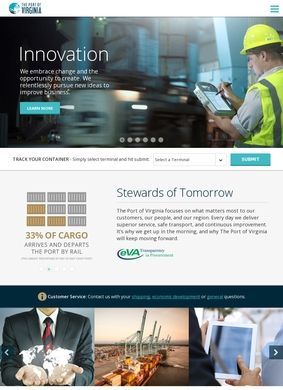
As a piece of web real estate, the Port of Virginia site is a working tool before it is anything else. Beyond the operational pages it carries a Sales team page for new business, a separate Operations Portal on its own subdomain for active users, a Careers section, procurement information for would-be vendors, FOIA request details appropriate to a public body, and a Claims and Risk Management portal for the times cargo is damaged or lost.
Each of those points at a different visitor. The Operations Portal is for carriers and forwarders with live cargo to track. Procurement and the FOIA pages are the marks of a government agency obliged to open its books. Careers is for people wanting to work the docks or the offices behind them. The Port of Virginia has organized its site around tasks people come to complete, and there is little on it to browse for pleasure.
Two of those pages say something about accountability. The Claims and Risk Management portal exists because cargo does get damaged, and a serious operator gives shippers a defined route to file a claim instead of a phone number and a shrug. The FOIA information is there because the Port of Virginia, as a public agency, can be compelled to disclose records, a kind of openness a private terminal never has to offer.
The Careers section fits the same civic frame. A port of this size is a large regional employer, from crane operators and longshore labor to the analysts and administrators upstairs, and the Port of Virginia treats hiring as one of its standing functions, not an afterthought bolted onto a sales site.
That is a fair choice for what this is. The Port of Virginia does not need a scenic front page.
The digital footprint extends to LinkedIn and the broader social platforms, though for a freight and logistics audience LinkedIn is the one doing the real work. The tone across the public-facing material is capable and institutional, the voice of an agency reporting to a state rather than a brand selling to a shopper.
As a resource to consult, the Port of Virginia rewards a narrow audience well and a general one barely at all. A shipper, a logistics planner, a vendor or a jobseeker gets precisely what they came for: terminal operations, a rail and trucking reach that is genuinely strong, a live operations portal, and clear procurement and claims paths. Everyone else meets a state agency's public face, competent and a little dry, dressed up here and there with promotional lines that add nothing.
The deep water and the rail connections are the real substance, and they are substantial enough to carry the whole thing. The Port of Virginia would read as more credible if it trusted them and dropped the world-class customer service gloss.