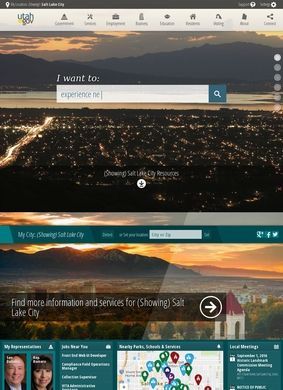
Renewing a vehicle registration or a driver's license, filing state income tax, buying a hunting or fishing license, looking up a court case, checking whether a contractor holds a valid professional license: these are the errands that send most Utah residents to Utah.gov, and the site is built around exactly that kind of task. It opens as a routing layer for the whole state government, pointing residents, businesses, and visitors toward the agency or portal that handles their specific need. Very little happens on the front page itself. The work is in where it sends you.
Services and tasks for residents
The catalogue of what it links to is broad. Residents can reach vehicle and license renewals through the DMV portal, file state income tax at the Tax Commission, register to vote and pull election information, apply for unemployment and other help through Workforce Services, and file public records requests. Businesses get a separate lane for licensing and registration, the kind a company needs before it can legally operate in the state. Underneath all of that sits a searchable directory of state agencies and elected officials, plus the departments a person rarely thinks about until they need one: Commerce, Public Safety, Health, and the rest.
Business licensing and registration
What gives the site its practical value is the breadth of small, specific errands it accounts for. Hunting and fishing permits sit next to business registration; a professional licensing lookup, the sort a homeowner might run before hiring, sits a click from court case records. These are not headline services, and that is the point. A state portal proves itself on the long tail of narrow tasks nobody plans a day around, and Utah.gov gathers a wide spread of them into one navigable set of categories instead of scattering them across search results.
Hunting permits, court records, professional licenses
The honest description of Utah.gov is a hub that hands you off. Most of the real transactions live on dedicated sub-sites: the DMV runs its own system, the courts run case lookup on theirs, the Tax Commission owns tax filing end to end. Utah.gov is the index that gets you to the right door. That design has a clear upside. Instead of memorizing which of dozens of agencies owns your problem, you start in one place and follow the category. Residents, businesses, and visitors each get their own entry lane, which cuts down on the guessing.
How the portal routes you to agencies
The trade-off is that your experience depends heavily on the destination, not on the portal. A smooth landing page can still deposit you onto an agency system that feels a decade older, with its own login, its own layout, and its own quirks. The portal cannot paper over that variance. It can only get you there. For someone who lands mid-task, already knowing which service they want, the extra hop through Utah.gov is a small tax on the way to the thing they actually came to do.
Reference materials and announcements
Beyond the transactional errands, the site doubles as a reference shelf. It carries access to Utah state law and code and to legislative information, so a resident trying to read the actual statute behind a rule has a route to it. News and press releases from the governor's office and state agencies sit alongside the service links, which makes the portal a reasonable first stop for official announcements as well as paperwork. State job listings connect through to the employment portal, useful to anyone weighing public-sector work.
State law, legislative information, job listings
The visitor-facing material leans outward too. Utah.gov threads toward state parks and the tourism side through Visit Utah, so the same front door that handles a tax filing also points a road-tripper at where to go and what to see. It is a wide remit for one gateway, and the site mostly keeps it legible by sorting everything into the resident, business, and visitor buckets. Whether every one of those links stays current is the part a portal like this always struggles with, since it depends on dozens of separate teams keeping their own pages alive.
Does every link stay current?
Utah.gov earns trust the way an official state gateway does: it is the canonical source, so the information comes straight from the agencies that own it. For a citizen sorting out a renewal deadline or a business owner figuring out which license they need first, that is worth more than a slicker layout. The content is organized, the categories are sensible, and the search over the agency directory does what it should.
Handoff quality depends on destination systems
What I keep circling back to is the seam between the polished index and the patchwork of systems it feeds you into. Utah.gov can promise you a clean starting point and still leave you fighting an aging agency portal three clicks later, and there is no way to judge from the front page how rough that particular handoff will be. The gateway is only as good as the door it opens, and that is the part it cannot control.