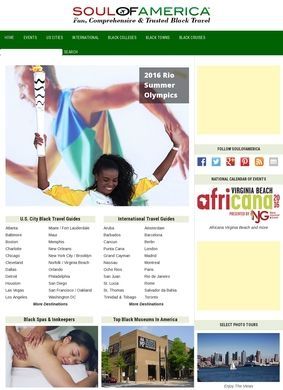
Soul of America runs 155 destination guides built around one organizing idea: travel seen through Black culture and history. That is a narrow lens for a travel site, and it is also the whole point. Most travel guides try to be everything to everyone and end up generic. Soul of America picks an audience and writes for it, which is why the coverage reads less like a stock listicle and more like someone who actually cared which places belong on the map.
Geographic coverage across U.S. cities and overseas
The geographic spread is wider than expected. There are U.S. city guides for the obvious anchors (Atlanta, Chicago, New York, Los Angeles), a Caribbean tier covering Jamaica, the Bahamas and Puerto Rico, and then a jump overseas to Paris, London, Egypt and South Africa. So Soul of America is not parochial despite its focus. A traveler planning a trip to any of those places gets a starting point that already filters for cultural relevance, saving the work of cross-referencing a generic guide against a separate search.
Thematic guides beyond destination pages
Where Soul of America gets more distinctive is in the thematic content sitting alongside the place pages. The site keeps guides to historically Black towns and communities, to Black colleges and universities, to museums and civil rights sites, and to subjects rarely bundled together elsewhere: Black cruises, sports travel, top beaches, and a Black Hollywood section. That clustering is the real value. Someone who wants to build a trip around HBCU campuses or civil rights landmarks does not have to assemble it from scattered articles, because the editorial choices have already done that assembly. It is the kind of curation that is genuinely hard to replicate with an algorithm.
Travel planning tools and utilities
Beyond the destination writing, Soul of America carries a layer of utilities that is easy to miss on first pass. There is flight tracking, airline seat maps, ground transportation resources for Amtrak and car rentals, TSA security information, passport and visa guidance, weather maps, and travel credit card recommendations. None of this is unique to Soul of America, and most experienced travelers already have a preferred tool for each, but having them collected in one place removes friction for someone who would otherwise open six tabs.
How the convenience layer supports the full planning arc
The honest read on these tools is that they are a convenience layer, not a reason to visit on their own. A seat map here is the same seat map you would find elsewhere. What they accomplish is keeping a reader inside the site through the full arc of planning, from inspiration to the logistics of actually getting on the plane. For a guide that wants to be a one-stop resource, that breadth makes sense, and it is executed without feeling like padding.
Transparent advertising model for Black travelers
The business model is visible and unhidden, which counts in its favor. Unlike a generic business directory that lists travel operators without editorial input, Soul of America carries advertising and runs an "Advertise" section aimed at businesses that want to reach Black travelers. That is a reasonable way to fund free destination content, and the site does not pretend otherwise. Knowing that some of what you read sits next to paid placement is useful context, and at least here the commercial side is stated openly rather than buried in fine print.
Limited external reviews and contact transparency
On the reputation side there is not a great deal to go on. The Facebook page tied to Soul of America carries 13 reviews with a 94 percent recommend rate, which is a warm result even if the sample is small. It is worth noting that a Tripadvisor result under a similar name points to a separate Nashville tour operator, not this publication, so anyone checking ratings should be careful not to conflate the two. No other third-party platform ratings surfaced for the website itself. For a content site where most readers arrive through search and never leave a star rating, the absence of a bigger review footprint is not alarming, but it does mean you are largely judging Soul of America on its own terms.
Contact details are the softer spot. The homepage and visible content do not surface a phone number, an email, or a physical address. There is an "About Us" page and the "Advertise" section, so a route to reach the operators exists, yet a reader who wants to verify who is behind Soul of America has to dig for it. For a publication this is less of a problem than it would be for a service business; you are reading articles, not handing over a deposit. Still, a clearer contact path would lift the credibility a notch.
Social media presence across multiple platforms
Social presence rounds out the picture, with accounts on BlueSky, Facebook, Instagram and Pinterest. That spread is reasonable evidence of an active publisher. For a travel guide that lives or dies on freshness, an operator who maintains multiple channels is a better sign than a dormant one.
Soul of America stands apart by knowing exactly who it is talking to and not watering that down. The destination guides are specific, the thematic clusters are the sort of thing you cannot easily build from a general source, and the tool layer keeps a planner from wandering off. The weaker points land: a limited review footprint outside Facebook and contact details that take effort to find. When the published content is this focused and this consistently executed, the absence of a bigger external reputation trail does not change the picture much.