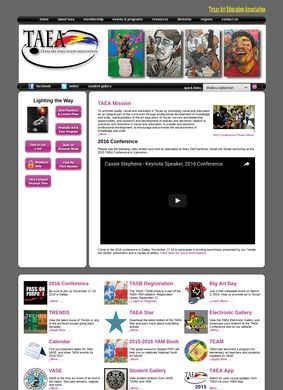
Running a statewide competition built entirely around a flag is an odd choice until you understand what TAEA is for. Youth Art Month ties a student flag design contest to the txEDCON gathering, which is a small detail but a clarifying one: this is a group that treats classroom art as something worth organizing statewide events around. TAEA represents visual arts educators across Texas, and once you start reading what it actually does, the breadth of the membership is the first thing that registers.
Membership categories and structure
TAEA pulls together art instructors from elementary grades through universities, alongside visual arts administrators, museum educators, community art educators, and retired members who want to stay connected. That spread is reflected in the membership categories, which run from active classroom teachers and higher education faculty to museum and community educators, students, and people who have left full-time teaching behind. The structure underneath is genuinely organized: twenty regional chapters and eight specialized divisions. For an organization covering a state the size of Texas, that regional layering does real work. An art teacher in El Paso has different concerns from one in Houston, and a chapter system at least tries to keep TAEA from being a Dallas-only affair.
Advocacy for arts education funding
Advocacy is one of the two things TAEA leans on hardest. It positions itself as the voice for quality visual arts education at the state level, representing art teachers in policy conversations where their subject often gets squeezed out of the budget first. I have a slight wariness of any association that lists advocacy as a headline service, because the word can cover a lot of vague activity, but in the context of public school arts funding the role is concrete and specific enough. Someone has to argue that art belongs in the curriculum when the money gets tight, and a statewide body with chapters in every region is better placed to do that than individual teachers writing to their districts one at a time. TAEA's size gives it standing and institutional reach that individual members simply cannot replicate.
Student competitions across Texas
The other thing TAEA puts front and center is its slate of student programs, and these are the parts of the offering that feel most tangible. The Visual Arts Scholastic Event, known as VASE, is the flagship for older students. The Texas Elementary Art Meet, or TEAM, serves the younger end. Big Art Day sits alongside these, and the Youth Art Month flag competition rounds out a calendar that gives students at every grade level something to enter and somewhere to have their work seen.
These events are the kind of thing that justifies an association existing at all. A single school can mount an art show; only a coordinated statewide body can run a scholastic event that lets students measure their work against peers across Texas and earn recognition that carries beyond their own hallway. The naming convention (VASE, TEAM, YAM) points to programs that have been around long enough to settle into recognizable brands within the Texas art education world, which is usually a sign of continuity that teachers can plan around year to year.
Professional development opportunities for teachers
For the educators themselves, the professional development calendar is substantial. There is an annual fall conference, which for most state associations is the centerpiece of the year, plus summer workshops, mini-conferences scattered through the calendar, and book studies for teachers who want something more reflective. A leadership scholars program rounds out the development side, aimed presumably at members who want to move into chapter or division roles. That is a fuller offering than the bare-minimum annual-meeting-and-newsletter model some professional groups settle for.
Member resources and directory
Membership itself comes with the practical resources you would expect: a newsletter, a member directory, and automatic enrollment in the mailing list. The directory is worth singling out, because for a profession as scattered as art teaching, being able to find a colleague who teaches the same grade or specialization in another district is a real benefit. People who are not members can still subscribe to the mailing list on its own, which is a reasonable bit of openness, letting interested educators stay in the loop without committing to dues first.
The site also carries job listings for art educators and networking resources. Job boards on association sites can be hit or miss, but a subject-specific one is genuinely useful: art education positions do not always surface clearly on general school district hiring portals, and a teacher looking specifically for an arts role benefits from a feed filtered down to exactly that. TAEA makes this available to anyone visiting the site, members and non-members alike.
Weighing the program's depth
Where the offering gets a little harder to evaluate from the outside is depth. The eight specialized divisions are mentioned but the practical difference between belonging to one versus another is the sort of thing that only becomes clear once you are inside the membership. Same with the leadership scholars program, which sounds promising but is described in broad strokes. None of that is a flaw exactly, since an association site is partly a recruitment tool and partly a members-only portal, but a prospective member browsing from the outside is left to take some of the value on faith. TAEA gives enough to make the case; it does not give a full accounting of what joining actually looks like week to week.
The one area worth pressing on is how the regional chapters function day to day. Twenty chapters is a lot of moving parts, and the value of that structure depends entirely on how active the local groups are. A chapter that meets regularly and runs its own workshops is worth far more to a member than one that exists mostly on paper. The association's overall organization looks sound, but the lived experience will differ depending on which corner of Texas a member sits in. That variability is inherent to any regional network and not a criticism of TAEA specifically, but it is worth knowing going in.
Assessing outside reputation
Outside reputation is limited. A search turns up the expected state association presence in arts education circles and some community references to TAEA-affiliated events, but no aggregated third-party review count anywhere. That is typical for professional associations rather than consumer-facing businesses, and it does not change the read on the organization itself. What TAEA publishes is detailed enough to assess on its own.
What is clear, across all of it, is consistency of purpose. Every piece of this fits the stated mission of promoting visual arts education in Texas, from the youngest students entering TEAM to retired teachers keeping a foot in the community. There is no scope creep, no sense of TAEA trying to be many things at once. The student competitions give the association a visible public face, the professional development gives members a reason to renew, and the advocacy role addresses a genuine vulnerability in how schools fund the arts. That is a coherent package, and the verdict is positive: TAEA looks like a serious, well-structured professional body doing the unglamorous work that keeps a subject area alive in public education.