Years after closing to new enrollments, the Texas Guaranteed Tuition Plan still pays college tuition every semester for the families who locked in contracts decades ago. That single fact explains most of what makes this program unusual. The Texas Guaranteed Tuition Plan is run by the state of Texas, also called the Texas Tomorrow Fund, and its core promise is backed by a constitutional amendment voters approved in November 1997. So even though no one can buy in anymore, the site exists to serve the people who already did, and it keeps doing the unglamorous work of crediting hours against real bills.
How tuition hours hold their value
The promise is worth restating plainly because it is stronger than what most college savings products offer. Under the Texas Guaranteed Tuition Plan, contract holders are buying tuition hours, and those hours hold their value no matter what the stock market does. A bad year for equities does not shrink anyone's benefit. For a parent who signed a contract in the late 1990s with a child now in college, that is the whole point: the cost of a credit hour was fixed at purchase, and the fund absorbs the difference between then and now. The constitutional backing is what separates this guarantee from an ordinary contractual promise, since the obligation to pay is written into the state's governing document.
Reimbursement rates for 2025-2026
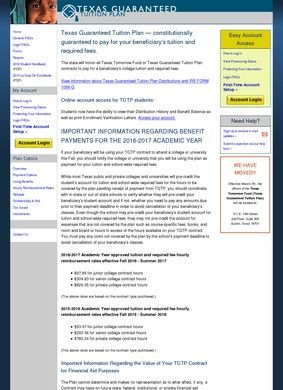
The numbers carry the message here, and the Texas Guaranteed Tuition Plan publishes them without softening. For the 2025-2026 year, a junior college contract reimburses $129.32 per hour, a senior college contract pays $372.70 per hour, and a private college contract pays $1,115.12 per hour. The gap between those tiers is enormous. It tracks the very different sticker prices the plan agreed to cover when contracts were sold. Anyone holding an older contract can read the current rate and know exactly what the fund will send the school for each enrolled hour. No estimating, no projection, no asterisk pointing at market conditions.
The conversion mechanics are spelled out rather than buried. The Texas Guaranteed Tuition Plan coordinates payment directly with the college, and schools typically pre-credit a student's account while the payment is still processing. For a student staring at a tuition deadline, that is a significant detail, because the registrar is usually not holding enrollment hostage while paperwork moves between the fund and the bursar. The benefit covers tuition and schoolwide required fees, so contract holders can see what falls inside the guarantee and what does not. Fees charged only to certain students or programs sit outside that scope, and the Using Benefits section is reasonably direct about that boundary.
The site groups practical questions into clear sections: Plan Overview, Payment Options, Using Benefits, Hourly Reimbursement Rates, Refunds, Scholarships and Aid, Tax Issues, and Investments. There are separate General FAQs and Login FAQs, which makes sense given that questions about a contract are different from questions about getting into the portal. Forms and Reports sit alongside these, and the 2026 Student Handbook is offered as a downloadable PDF.
Account portal and enrollment verification
The online account portal is where most contract holders spend their time, and it covers the basics well. Account owners and students can log in to view distribution history, check the remaining benefit balance, and watch the processing status of a current payment. The Texas Guaranteed Tuition Plan portal also produces enrollment verification letters, which schools and sometimes outside agencies request, so families do not have to phone in and wait for one to be mailed. Distribution history is useful at tax time, since it lines up with what the program reports to the IRS.
Tax handling gets its own section, and rightly so. Distributions from the Texas Guaranteed Tuition Plan are reported to the IRS on Form 1099-Q, and the site explains what that form means at filing time. This is the kind of thing that trips people up every spring, and having a plain explanation tied to the program's own distributions saves a lot of confused searching. The Tax Issues section and the FAQs work together on this, so a contract holder can reconcile what they received against what the form shows.
There is also a protective angle the site notes: Texas Guaranteed Tuition Plan assets are shielded under Texas law from being counted in certain financial determinations. For families weighing how a prepaid balance interacts with other obligations or aid calculations, that is a meaningful piece of information to have stated outright.
Not every contract plays out the simple way, and the Texas Guaranteed Tuition Plan acknowledges as much. The Refunds section addresses what happens when a contract is not used as originally planned, and the Scholarships and Aid material covers how the benefit interacts with money a student wins from other sources. These are the situations that generate the most phone calls, so it is good that they get dedicated space instead of a vague catch-all line. A student who earns a full scholarship still has a contract with value, and the site treats that as a question deserving its own answer.
One thing worth naming honestly: because the program no longer accepts new contracts, much of the material reads as maintenance documentation for an aging book of business. The Investments section, the annual reports, and the handbook updates each year all point to a program in long, careful wind-down rather than one chasing growth. That is not a flaw. It is exactly what a closed, guaranteed fund should look like, and the steadiness is the feature.
For someone who is neither a contract holder nor a Texas family from that era, there is not much to do here. The site has no interest in attracting anyone new, and it shows. Everything is pitched at people who already have a stake. Browsing this entry in a business directory would feel beside the point, because the audience is fixed and finite. The value sits entirely in serving the contracts that already exist.
Comparing prepaid plans to investment accounts
Where the Texas Guaranteed Tuition Plan separates itself from ordinary college savings vehicles is certainty. A 529 investment account rises and falls with markets; this fund pays a defined number of hours at a published rate regardless. The site reinforces that distinction at every turn, from the rate tables to the constitutional guarantee language. The Investments section explains how the underlying assets are managed to meet those guaranteed obligations, which is more transparency than a typical contract holder probably expects to find. On that dimension, the Texas Guaranteed Tuition Plan is doing exactly what it promised decades ago, and the documentation reflects that.