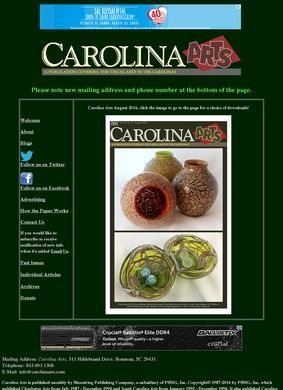
Someone trying to find out which Greenville galleries are hanging new work, or which museums across the Carolinas have a show worth the drive, runs into the same wall: the information is scattered across dozens of separate sites, flyers, and mailing lists. Carolina Arts sets out to pull all of it into one place. It is a monthly publication, both print and digital, covering arts and cultural news for the two Carolinas, and it has been doing that job for well over three decades under the Carolina Arts name.
The publication began life as Charleston Arts, widened into South Carolina Arts, and now runs simply as Carolina Arts, a lineage that suggests it grew alongside its readership instead of parachuting in fully formed. It appears every month, and it is given away, not sold, a point the masthead makes with the blunt line Absolutely Free, You Can't Buy It. That single sentence tells you most of what you need to know about who it is for and how it pays for itself.
A monthly built around the galleries
The spine of Carolina Arts is coverage of the visual-arts scene, and it is organised the way a reader actually uses it, which is by place. The content is broken out region by region, with sections like the commercial galleries of the Greenville area sitting beside museum and arts-organisation coverage from other parts of the state and beyond.
For a reader planning a weekend, or an artist tracking where the shows are opening, that geographic cut is the practical heart of the whole enterprise. It is closer to a working reference than a magazine you read once and recycle, and that is the frame to keep in mind when weighing everything else it does.
Regional listings for galleries and museums
The regional structure is where the publication proves genuinely useful. Commercial galleries, museums, and arts organisations are grouped by area, so a resident of the Upstate is not wading through coastal listings to find what is open nearby. It is a directory logic applied to the arts, and it suits a print-and-web hybrid that can carry long, sortable listings a glossy monthly would never have room for.
Carolina Arts leans into breadth here instead of narrowing to a handful of headline shows, which is the right instinct for a paper meant to serve a whole region, not one city's opening-night crowd.
The reader who benefits most is the one with a specific question, a town, a medium, a venue, and the layout answers that kind of question directly.
An archive you can page back through
The other quietly valuable feature is the archive. Carolina Arts posts full monthly issues as PDFs going back years, alongside individual articles pulled out and hosted on their own, so a reader can trace a gallery's history or dig up an old feature without hunting through a library's microfilm. Institutional memory in a regional arts scene tends to evaporate fast: shows close, galleries move, and the only record that a particular exhibition happened at all is often a listing in a monthly like this one.
For a working history of the Carolinas' cultural life, that back catalogue may prove more useful over time than any single current issue. Plenty of free monthlies let their old numbers vanish; Carolina Arts keeps them where anyone can reach them.
Free to read, and easy to reach
Two things make Carolina Arts easy to deal with as a reader. It costs nothing, and it is not hard to get in touch.
Contact details, a street address, a phone number, an email, and a proper contact page, are laid out plainly in the site's navigation, so a gallery wanting to submit news or a reader with a correction knows exactly where to go. The free model is stated outright, and a no-cost email subscription pings you when new content lands, so keeping up with Carolina Arts does not even depend on remembering to check the site.
The subscription and the price that isn't one
The email-notification service is the mechanism that turns a monthly into something closer to a running feed. Sign up, and new material arrives in the inbox on its own schedule.
There is no paywall waiting behind the sign-up, because the entire publication is free by design. That the masthead advertises the price rather than burying it fits the character of a community paper like Carolina Arts, funded by the venues it covers instead of by the people reading it. For an audience that skews toward students, working artists, and gallery-goers keeping an eye on their spending, a genuinely free and current source of listings is worth having, and the subscription removes even the small friction of visiting the page.
Advertising, and the company behind the paper
The revenue side is spelled out with the same candour. Carolina Arts sells advertising to businesses and galleries, which is the ordinary bargain of a free publication: readers pay nothing, and the venues that want their exhibitions seen pay to reach them. Behind the paper sits Shoestring Publishing Company, itself a part of PSMG, so this is a modest but established operation with a real corporate structure, not a one-person blog, which lends it a measure of continuity and accountability.
A publisher with a company behind it tends to keep the lights on and the archive online, which is exactly what a long-running listings resource depends on.
Independent evidence barely exists, and it would be wrong to dress that up. A search turns up a company-information listing and the publication's own Facebook presence, but no star ratings and no third-party reviews on the platforms where such things usually accumulate. The case for Carolina Arts therefore rests on the work itself, the depth and currency of its listings, rather than on a visible wall of testimonials from readers.
For a regional arts monthly that has run this long, the absence of reviews reads less as a red flag than as the simple reality of a niche publication that its audience uses without ever thinking to rate.
What a reader ends up with from Carolina Arts is a monthly that sorts the galleries by region, hands its back issues over as PDFs, and prints a line across the masthead insisting you could not buy it even if you tried.