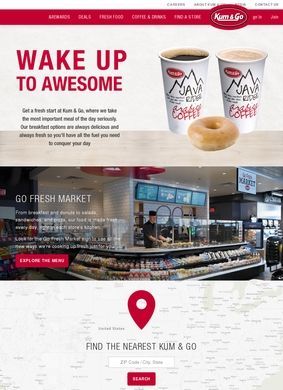
What happens when you type kumandgo.com into a browser today? You land on Maverik. The 2024 merger folded Kum & Go into Maverik, and the old address now points travelers toward a site branded "Adventure's First Stop." So a review of Kum & Go is really a review of what the chain became: a fuel-and-food convenience network that sells gas, hot burritos, bean-to-cup coffee, and a loyalty scheme built to keep you coming back to the pump.
The shopping angle here is not shelves of groceries. What Kum & Go now represents is the gas station transaction reimagined as a rewards ecosystem, and the site puts that front and center.
Fuel, food, and the pay card that ties them together
The centerpiece is the Nitro pay card. Link it, pay with it, and Kum & Go advertises 15 cents or more off every gallon plus a quarter off fountain drinks. That is a straightforward pitch for anyone who fills up on a regular route.
Food gets nearly equal billing. The BonFire brand covers the hot case: breakfast sandwiches, burritos, pizza, and meal deals in the four-to-seven-dollar range that bundle a hot dog or a slice with chips, coffee, or a soda. It is priced to catch the impulse buy, the kind of quick lunch a driver grabs without thinking twice about it. Bundling a slice of pizza, a bag of chips, and a fountain drink into one low number is an old convenience-store trick, and it works here because the price points are specific and the photos are appetizing enough to sell the stop.
Alongside that runs the Maverik coffee program, bean-to-cup, hot and iced, which is the sort of thing gas stations increasingly lean on to compete with drive-through chains.
There is also merchandise. Maverik Gear sells branded apparel, which tells you Kum & Go wants to be a lifestyle name and something more than a place you stop because your tank is low.
The Adventure Club and its professional tier
Loyalty is where Kum & Go spends most of its energy. Adventure Club hands out free items, weekly deals, punch cards, and something called trail points. The mechanics are gamified on purpose, and I found the layering of punch cards on top of a points system a little busy to parse at a glance, though the payoff for a frequent visitor is easy enough to see.
What sets it apart from a typical gas-station app is the split into tiers. A separate Adventure Club Professional tier targets commercial and fleet drivers, and a distinct Fleet fuel-card program serves trucking and business accounts. That is a deliberate move by Kum & Go to court the driver who buys hundreds of gallons a month, well beyond the commuter topping off on the way home.
Sweepstakes and the app
The promotions lean big and loud. Win a Ford F-250 with a camper and ATVs, or a 4Runner: these are the giveaways dangled to pull sign-ups. Whether that kind of prize moves you or feels like noise probably depends on how you feel about sweepstakes in general.
The mobile app pulls the whole thing together, handling ordering, deals, and account management in one place. For a chain whose model depends on repeat visits, funneling everything through an app makes sense, and Kum & Go pushes the download hard.
Finding a store and reaching a person
Navigation is built around the map. A "Locations" finder, sometimes labeled "Find a Maverik," is the primary tool, and a "Sign In" waits at the top for account holders. If you know what you want, deals, rewards, a nearby store, the path is short.
Reaching an actual person is harder. The Kum & Go homepage is built for offers and sign-ups, and there is no visible phone number, no posted address, and no obvious way to reach the company on the pages that loaded. For a chain this size that is not unusual, since individual stores are meant to be reached through the locator, which surfaces the specific spot near you. A customer with a general question rather than a store-specific one has to hunt a little, and that is a small friction point on an otherwise slick site.
None of that changes what the site is for. It exists to get you enrolled, get you the app, and get you to a pump. On those terms Kum & Go is clear and it moves fast.
How it lands with reviewers
The reputation trail is a bit lopsided, and it is worth being honest about why. Most of what surfaces is about Kum & Go as an employer, not as a store. Glassdoor sits at 3.6 out of 5 across 436 reviews, CareerBliss reports 3.8 from a smaller pool, and Indeed carries more than a thousand employee reviews without a single headline star figure. That is useful if you are thinking about working there. It says nothing about whether the coffee is any good.
On the customer side the numbers drop off and scatter by location, which is the nature of a store network where each Kum & Go builds its own local standing. A Birdeye page for a Colorado Springs store shows 3.8 stars across 48 reviews. Tripadvisor entries swing hard depending on the town: 3.5 out of 5 for a Bryant, Arkansas store on four reviews, 4.5 for a Dacono, Colorado location on six, and a clean 5.0 for a Paragould, Arkansas spot on four.
Those are tiny samples, too small to read much into on their own, and the spread just confirms the experience tracks with whichever store you happen to pull into.
That is a fair thing to expect from a convenience chain. The brand sets the menu and the rewards, and the local crew sets the tone. What is missing is a large, aggregated customer rating on any single major platform, so a shopper looking for one confident number will not find it here. The employer reviews pile up in the hundreds, the customer reviews are scattered a handful at a time, and neither one gives you much to lean on.
So where does Kum & Go land? As a website it is a competent, promotion-heavy front door to a fuel-and-food loyalty machine, now wearing Maverik's colors, and it does its one job, converting visitors into members, without much fuss. The rewards run deep, the food is priced to tempt, and the split between everyday drivers and fleet customers shows real thought. What the site will not tell you is whether the location down the road is the 5.0 or the 3.5, and that answer only comes from pulling in and trying it.