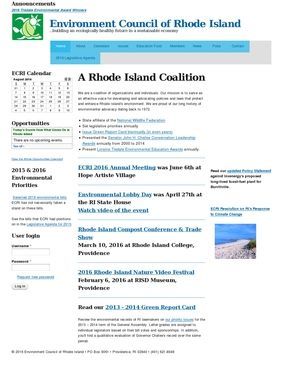
A Rhode Islander who wants to move the needle on a state environmental bill runs into the same wall fast: the State House moves on its own calendar, dozens of bills compete for attention, and one concerned citizen has almost no pull alone. The Environmental Council of Rhode Island exists to solve exactly that coordination problem. It is a nonprofit coalition of more than 60 organizations and individuals that pools their weight behind shared environmental policy goals, and it has done the unglamorous work of turning scattered concern into a single voice at the legislature.
That is the pitch, anyway. What the Environmental Council of Rhode Island delivers behind it is more mixed.
How the coalition holds together
Membership is the backbone. Over 60 groups and individuals belong, which for a small state is a serious share of the organized environmental community, and it gives the Environmental Council of Rhode Island a claim to speak for a broad slice of it. A coalition of that size also means the positions count for more at a hearing, because a legislator hears from 60 groups at once instead of one.
There is a membership program with a form to join, currently handled through Google Drive links while the website is rebuilt. It is functional. It is also a reminder that the coalition runs on member energy more than on a big communications budget.
The top legislative priorities
The clearest product is the set of published legislative priorities. Each session, the coalition puts out a document naming the specific bills and policy goals it is backing, and it keeps versions from multiple years available. For anyone trying to follow environmental policy at the state level, this is the useful stuff: a plain, sourced list of what the movement is actually pushing for, decided collectively by member groups.
It saves a citizen from reading hundreds of bills to find the handful that matter. For a member group, it is also a coordination device: everyone signs on to the same asks, so the movement does not splinter into competing bills. The Environmental Council of Rhode Island treats this as its central output, and that focus is the right call.
Grading the legislature and getting people there
Two things turn priorities into pressure. The first is the Green Report Card, a tool that grades legislators and policy against the Environmental Council of Rhode Island's standards.
A scorecard is a blunt instrument, but it works: it gives voters a quick read on where their representative stands, and it gives legislators a reason to care what the Environmental Council of Rhode Island thinks of their record. Whether a legislator agrees with the grade or not, the Green Report Card forces the environmental record into the open, where a voter can see it. Accountability tools like this are what separate a coalition that lobbies from one that only issues statements.
Earth Day Lobby Day and joining in
The second is showing up in person. The coalition runs an Earth Day Lobby Day, which brings advocates to the State House to press legislators face to face on the year's priorities. It is a smart piece of organizing, because a busy lawmaker responds differently to a room full of constituents than to an email. Beyond the big day, the Environmental Council of Rhode Island puts out member updates and keeps a community-engagement thread going, so involvement is not limited to a single day each year.
The audience is broad: seasoned environmental advocates, the member organizations themselves, and ordinary residents who just want to know how to help. If you want to help, the path in is clear enough: join, read the priorities, turn up.
A site under construction, and scant outside proof
One caveat is impossible to miss: the website is in the middle of a redesign, and it shows. Core materials, the priority documents, event details, the membership form, currently live behind Google Drive links stitched into a stopgap site.
Everything a visitor needs is reachable, but it takes patience, and the presentation undersells the Environmental Council of Rhode Island, an organization doing real work. There is also a separate arm, the Environment Council of Rhode Island Education Fund, a 501(c)(3) that appears in nonprofit databases and handles project work like a Green Infrastructure Coalition and a Providence climate-justice plan. The two entities are easy to confuse, and the site does little to explain how they relate.
Outside validation is scarce, which is worth saying plainly. The Facebook page carries four reviews but shows no star rating. Charity Navigator has a profile but reports that the Environmental Council of Rhode Island cannot be evaluated under its accountability and finance system, so there is no score there. A 'cannot be evaluated' note is not a bad grade; it usually means the organization is small or files differently, so it should not be read as a red flag.
A GuideStar entry exists for the affiliated Education Fund, and Vote Smart lists an interest-group page, yet neither surfaced a numeric rating. Google, Trustpilot, Yelp, Tripadvisor, Glassdoor and the BBB turn up nothing. For a group as established as the Environmental Council of Rhode Island, I found the near-total absence of third-party ratings a little surprising, though it fits the reality that policy advocacy groups rarely collect the consumer reviews a restaurant or contractor does.
Contact runs entirely through email and social channels. Two working email addresses are published, one for the director and one general, and the coalition is present on LinkedIn, Facebook, Instagram and Bluesky. What is missing is a phone number or a mailing address, and there is no single contact page pulling it together, so reaching the Environmental Council of Rhode Island means emailing or messaging and waiting. The upside of email-first contact is a paper trail; the downside is that nothing on the site tells a first-time visitor how quickly to expect a reply.
For an all-volunteer advocacy group that is understandable, though a member with a time-sensitive question might wish for a faster line.
The most concrete thing the Environmental Council of Rhode Island still puts in front of a visitor is that stack of legislative priority documents, one per session, listing bill numbers and positions in black and white. Everything else, the redesign, the scorecard, the Lobby Day, orbits around that.