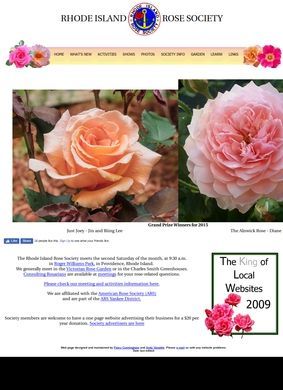
You bought a rose two springs ago, watched it limp through one season and then collapse to black spot, and now you want to grow them properly without guessing. That gap, between owning a rose and knowing how to keep it alive in a New England climate, is exactly where the Rhode Island Rose Society steps in. RIRS is a nonprofit membership group for rose growers in the state, and it states its purpose plainly on its About page: to study, foster, and encourage rose culture including the exhibition of roses. The wording is old-fashioned in a way that fits a club that has clearly been doing this for a long time.
Monthly meetings and the annual rose show
What you get is closer to a working garden club than a glossy resource site. RIRS holds monthly meetings on the second Saturday of each month at 10 in the morning, which is the kind of fixed, repeating commitment that tells you the group runs on real people showing up rather than on a web team posting content. The site has separate pages for those meetings, for membership, for its resources, and for the rose show, so the structure mirrors how the organization actually operates. Finding it through a business directory search rather than a direct link is probably how most newcomers land here, and the site does enough to orient them once they arrive.
How the organization structures its calendar
The annual June rose show is the centerpiece of the year, and RIRS posts results afterward. For anyone who has only ever grown roses in a back border, an exhibition is a useful thing to watch: it shows you what a well-disbudded bloom is supposed to look like, what counts as a fault, and how far ahead the serious growers in your own region are working. Tying the show to the calendar also points to a real activity, not a page that was written once and forgotten.
What exhibition results reveal to new growers
The quarterly newsletter is the other piece worth weighing if you are deciding whether to join. It is called the Rhode Island Rose Review and RIRS describes it as award-winning, which for a small regional club usually means it circulates into the wider rose community and gets judged there. A quarterly publication is a steadier commitment than many volunteer groups manage, and it puts the membership in the position of producing something with continuity behind it. There is also an annual calendar photography contest open to members, a low-pressure way to get people pointing cameras at their own gardens and comparing results.
The Rhode Island Rose Review
None of this is flashy. It is the ordinary machinery of a club that meets, exhibits, publishes, and keeps members involved across the seasons. That is not a criticism.
Newsletter and photography contest for members
The educational side leans on accumulated material. RIRS keeps donated newsletter archives and acquisition files, with pictures and data on individual rose varieties, and notes that members helped build this collection through donations. For a grower trying to decide which cultivars survive Rhode Island winters, that kind of variety-level record tends to be more practical than the generic advice found elsewhere online, because it reflects what people in the same hardiness zone have grown and kept notes on.
Variety files built from member donations
The affiliations are worth looking at too. RIRS is connected to the American Rose Society and to the Yankee District, which places this small state group inside a national structure of judges, shows, and shared standards. That linkage matters for a beginner: it means the people running the local Saturday meetings are plugged into the same rules and resources as exhibitors across the country, so the guidance you receive is not one gardener's habit passed along informally.
Connection to American Rose Society standards
Membership comes with listed benefits, framed around the things the site already describes: the newsletter, the meetings, the show, the contests. That is at least honest. A membership that promises exactly what the rest of the site delivers is easier to trust than one padded with vague perks. The maintenance of the variety files through member donations is also worth a second look. It tells you the collection grows organically from the people who use it, which is both a strength and a limit. The depth depends on who contributes, so coverage of any given rose may be uneven. That is the honest tradeoff of a volunteer-built archive.
Membership benefits and honest tradeoffs
Reaching RIRS is harder than it should be. The landing page shows no phone number and no mailing address, which for a society that meets in a physical location every month is a real omission. Anyone wanting to attend a Saturday meeting has to figure out where it happens through some route the site does not make obvious. The only direct contact is a webmaster email and a link to a Facebook group.
Missing contact information and location details
A search for outside opinion on RIRS turned up nothing usable, no third-party reviews or ratings on the platforms where a club like this might surface. That is not damning. Small horticultural societies rarely collect star ratings, and their reputation lives inside their local network and the rose community. But it does mean a newcomer has little independent input to go on and has to judge the society on what its own pages show.
No third-party reviews or external ratings
The activities look real enough, the affiliations are legitimate, and the newsletter and the June show give the year a genuine rhythm. The Facebook group is probably where current life and conversation happen day to day. What the site lacks is a practical front door: a room number, a building name, something that lets a person actually walk in. RIRS does a reasonable job of describing what it is. It does a worse job of making it easy to arrive.