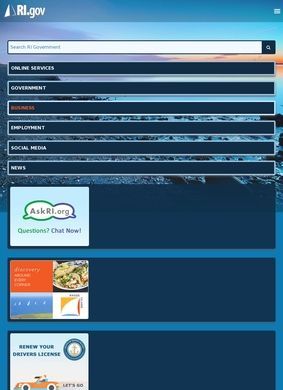
RI.gov is the official internet portal of the State of Rhode Island, the single web address through which residents, businesses, and visitors reach state government information and conduct official transactions online. The point of the site is consolidation: instead of hunting down individual agency addresses, a person lands here and gets routed to whatever part of state government they need. Most of the time that means completing a transaction.
Completing state transactions online
The transactional list is long and genuinely useful. Vehicle registration, license renewals, VIN checks, and the bill of sale paperwork all run through the DMV channel. Unemployment insurance claims go through the Department of Labor and Training. Child support payments and case management have their own path, as do criminal records requests, birth certificate orders, and a straightforward address change process. Rhode Island Government also handles state tax information and refund status, which is one of the queries people tend to fire off repeatedly during a given stretch of the year. None of this requires a trip to a counter, and that is the central promise the site is built around.
Business filings and environmental permits
Business and legal filings get equal treatment. Secretary of State filings and business registration are reachable directly, which is essential for anyone forming or maintaining a company in the state. The Department of Environmental Management connects through for permits and the environmental information that contractors, landowners, and developers tend to need before they break ground. Employment resources and job listings sit alongside all of this, aimed both at people looking for work and at state hiring itself.
Trending topics surface popular services
One design choice stands out as practical. Rhode Island Government carries a trending-topics navigation that surfaces whatever services are being accessed most heavily at the moment. That is a genuinely smart piece of engineering, because government web traffic spikes in predictable ways: tax season, registration deadlines, severe weather events that send people toward DEM or labor services. Instead of forcing everyone through the same static menu, the portal lets demand reshape the front door in real time, so the thing most people came for is usually already in view.
Links to legislative resources
Beyond the executive agencies, Rhode Island Government reaches sideways into the other branches. It links to the Rhode Island General Assembly portal, where bill search, hearing schedules, and legislator contact information live. For a resident trying to track a piece of legislation or figure out who represents them, that connection turns a vague civic impulse into a few clicks. Rhode Island Government treats the legislative side as part of the same ecosystem rather than a separate world a citizen has to discover on their own.
Building permits and plan review
The statewide e-permitting portal is another substantive piece. It covers building permits, inspections, and electronic plan review, and it is built to serve both municipalities and state agencies. Electronic plan review in particular is the sort of capability that used to mean stacks of paper drawings carried into an office; moving it online changes the working rhythm for builders and the local officials who sign off on their work. Tying municipal-level permitting into Rhode Island Government also nudges smaller towns toward a shared system instead of each one running its own patchwork.
Transparency through open meeting notices
There is also an open-government layer. The OpenGov directory lists government officials and posts open meeting notices, which speaks to the transparency obligations that bind public bodies in the state. Open meeting notices are dry reading, but they are exactly the kind of thing a watchful resident, a reporter, or an advocacy group goes looking for, and having them aggregated in one directory beats chasing notices across dozens of separate agency calendars.
Who the portal serves
Who Rhode Island Government serves is worth spelling out, because the audience is broad and the site clearly tries to hold all of it at once. The general public uses it for everyday transactions: renewing a license, ordering a birth certificate, checking a tax refund. Businesses operating in Rhode Island lean on the registration, filing, and permitting tracks. State employees touch the employment and internal-facing resources. Local municipalities plug into the permitting and inspection machinery. Rhode Island Government has to be legible to a first-time user filing a single document and to a town clerk who works inside these systems every day, and the structure reflects that split audience.
What holds the whole thing together is the role it plays as a hub. Every executive, legislative, and administrative agency website is reachable from here, so the portal's real value is less about any one service and more about being the reliable starting point. A resident does not need to know which specific agency owns a given task; they start at Rhode Island Government and follow the path. That removes a real barrier, because the org chart of state government is opaque to most people, and the portal absorbs that complexity so the user does not have to.
From piecemeal agencies to one portal
For anyone weighing Rhode Island Government against the alternative of dealing with state agencies piecemeal, the contrast is stark. The older pattern meant knowing the right office, finding its hours, and often showing up in person. Rhode Island Government collapses that into electronic self-service for a wide swath of common needs, and it does so without making the user understand the bureaucracy underneath. That is the practical case for the site, and it is a strong one.
Uneven quality across linked agencies
The breadth does carry a built-in caveat. A portal that fronts this many distinct agencies inherits the unevenness of those agencies. Some services behind the links will be polished and quick; others will be older systems with their own quirks and their own pace. Rhode Island Government can route a person cleanly to the DMV or the tax track, but the experience once they arrive depends on the agency that owns that function. That is the nature of an aggregator, and it is fair to keep in mind before assuming every path is equally smooth.
Even so, the design intent is consistent and the coverage is comprehensive. Rhode Island Government is trying to be the one URL a person in the state needs to remember, and the range of services it threads together, from vehicle paperwork and tax refunds to legislative tracking, environmental permits, and open meeting notices, backs up that ambition. The trending-topics feature shows attention to how people find their way in, and the links into the General Assembly, the e-permitting system, and the OpenGov directory confirm that Rhode Island Government is built as a genuine front door to all three branches rather than an index of the executive agencies alone.
There is no single headline service here, and that is the point. A driver renewing a registration and a town official submitting a plan for review are using the same front door for entirely different ends. Rhode Island Government holds both of those journeys, and dozens more, behind one address that a person can reasonably be expected to remember.