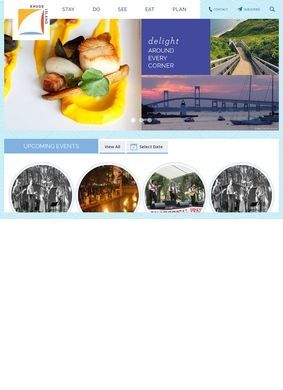
Behind Visit Rhode Island sits the Rhode Island Commerce Corporation, the state's own economic-development arm, which means the smallest state in the country runs its tourism marketing through the same body that courts business investment. That pairing shows in how the site is built: not a hobbyist's collection of beach photos but a working portal meant to move people into hotel rooms, restaurants, and event tickets, with a back-end extranet that local tourism operators log into to keep their own listings current. Knowing who publishes it changes how you read everything on the page.
Trip planning organized by traveler questions
The practical core of Visit Rhode Island is trip planning, and it organizes that the way a traveler's questions actually arrive. Things To Do is the deepest section and spreads wide: arts and culture, historic sites, the Newport mansions, beaches and water sports, nightlife, family activities, parks, golf, and guided tours all get their own routes in. Someone arriving with no fixed plan can browse by interest and land somewhere specific, which is the hard part most destination sites fumble.
Things To Do spans arts, beaches, mansions, nightlife
Lodging and food are handled by Visit Rhode Island as statewide directories rather than curated short lists. Places to Stay pulls together hotels and other accommodation across the state, and the Dining section runs as a restaurant directory you can search. Because listings are fed through a partner extranet, participating businesses are responsible for their own entries, which tends to keep hours and details fresher than a one-time editorial roundup would. The trade-off is breadth over hand-picked taste: Visit Rhode Island runs closer to a comprehensive register than a critic's favorites, and a visitor who wants tight recommendations may still need to cross-check elsewhere.
Lodging directories fed through partner extranet
One of the more useful editorial decisions on Visit Rhode Island is the regional split. Rather than treating the state as one undifferentiated blob, Visit Rhode Island groups its guidance into Providence, Newport County, Block Island, and South County. These are genuinely different experiences. Providence is the urban, food-and-arts capital; Newport County carries the Gilded Age mansions and the harbor; Block Island is the ferry-out, slow-down island; South County is the stretch of beaches and small shore towns. Splitting the content this way lets a traveler match a region to the kind of trip they want before drilling into individual venues.
Regional guides for Providence, Newport, Block Island, South County
That structure also solves a logistics problem. Block Island is not a place you wander onto, and Visit Rhode Island backs the regional guides with transportation information covering airports, ferries, and public transit. Putting transit details alongside the regional content is a sensible call. Planning and getting-there live in the same place instead of forcing a separate hunt.
Transportation details integrated with regional content
Visit Rhode Island ties its regional browsing back to a calendar through the Events section. A statewide events listing ages badly when neglected, so running it on the same maintained platform as the rest of the site keeps it accurate. A festival weekend or a gallery opening is often the actual reason a trip gets booked, and having that calendar next to the lodging and dining directories makes it easier to build a date-anchored itinerary instead of guessing what might be happening.
Events calendar keeps festival listings current
Beyond day-to-day trip planning, Visit Rhode Island reaches into a few areas that show it is serving more than casual weekend visitors. Travel guides in both print and digital formats acknowledge that plenty of travelers still want something tangible to carry. Wedding planning resources are folded in for couples considering Rhode Island venues, which is a real market given the Newport coastline's draw for destination weddings. A media and press photo library sits there too, standard for an official tourism office, aimed at journalists and travel writers as well as end consumers.
Wedding planning resources for destination events
The technology underneath is worth a mention because it explains the consistency. Visit Rhode Island is built on the SimpleView platform, the same content and CRM system that powers a large share of official destination marketing sites in North America, and tourism businesses interact with it through a SimpleView extranet. That choice is unglamorous and entirely appropriate. It gives Visit Rhode Island a stable structure and gives partner businesses a defined way to keep their listings honest, which is more valuable to a traveler than any flashy design feature.
SimpleView platform manages listings through extranet
Social presence is built around the #VisitRhodeIsland hashtag across Facebook, Instagram, Twitter, Pinterest, YouTube, and LinkedIn. Spreading across that many channels is typical for a state tourism office trying to reach every audience from Pinterest trip-boarders to LinkedIn business-event planners, and the shared hashtag gives scattered channels a common thread. A newsletter signup rounds out the outreach for travelers who would rather have seasonal ideas pushed to them than return to Visit Rhode Island cold each time.
Social channels share the VisitRhodeIsland hashtag
What Visit Rhode Island does not pretend to be is a booking engine. It points you toward hotels, restaurants, events, and operators, and it is candid about that role: it informs and routes, then hands you off to the venue or a third party to transact. For the trip-planning stage that is the right scope, because the value here is a consolidated, region-aware overview of what the state holds, not a checkout flow that would duplicate what hotels and ferry operators already run.
Site informs, routes, then hands off to venues
There is a clear split in who gets the most from Visit Rhode Island. A first-time visitor benefits most, because the regional breakdown and the breadth of Things To Do turn a vague idea of Rhode Island into a structured shortlist fast. A returning traveler or a resident hosting guests will lean on the events calendar and the dining directory more than the overview pages. The partner extranet means the people who run actual businesses have a stake in keeping their own entries accurate, which is the quiet mechanism that keeps a directory of this size from going stale.
Visit Rhode Island leans toward inclusion over editorial selection. Because Places to Stay and Dining aim to cover the whole state, the depth of any single entry depends on how much effort that business put into its own listing, so a major Newport hotel may read richly while a small shoreline diner shows little more than the basics. The site gives the full field; the judgment call stays with you.
Taken as a whole, Visit Rhode Island is the state's coordinated front door for tourism, built with the regional logic a geographically varied state needs and wired to a maintenance system that keeps listings from going stale. The Newport mansions, the Block Island ferry, the Providence food scene, and the South County beaches each get a defined lane, and the practical layers of transit, events, and printable guides sit close enough to be useful when planning starts. It is the most complete single starting point Rhode Island offers.