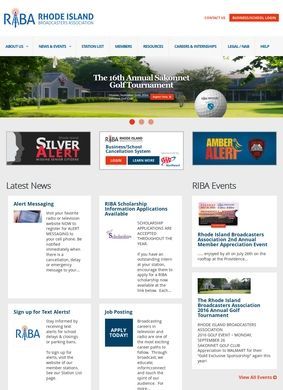
What does a state broadcasters' association actually do for someone who is not a broadcaster? For RIBA, the Rhode Island Broadcasters Association, the honest answer is: almost nothing most of the year, and one genuinely useful thing during a snowstorm. That one thing is the Business and School Cancellation System that RIBA operates. When a winter storm crosses Southern New England, member radio and television stations pull closure and emergency announcements from a shared feed, so a school or company files a single notice and it reaches the whole regional broadcast chain at once. A parent wants to know whether school is open; the feed answers that. This is the part of RIBA that touches ordinary residents, and it is the part worth understanding first.
Business and School Cancellation System
Everything else the site describes is built around that same broadcast reach or around the trade group's members. RIBA runs two public-safety alert programs that travel further than its membership. The Silver Alert program pushes notifications when a senior with a cognitive disorder goes missing, and the site carries Amber Alert information and resources for missing children. Both ride the distribution network the closings system already uses, which is a sensible reuse of an existing pipe. On the member side, RIBA handles regulatory and compliance work that smaller stations struggle to manage alone: FCC matters, the Emergency Alert System, and legislation moving through the statehouse. A mid-sized station with no compliance department gets a central body tracking EAS requirements and federal rule changes, which is a real service even if it is invisible to the public until something breaks.
Public safety alerts for missing persons
The trouble is that the value here is almost entirely event-triggered, and a directory entry is a calm-day artifact. On a day with no storm and no missing-person alert, the site is a set of program descriptions and reference pages. The cancellation feed sits idle. The alerts sit idle. What remains for a visitor to read is the published copy describing what those systems would do if activated, plus a few sections that refresh on their own slow cycles.
Career portal and annual scholarships
There is a Career Portal listing broadcasting jobs and internships, which gives RIBA a hand in supplying talent to its own stations. There are annual scholarships, with the application window opening December 1 for the following academic year, a fixed deadline a student can plan against. A directory of participating member stations maps the regional broadcast landscape, paired with news and events coverage, a member resources area, FCC and EAS materials for working broadcasters, and an About section recording leadership and organizational history. Useful, but most of it is reference material or self-described program copy, and a reader cannot test any of the operational claims from a listing. The closings feed either works when the storm hits or it does not, and a calm-day page proves nothing either way.
Why does RIBA lack public reviews?
A search across Google Maps, Yelp, and comparable platforms returned no public ratings or user reviews for RIBA. For a trade body whose relationships are institutional, with member stations and government agencies rather than walk-in consumers, that is what you would expect; there is no customer base to leave stars. So the usual outside check is unavailable here, and the absence is neither flattering nor damning. It simply means a reader is left with the association's own account of itself and nothing independent to set against it.
Who actually needs this page?
That leaves the question of who should actually spend time on this page, and the honest reading is: very few people, and only at very specific moments. A station manager weighing membership already knows RIBA through industry channels and will evaluate it through those, not through a directory listing.
Testing operational claims on a calm day
A student chasing the scholarship needs the December 1 date and the portal link, both of which are stated, and then has no further reason to linger. A parent during a storm wants the live closings feed on a broadcaster's own channel, not a description of how the feed works. For everyone else, the listing is a placeholder for systems that only mean something when they fire, and there is no standing reason to return between weather seasons. RIBA may run its programs well; the page about RIBA cannot demonstrate that, and it does not try to.
Single broadcast distribution for multiple programs
One concrete note on the structure of it all: the closings feed, the Silver Alert program, and the Amber Alert resources all run on the same broadcast distribution, which is why a single regional organization can carry weather closures and missing-person notices under one roof without building three separate systems. It is a tidy piece of engineering for an organization that, on the page at least, is mostly waiting for the weather to turn.