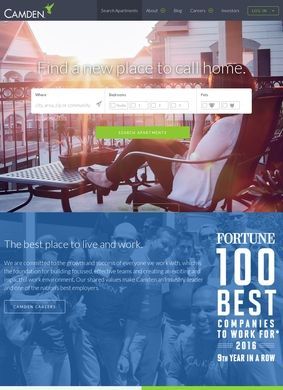
Community Housing Partners points to camdenliving.com, the public face of Camden Property Trust, a large publicly traded apartment company (NYSE: CPT) headquartered in Houston. That gap between the listed name and the actual brand on the page is worth flagging up front: a renter clicking through Community Housing Partners expecting a local operator lands instead on a national rental platform with luxury apartment communities spread across Texas, Georgia, Arizona, Florida, Virginia, Colorado and several other states.
Search tools and online leasing
The Community Housing Partners site is straightforward to use. There is an apartment search and a comparison tool that lets you line up units side by side, floor plans from studios up to three bedrooms, and quoted rents starting near $1,599 a month. Leasing happens online through the MyCamden portal, and once you are a resident the same portal handles maintenance requests and account management. Clicking between property pages and the search filters shows a user flow from browsing a community to starting an application that feels coherent, which is not always the case with multi-market rental sites that bolt search onto a corporate shell.
Amenities vary by property
Amenities are listed per community: pools, dog parks, fitness centers, organized resident programming, and in some properties co-working spaces and package lockers. Because the portfolio is large, what you get depends entirely on the building you pick, and the per-property pages do most of the practical work. Those pages carry their own leasing office numbers and community-level email addresses. A single 713-354-2500 line, listed as 24/7 support, sits at the company level alongside social profiles on LinkedIn, Instagram, Facebook, YouTube and Pinterest.
Employer ratings versus tenant reviews
The picture splits here in a way worth spelling out. As an employer, Community Housing Partners scores extremely well: Glassdoor shows about 4.6 out of 5 from roughly 985 reviews, with a 94 percent approval figure, and Camden holds a Fortune 100 Best Companies to Work For ranking. That is a genuinely strong workplace record and it is directly relevant to job seekers reading this listing.
Renter feedback across platforms
As a landlord, the renter-facing numbers are weaker. Trustpilot carries around 30 reviews with poor aggregate sentiment. Traders Union shows 29 reviews averaging 1.8 out of 5. The Better Business Bureau page for the Houston entity lists Community Housing Partners as not accredited, with complaints on file. ApartmentRatings.com spreads its verdicts across individual communities, where scores run mixed, which tracks with how a large portfolio behaves: some buildings and management teams clearly outperform others. The contrast between a high employer score and soft tenant scores is the single most useful thing to understand before signing a lease.
Corporate scale and financial standing
The site rounds out what you would expect from a Fortune-listed operator. There is a blog covering home and lifestyle topics, a career portal, investor relations material tied to the publicly traded structure, and a Camden Cares corporate responsibility section. For a prospective renter all of that sits well behind the search tool in importance, though the investor pages signal scale and financial accountability, which counts for something when weighing whether a landlord will remain solvent for the length of a lease.
From national portfolio to local property
One practical note: mixed-to-poor renter reviews need to be read at the community level, not the brand level. Because Community Housing Partners covers a portfolio this broad, a national average tells you very little about the specific building you are considering. The unit you tour in Phoenix may be managed by a different team than the one in Atlanta, and the ApartmentRatings spread bears that out. Brand reputation sets a floor; individual property reviews, checked at the specific address, offer a more concrete and reliable picture.
Transparency in leasing and operations
On transparency, Community Housing Partners does not hide much. The leasing process is documented rather than gated behind a sales call, and financial standing is public by law given the REIT structure. For a category where opacity is common, Community Housing Partners is more open than many comparable operators, even if that openness exposes uneven tenant feedback alongside strong financials and employer ratings.
A renter shopping Sun Belt and Mountain West metros where Community Housing Partners has communities will find a polished, usable search and a real application path. The smart approach is to go straight to the individual property page for any building of interest, pull up its ApartmentRatings entry, and call that community's leasing office to confirm current availability and actual rent rather than the headline figure. Community Housing Partners is a credible national operator on paper; for any specific building, the due diligence belongs at the property level, where the local details tell a more concrete story.