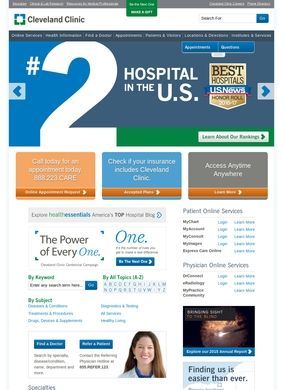
Decades of holding the top US ranking for heart care tell you most of what you need to know about where Cleveland Clinic puts its energy. The main site at my.clevelandclinic.org wraps a sprawling academic medical center into something a patient can navigate, which is no small feat given how many specialties sit underneath it. Cardiology and cardiovascular surgery lead the reputation, but the depth runs through oncology, neurology and neurosurgery, orthopedics, gastroenterology, urology, transplant work, endocrinology, and rheumatology, with primary care anchoring the base. A patient looking for one referral and a patient mapping out a complex multi-year treatment plan both land in the same place.
MyChart portal features
The practical heart of the portal is MyChart. Through it a patient schedules appointments, reads test results without waiting for a phone callback, messages the care team directly, and manages prescriptions. None of that is novel in modern healthcare, but having it integrated under one login for an institution this large changes the day-to-day experience of being a patient. The site also folds in telehealth and virtual visits, which matter for follow-ups and for people who live nowhere near Ohio. The second-opinion service is the more telling inclusion, because an institution comfortable having its judgment checked against another provider's is one confident in the specialty depth behind it, and that confidence reads as earned here.
From Cleveland to global locations
Geography is part of the story too. Cleveland Clinic is headquartered in Cleveland and runs multiple hospitals and regional health centers throughout Ohio, which is the reason this entry sits under the Ohio category in the first place. The footprint reaches well past the state, with locations in Florida, Nevada, Toronto, London, and Abu Dhabi. For a patient that means a name carrying the same clinical standards can show up in places that have nothing else to do with northeast Ohio. International patient services back this up, smoothing the logistics for people traveling specifically to access the care.
Research and medical education
What separates an academic medical center from a large hospital group shows up in the research and teaching arms. The Lerner Research Institute runs the clinical trials and laboratory work, where new treatments get tested before they reach standard practice. Cleveland Clinic also operates its own medical school: the Lerner College of Medicine handles graduate medical education, training the physicians who go on to staff this and other institutions. Neither of these is something a patient interacts with directly on a typical visit, yet both shape the quality of care available, since a center conducting its own trials can sometimes offer options that exist nowhere else.
Health library resources
The health library deserves its own mention because it does work most hospital sites do badly. It carries detailed condition and symptom information, the kind of reference material people reach for late at night when something feels wrong and they want to understand it before deciding whether to act. The tone is clinical without being impenetrable, and because it sits under the same roof as the actual care, the information connects to a real path forward instead of dead-ending. Plenty of people first encounter Cleveland Clinic through these articles long before they become patients, arriving from a search about a symptom and staying because the explanation was clear.
Specialty depth and breadth
If there is a tension in a site this size, it is the one every comprehensive institution faces: breadth can blur into sameness, where every specialty page reads with the same measured voice and a newcomer struggles to tell whether the cardiology depth they keep hearing about is genuinely deeper than the rheumatology offering. The portal handles this reasonably by letting MyChart and the appointment flow do the narrowing, so a patient is rarely browsing the whole institution at once. Still, the sheer scope means first-time visitors should expect to spend a few minutes orienting before the structure clicks into place.
Integration of care and access
Taken together, what the site presents is an institution that has built outward from a few areas of genuine excellence into something close to full-spectrum medicine, then put a usable digital front door on it. The combination of frontline care, virtual access, an honest second-opinion service, active research, and a teaching college is the profile of a place operating at the top tier of American medicine, and the website reflects that without overselling it. Cleveland Clinic's record with serious diagnoses is well-documented, the footprint spans multiple continents, and the integrated portal makes navigating that record more straightforward than the digital front ends of comparable institutions typically allow. Whether reorganizing care around a distant hospital is worth the effort is a practical question each patient has to answer, but Cleveland Clinic provides something solid to work from.