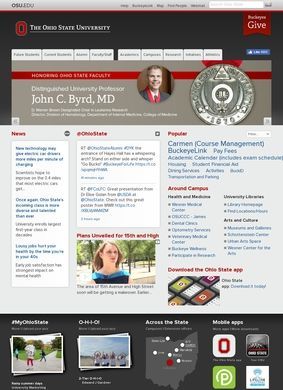
Holding one of only 53 NCI-designated cancer center designations in the United States is not a credential Ohio State University stumbled into. The James Cancer Hospital, embedded within the Wexner Medical Center, earned that standing through sustained research output and clinical volume, and it tells you something concrete about the tier of institution you are dealing with. A public university running a hospital at that level is genuinely uncommon, and it shapes almost everything else about what Ohio State University offers to students, researchers, and patients across Ohio.
The Wexner Medical Center and cancer research
The Wexner Medical Center is the anchor of the health sciences side, and its presence pulls the university into territory that teaching colleges without clinical operations cannot reach. Faculty treat real patients. Graduate students train in working environments, not simulated ones. Research findings have somewhere to land: wards, clinical trials, equipment funded by federal partnerships. For anyone weighing Ohio State University as a destination for medicine, dentistry, veterinary medicine, pharmacy, or optometry, the working hospital attached to the university changes the comparison entirely. Add law to that roster and you are looking at a heavier load of professional schools than the typical large public institution attempts, which is worth registering before reducing the place to its undergraduate enrollment.
Campus size and regional options
That enrollment is large. Around 60,000 students attend the Columbus flagship, which puts Ohio State University among the biggest single campuses in the country. The scale cuts both ways, and the university's own materials do not hide it. A student gains access to an enormous course catalog, one of the better-funded library systems among public universities, and a range of degree options that few schools can match. The trade is density: at 60,000 students, personalized attention is something you seek out, not something that finds you. The five regional campuses, at Lima, Marion, Mansfield, Newark, and Wooster, offer a smaller entry point into the same degree-granting system, which is useful for students who want the Ohio State University credential without the Columbus crowd.
Research across forensic anthropology to biomedical sciences
The breadth of research at Ohio State University is one of the harder things to summarize without making it sound like promotional copy, so the specifics matter more here than the summary. Forensic anthropology, glaciology, biomedical sciences, and engineering all appear in the institutional profile, alongside active partnerships with NASA. Forensic anthropology and glaciology do not typically share a campus with a Level 1 trauma center, and that overlap reflects a university that has built depth in specialized fields instead of concentrating resources in a few headline departments.
NASA partnerships for graduate students
The NASA connection is worth treating as more than a name-drop. Collaborations at that level fund equipment, create funded research positions for graduate students, and give undergraduates a realistic path into applied science work they could not access at a regional school. Combined with the biomedical research running through the medical center, Ohio State University has built a research portfolio that reaches from ice cores to oncology. That range is a genuine draw for graduate students in niche disciplines, who have a realistic chance of finding faculty already working in their area when they arrive.
Degree pathways from associate to professional doctorates
Degree levels run from associate through bachelor's, master's, doctoral, and professional, which means Ohio State University serves a two-year credential student and a PhD candidate without pushing either toward another school. The Ohio State Online program extends that further, covering continuing and online education for people who cannot relocate or attend in person. For a state institution with an obligation to reach residents across Ohio, the combination of six campuses plus an online arm covers a lot of ground. The affordability initiatives and community mentorship programs the university describes fit the public mission rather than looking like branding.
Student services at large-scale enrollment
Student support is extensive on paper: housing and dining, financial aid advising, health and counseling services, career placement, and academic support for the first years. None of those individually are rare; every large school offers some version of each. What is different at Ohio State University is what the enrollment figure forces. A counseling service that has to function at 60,000-student scale cannot be a two-person office. Career placement at that volume needs relationships with employers in volume. The sheer size that some students find daunting is also what funds the infrastructure behind those services, and that is a concrete benefit that gets underplayed when people discuss the drawbacks of large campuses.
How does athletics shape institutional identity?
Ohio State University competes in the Big Ten Conference across a wide set of varsity sports, and the Buckeyes are a genuine part of what the institution is rather than a peripheral program. For a portion of applicants, athletics are part of why they choose Ohio State University, and the university treats that honestly. The athletic program also drives alumni attachment in a way that goes beyond game-day sentiment: a large, organized, and engaged alumni base feeds career networks, mentorship pipelines, and the private donations that fund research labs and named professorships. Alumni engagement and athletics reinforce each other at Ohio State University in a cycle that a less prominent institution cannot replicate.
Who is the right fit for this campus?
Ohio State University is also clear about what it is not. The Columbus campus is not a place where a student wanting a small-cohort, high-contact experience will find it automatically. That is not a failing; it is a design choice that comes with the public university mission and the resources that size generates. A student who knows what they want to study, who can navigate a large institution, and who values depth of options over intimacy is a natural fit. The regional campuses and online programs extend the university's reach to people anchored to other parts of the state or needing a flexible format, and that breadth is worth something concrete for Ohio residents who want a degree carrying the Ohio State University name without physically living in Columbus.
Taken whole, Ohio State University runs a system that spans six campuses across Ohio, maintains a medical complex operating one of the country's small number of NCI-designated cancer centers, and offers a degree ladder from associate credentials through professional doctorates in medicine, law, and veterinary medicine. The research arm connects to NASA, to federal biomedical programs, and to fields as different as glaciology and forensic anthropology. For a student or researcher who fits the scale, the infrastructure behind Ohio State University is hard to find at another public institution in the state.