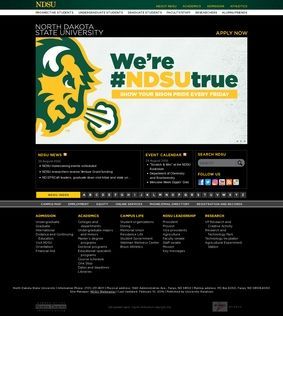
Classified at the R1 doctoral tier for research activity, North Dakota State University is a public land-grant institution in Fargo, North Dakota, and that classification shapes almost everything visible on the site. This is not a small teaching college with a graduate program attached. It runs full doctoral pipelines alongside undergraduate teaching, and the public-facing material reflects that dual purpose without burying either side.
Six colleges and degree pathways
The academic structure groups into six colleges: Agriculture, Food Systems, and Natural Resources; Arts and Sciences; Business; Engineering; Health and Human Sciences; and a Graduate School that sits across the others. For a prospective student figuring out where a particular field lives, that grouping at North Dakota State University does the navigation work cleanly. Agriculture gets top billing, which fits the land-grant lineage and the region. The presence of a standalone College of Business and a College of Engineering marks a broad institution covering the professional fields people usually look for, not a narrow specialist school.
Degree options run the full ladder: undergraduate majors and minors, master's degrees, doctoral programs, and certificates at both levels. The certificate tier gives working adults and career-changers a way into the institution without committing to a full degree. Online program options extend the reach of North Dakota State University beyond students who can relocate to Fargo. None of this is unusual for a university of this size, but it is laid out in a way that lets someone match their situation to an offering quickly.
Research emphasis on applied work
The research side is where the R1 label proves its weight. North Dakota State University describes work in crop science, cybersecurity, and engineering, with a stated emphasis on industry-connected applied research. Crop science is the expected strength given the agricultural roots and the surrounding region, with direct downstream value for the farms and food businesses of the northern plains. Cybersecurity and engineering point toward the more contemporary, technology-facing side of the campus.
The phrase that stands out is applied research connected to industry. Plenty of universities frame their output as purely theoretical or measured in publication counts. The framing here leans toward problems that have a practical buyer or beneficiary, which is a reasonable thing for a land-grant school to foreground. A graduate student weighing programs, or a company looking for a research partner in the region, gets a clear enough picture of what North Dakota State University prioritizes. The site does not drown the visitor in metrics, and the restraint is welcome.
What the material does not do is quantify the research enterprise in detail. There is no count of research dollars, labs, or patents in front of the casual visitor. For most prospective undergraduates that absence is irrelevant. For a doctoral applicant comparing institutions, it means the headline claims need to be followed into the individual college and department pages before any real comparison is possible. That is normal for a university homepage and is not a fault so much as a limit of how far a top-level look at North Dakota State University can take you.
Athletic record and conference standing
Athletics gets real estate, and the numbers are concrete. North Dakota State University competes at the NCAA level and has accumulated 289 conference titles and 30 national championships since 1925. Those are specific, datable figures rather than vague claims of sporting tradition, and specificity is what gives them credibility. North Dakota State University recently joined the Mountain West Conference, a move that points to a step up in competitive profile and is the sort of detail that matters to recruited athletes and to fans who follow the program.
Student services and campus life
Student life is covered across the expected categories: on-campus housing and dining, student success services, experiential learning programs, arts and culture programming, student organizations, and alumni network support. This is the standard inventory a residential university needs to show, and North Dakota State University covers it in full. The experiential learning mention is the one worth singling out, because it ties back to the applied research posture and suggests the practical orientation runs through teaching as well as faculty work.
On administration, there is a One Stop student services office, an admissions function, a faculty and staff directory, and an employment portal. The One Stop concept is genuinely useful: consolidating the scattered offices that handle financial aid, registration, and billing into a single point of contact removes a real source of frustration for students. The faculty and staff directory and the jobs portal round out the institutional structure that any university of this scale needs to expose. Their presence at North Dakota State University is a quiet mark of completeness.
Recognition as College of Distinction
One external marker appears: North Dakota State University was named a 2026 to 2027 College of Distinction for the second consecutive year. A repeated recognition is more meaningful than a one-off, since it reflects something durable about the place. It is a recognition aimed at undergraduate experience and engagement, which fits the residential, broad-access profile the rest of the site builds. I would not weigh it above the underlying R1 status, but it is a fair piece of supporting evidence presented without overstatement.
Pulling the threads together, the picture of North Dakota State University that emerges from the site is consistent and substantive. The land-grant agricultural identity, the R1 research classification, the six-college academic spread, and the documented athletic record all point in the same direction: a full-service public university serving a region that genuinely needs one. The dual address to traditional undergraduates and to graduate and professional students is reflected in how the offerings are organized, with the certificate and online tiers widening the door for people who do not fit the residential mold.
The honest limit is the one common to any institutional homepage: it tells you what exists and gives you the credible headline facts, but it cannot substitute for digging into the specific department, the specific funding package, or the specific research lab that a serious applicant cares about. North Dakota State University presents itself as exactly what its classification implies, a broad land-grant R1 institution with deep agricultural research, a strong and quantified athletic program, and the full apparatus of student services a residential campus requires.
There is no inflation in how it is laid out, and the specific numbers alongside the repeated recognition give the claims more spine than the usual university brochure manages. For an undergraduate sizing up whether North Dakota State University belongs on a shortlist, the material here is enough to make that call; doctoral candidates and industry partners researching North Dakota State University will need to go several clicks deeper.