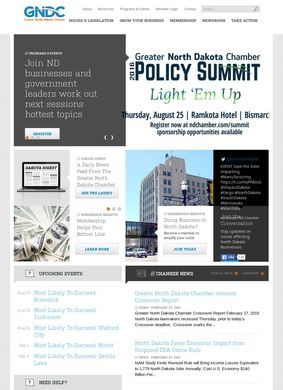
Nearly a century of continuous operation is the first thing worth knowing about GNDC, the Greater North Dakota Chamber. That kind of run gives an organization a settled role, and GNDC has used it to position itself as the statewide voice for business across North Dakota, speaking for companies of every size and sector instead of one city or one industry. A local chamber covers a town; this one covers a state, and that difference shapes the whole offering.
Advocacy and policy influence through PAC membership
Most of what the organization does sits in two areas that reinforce each other: advocacy and information. On the advocacy side, GNDC runs policy work, voter education resources, and a separate political action committee, the ND Chamber PAC, which lets it engage in the electoral side of business policy on its own terms. Members who want to go further can apply to serve on the board of directors. None of this is decorative. A chamber that publishes voter guides and keeps a PAC is making a clear statement about how it intends to influence the conditions its members operate under, and GNDC has kept that machinery running long enough to carry institutional credibility.
Economic research as a primary information source
The information side is where GNDC becomes genuinely useful to people who are not members. The organization publishes economic research, including the ND Economics and Employer Survey and a Report on Business. For anyone trying to understand hiring conditions, wage pressure, or the broader business climate in the state, that survey data is a primary source, and primary sources on a small-population state economy are not easy to come by. A business deciding whether to expand in North Dakota, or a journalist covering the state economy, would have reason to read what GNDC puts out.
That research function is also what separates a working state chamber from a glorified events calendar. Gathering employer survey data takes effort and continuity, and producing it year after year marks an organization that treats data as part of its core job. The Report on Business gives the numbers a regular home, and the value compounds over time as the record becomes comparable across periods. A one-off survey tells you little; a long series tells you where the state is heading.
Brass Tacks blog for current business news
Alongside the formal research there is a blog called Brass Tacks, built around expert Q&As and business news. The naming is plain in a way that fits the subject, and the format, short interviews with people who know a given corner of the economy, tends to age better than opinion columns. It gives the chamber a way to stay current without waiting for a formal publication cycle, and it makes the site worth checking between the big annual reports.
The event calendar adds another layer. GNDC hosts a Policy Summit, a set of Policy Outlook forums, the National Civics Bee State Finals, and a Manufacturing Day. The Policy Summit and the Outlook forums are the natural anchor points for the advocacy work, the moments where members and policymakers end up in the same room. Scheduling them as recurring fixtures tells you something about how GNDC sees its own role: it wants to shape the agenda rather than wait to react.
The Civics Bee finals are a more surprising inclusion, pushing the organization past pure business advocacy into civic education, which is a longer game that very few state chambers bother to play. Whether that pays off in goodwill is hard to measure, but it is a distinctive choice. Hosting the state finals of a national competition also ties GNDC into a wider network that a purely local group could not match.
Manufacturing visibility programs
Manufacturing gets its own dedicated attention, and this is one of the more concrete things GNDC does. The Coolest Things Made in ND competition and the Faces of Manufacturing program both exist to put North Dakota manufacturers in front of a wider audience. For a sector that rarely markets itself well, that visibility has practical value, and it gives smaller producers a platform they would struggle to build alone. Pairing those programs with Manufacturing Day means the attention lands on a fixed date instead of drifting.
What membership tier should you choose?
Membership comes in two grades. There is a standard business membership and a premium tier branded Cornerstone Champions. The benefits attached to both center on advocacy, networking, and information-sharing, described honestly here without inflated promises. The premium tier reads as the support-the-mission-and-get-more-visibility option, which is how most associations structure their top band. Sponsorship slots for events are available separately, so a company can buy into a specific program without committing to the higher membership grade.
What the membership structure does not spell out is the precise dollar value a smaller business gets back from the standard tier versus the cost. Chambers tend to discuss that case by case instead of publishing a formula, so a small operator cannot fully size up the return without a conversation.
Taken together, the program list is broad without feeling padded. Advocacy, a PAC, original economic research, a working blog, several named annual events, two manufacturing programs, and a tiered membership add up to an organization that does more than hold mixers. Each piece connects to the central job of representing North Dakota business, and the research output in particular gives GNDC a reason to exist beyond networking.
The civic and manufacturing programs are where the organization shows a personality. A trade group could limit itself to lobbying and luncheons. Running a youth civics competition and championing individual manufacturers points toward a longer view of what keeps a state economy healthy: an informed public and a visible production base. Those are slow investments, and the fact that GNDC makes them is a point in its favor that the standard chamber template does not account for.
The honest limit on any outside assessment is that a chamber's value is heavily member-dependent. A business that shows up to events, uses the policy briefings, and leans on the network will get far more from GNDC than one that pays dues and forgets about it. The research is credible, the events are concrete, the advocacy machinery is built out. What a company extracts from it comes down to participation.
North Dakota is a small state by population, which means a statewide chamber can plausibly know and represent a meaningful slice of the business community in ways impossible in a large state. The flip side is that the total pool of members and resources is smaller, so the ambition of the program list has to be read against a modest base. GNDC concentrates on a handful of well-defined programs and runs them consistently rather than scattering effort across too many fronts. That focus is the right call for an organization its size.
The verdict is a solid yes with a condition. A North Dakota business that wants statewide policy representation, access to credible local economic data, and a manufacturing platform will find GNDC a serious and long-established option. A business looking only for casual local networking might find a city or regional chamber a better fit at lower cost. GNDC has built the machinery; the return depends on using it.