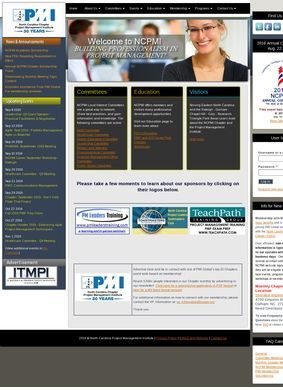
What does a project manager in North Carolina get for $25 a year? More than the price would imply. NCPMI is the state chapter of the Project Management Institute, and that annual fee opens access to a community of 4,313 members, a credential-prep pipeline, and an events calendar running from monthly chapter meetings up to an annual conference. The membership stat worth pausing on is buried in the roster: 2,916 of those members already hold the PMP, the Project Management Professional certification. Two out of three people in the room have passed the exam most newcomers are working toward. That ratio shapes what the chapter is good for, and it helps to understand it before joining.
NCPMI is listed in this business directory alongside other professional associations, and the listing prompted a closer look at what the chapter delivers versus what it simply names. The short answer is that it delivers more than a casual read suggests, but with some important caveats about depth versus breadth.
The split in the membership runs through everything on offer. Some of what NCPMI does is aimed at people working toward a credential; a good deal more is aimed at people who already hold one and need to maintain it. PMI certifications expire on a renewal cycle and require ongoing professional development to stay current, which is where the chapter finds its purpose. It exists partly to solve a problem its own members create by passing the exam in the first place.
Credential preparation for PMP and Agile
On the front end, NCPMI runs preparation courses for the PMP and the ACP, the Agile Certified Practitioner credential. That second one is worth noting. Plenty of regional chapters quietly treat project management as a single-certification world and leave everything else unaddressed. The chapter names multiple credential types and builds prep around more than one of them, which reflects more honestly how the field has fragmented into traditional and agile camps over the past decade.
PDU renewal through volunteer work
The renewal side is where the design gets clever. Maintaining a PMI certification means accumulating PDUs, Professional Development Units, on a set schedule, and NCPMI has wired its activities so that participation earns them. Volunteer work counts toward PDUs. So do workshops and the various learning sessions the chapter runs. A member who shows up, pitches in, and attends is also, quietly, satisfying a renewal requirement they would otherwise have to chase and pay for elsewhere. That alignment between contributing to the chapter and keeping your own paperwork alive is the practical engine behind why people stay involved year after year.
Speaker opportunities for experienced members
Speaker slots are open too, giving experienced members a route to present and bank renewal credit for it. It is a small structural detail, but it points to a chapter that wants its senior people actively engaged rather than quietly renewing in the background.
Communities of Practice by career stage
Beyond certifications, NCPMI organizes itself into Communities of Practice covering Agile, Communications, Higher Education, NextGen, and Veterans tracks. A Veterans track and a NextGen track are not generic additions. The chapter has identified distinct slices of its audience, people transitioning out of military careers and people early in civilian ones, and built something specific for each instead of running one undifferentiated networking night for everyone. The Higher Education track points in the same direction, toward project managers working inside universities whose constraints differ from those in corporate environments.
Monthly meetings and annual conference
The events calendar fills out the rest. Monthly chapter meetings provide a steady rhythm, the annual conference is the marquee gathering, and a layer of networking events and social good initiatives sits between those poles. NCPMI also runs a job board with career resources, which is useful for members actively job-hunting as well as those focused on renewal. Member discounts extend to training providers and, oddly, fitness center partnerships. That last perk has nothing to do with project management, but the gym deal is a familiar association-membership tactic for making the membership card feel worth carrying beyond the professional core.
The mix of serious offerings and incidental perks is familiar territory. A directory of training discounts you were likely to buy anyway, sitting next to a gym deal, pads the value proposition without adding much to the professional substance. The professional substance, though, is solid on its own, and the volunteer-to-PDU loop is genuinely useful in a way the fitness discount is not.
External review presence and reputation
A search for NCPMI on third-party review platforms turned up a very limited picture. Google shows no substantial review count for the chapter itself, and no Trustpilot or Yelp presence appeared. That is common for professional associations of this type, where members interact through events and internal forums and do not leave public ratings. The PMI brand itself carries widespread recognition, and the credential the chapter helps members earn and maintain has a clear market value. The chapter's reputation is effectively borrowed from that institutional standing.
The absence of external ratings does not say much either way about the quality of NCPMI's programming. What it does mean is that a prospective member cannot triangulate the lived experience through outside sources. The chapter's own communications and word of mouth within the North Carolina PM community are the main inputs available.
Best value for already-certified members
The math points fairly clearly at the already-certified. If you hold a PMP and live in North Carolina, $25 buys a structured, local way to earn renewal credit plus access to a network where most peers are at your level or above. That is a strong deal, and NCPMI is plainly built to deliver it. The certification-prep courses serve newcomers, but a newcomer is buying into a community where they start as a clear minority, surrounded by the credential they have not yet earned. That is not disqualifying, but it shapes expectations.
The breadth of the offering also raises a fair question about depth. A chapter promising prep for two credentials, five communities of practice, monthly meetings, an annual conference, a job board, volunteer programs, workshops, outreach, and speaker opportunities is promising a lot of surface area for a volunteer-run regional association. NCPMI lists all of it, but the listing alone cannot say how active any single track is, whether the Veterans community meets quarterly or exists mostly in name, or how populated the job board runs in a given month. Communities of practice are easy to announce and genuinely hard to sustain, and the difference between a thriving track and a dormant one is exactly what a prospective member would want to know.
For the price, the downside risk is small. The institutional backing of PMI gives the credential work real weight, and the PDU-earning structure is a legitimate draw for anyone already certified. What stays unresolved is whether the promised range translates into a calendar a member can realistically fill, or whether energy pools in a few tracks while the rest exist mainly as headings on a page. That gap between the catalog and the reality of showing up is the one thing the chapter's published materials, as thorough as they are, cannot close.