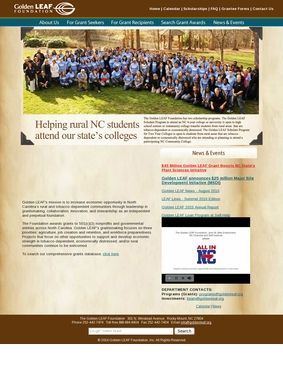
Golden Leaf Foundation channels its money through four named grant tracks, and picking the right door is most of the work up front: Open Grants, SITE (short for Strategic Industrial Training and Expansion), Economic Catalyst, and SPARC. Each carries a distinct purpose, so an applicant is steered toward a specific program instead of dropping every request into one undifferentiated pile. That sorting is a small thing that saves a lot of wasted effort.
The money has an unusual origin. Golden Leaf Foundation was funded through North Carolina's share of the tobacco settlement, and that history explains why its attention stays fixed on the rural and tobacco-dependent parts of the state rather than spreading thin across every cause a foundation could chase.
The stated aim is narrow and refreshingly plain: increase economic opportunity where it has been hardest to build. Golden Leaf Foundation frames that work around grantmaking, collaboration, innovation, and stewardship, and it commits to four priority areas that keep the focus from drifting, namely job creation and economic investment, workforce preparedness, agriculture, and community competitiveness.
The intended beneficiaries are named just as clearly: governmental entities, 501(c)(3) nonprofits, students, and economically distressed communities across North Carolina. A visitor knows within a minute or two whether they are in the right place, which is more than many funder sites manage. That specificity is a deliberate choice, and it does the reader a favor: an organization outside those categories learns quickly that Golden Leaf Foundation is not the right fit, and can move on instead of burning weeks on an application that was never going to land.
What the site puts in front of an applicant
The public site is built to move someone from a vague idea to a filed application. Golden Leaf Foundation's Grant Search Database lets a visitor look up what has already been funded, which is genuinely useful for judging whether a project has precedent or fits the pattern of past awards. That kind of searchable record is unusual candor for a grantmaker, and it quietly doubles as an accountability tool: anyone can see where the dollars went, in what county, and for what purpose.
A prospective applicant can use it to shape a proposal that echoes work the foundation has already chosen to back.
Alongside it sits a short quiz called Funding 101, aimed at people who do not yet know which of the four programs applies to them. It works as an orientation step, not a gimmick, and it lowers the barrier for a first-time applicant who might otherwise guess wrong. Two parts of the operation sit slightly apart from this main site, and that structure is worth explaining before anyone assumes the front page is the whole thing.
Open Grants, SITE, and the other funding tracks
The four tracks are not interchangeable. Open Grants reads as the broad, general-purpose route; SITE targets strategic industrial training and expansion, which points at manufacturers and the workforce pipelines around them; Economic Catalyst and SPARC round out the set for other needs the foundation has chosen to address. Applications themselves run through a separate Grant Portal hosted on a Fluxx subdomain. That is standard practice for grant-management software and not a warning sign, though a first-time applicant should expect to leave the main domain to file and track a request.
The two-site handoff can feel abrupt if nobody warns you, so it helps to treat the informational pages and the portal as one continuous process split across two addresses.
Golden Leaf Foundation also publishes grantee support resources, so the relationship does not end the moment an award clears. For a body distributing money that traces back to a public settlement, that follow-through is a genuine plus, and pairing it with the searchable database of past grants gives the whole operation a level of transparency that plenty of private funders never bother to offer. The programs are specific, the money is targeted, and the record is open to inspection. Those three facts do more for its credibility than any amount of mission-statement language could.
Scholarships and the separate student portal
Beyond grants, Golden Leaf Foundation administers scholarships for high school and community college students. These run through their own portal on a separately hosted domain, which means a student and a grant-seeking nonprofit are pointed at two entirely different systems from the start. The split is defensible, since those two audiences barely overlap and each needs a different application flow, but it does mean Golden Leaf Foundation's real footprint is spread across three web properties: the main informational site, the Fluxx grant portal, and the scholarship portal.
The practical takeaway is simple. Anyone evaluating Golden Leaf Foundation should treat the front page as an entrance and not a full map. A student arrives expecting a scholarship track; a county government or a nonprofit arrives expecting a grant track; the site does route each of them correctly, but the multi-portal layout is something to know going in so the extra clicks do not read as a dead end.
Reaching Rocky Mount and reading the reputation
Contact is easy, and for an organization that hands out money on the public's behalf that ease is close to a requirement. Golden Leaf Foundation lists a physical office in Rocky Mount, North Carolina, a direct phone line, and an online contact form, with links out to Facebook, X, and LinkedIn. There is no hunting for a way to reach a human, and no sense that the organization is trying to keep applicants at arm's length. That openness clears the bar without any fuss.
Outside opinion is harder to come by than the institutional footprint might suggest. No numeric star rating turns up on the major consumer review platforms; there is no Trustpilot, Google, or BBB score to cite. The Facebook page shows four reviews but sits as "Not yet rated," so it offers no usable signal one way or the other.
GuideStar and a nonprofit-transparency aggregator carry Golden Leaf Foundation's charity filings, its 990s and mission data, and describe overall sentiment toward the organization as broadly positive, though without attaching a quantified rating to it. The LinkedIn presence has roughly 3,300 followers, which reads as steady professional interest more than public acclaim.
None of that is damning. It simply tells you where to look for reassurance. The case for Golden Leaf Foundation rests on its public filings and its documented record of funded grants, not on a wall of star ratings, and for a grantmaker that is arguably the sounder evidence anyway. A crowd of five-star reviews would prove little about how well money reaches rural North Carolina; a searchable grant history and open 990s prove quite a lot.
A rural North Carolina nonprofit or a local government carrying a job-creation, workforce, or agricultural project has a clear reason to start with Golden Leaf Foundation, because the funding is aimed squarely at them and the process is transparent end to end. Someone chasing broad statewide or arts-and-culture funding would be better served looking at the North Carolina Rural Center, which covers overlapping rural ground with a wider, more general remit.
Measured against that alternative, Golden Leaf Foundation is the more specialized instrument: tighter in mission, bound to the tobacco-settlement mandate, and stronger for exactly the industrial, agricultural, and rural-economic work it was created to fund. For that specific job, it is a serious and credible place to begin, and the transparency baked into its grant record makes it easy to verify that claim rather than take it on trust.