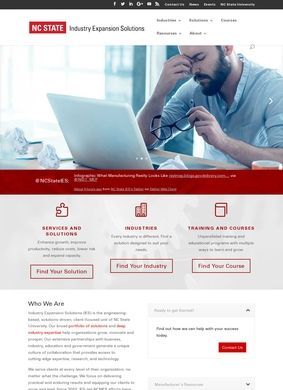
SMARTER NC is a federally funded program that helps North Carolina manufacturers modernize how they operate, and it runs out of the Industrial Extension Service, a unit of NC State University. That single program is a fair snapshot of the whole outfit: public money, university backing and a plain focus on making the state's factories work better. This is not a think tank writing reports. The Industrial Extension Service sells consulting, training and assessments to companies that make physical things, and it does so in every corner of the state.
The reach is genuinely statewide, and that shapes everything else. The Industrial Extension Service works with small and medium manufacturers first, but the client list runs much wider: educational and research institutions, healthcare and pharmaceutical firms, defense contractors, advanced textile startups, aerospace and energy companies, and government agencies. All 100 North Carolina counties sit inside its remit. That is a mandate no private consultancy would ever carry, and it changes what the organization is willing to take on.
Solutions built for the factory floor
The Solutions area is the core of what the Industrial Extension Service does, and it is arranged by the problems a manufacturer actually has, not by the services a seller wants to push. Manufacturing technology, business growth, continuous improvement, cybersecurity, defense initiatives, environmental and energy programs, product development and leadership development each get their own track.
The breadth is the point. A single plant can bring several unrelated headaches to one provider and get them handled under one roof.
Advanced manufacturing and continuous improvement
The heaviest emphasis sits on advanced manufacturing and on lean optimization, which the site frames as continuous improvement. This is the classic extension work: an assessment that finds the waste on a production line, followed by consulting and training to remove it. For a small manufacturer with no in-house process engineer, that outside assessment is often the first honest look at where time and money are leaking out of the operation.
What matters is that the Industrial Extension Service pairs the diagnosis with the follow-through. Plenty of firms will tell a factory what is wrong; far fewer stay to help fix it.
Cybersecurity and defense initiatives
Cybersecurity and defense initiatives are the other clear priority, and they reflect exactly who the Industrial Extension Service serves. A defense contractor, or a small shop feeding the aerospace and energy sectors, now faces security requirements that a corner machine shop never dealt with a decade ago. Bundling cybersecurity assessments and training in with the manufacturing work lets a company meet those obligations through a source it already trusts, instead of chasing a separate security vendor and hoping the two sides understand each other's world.
For a firm bidding on defense contracts, where a lapse can cost the contract outright, that single-provider convenience is a genuine draw.
Courses that come with a credential
Alongside the consulting, the Industrial Extension Service runs a Courses catalog aimed at working professionals. OSHA training, ISO certification, lean management, cybersecurity and project management are the headline tracks. The common thread is that most of them end in something an employer, an auditor or a paying customer actually recognizes and will act on.
OSHA safety and ISO certification
OSHA safety training and ISO certification are the two that matter most, because both tie directly to compliance and to winning contracts. A plant that needs OSHA-trained supervisors, or an ISO quality certification to land a customer, cannot treat that training as optional, and having it delivered by a university-affiliated provider lends a credibility the checkbox alone never would.
Lean management and project management courses round the Industrial Extension Service catalog out for staff being groomed to run things. The value is concrete: a certificate that opens a door, not a seminar that fills an afternoon and vanishes.
Programs that reach all 100 counties
Where the Industrial Extension Service moves past individual clients is its Programs, several of which are funded to serve the state at large. SMARTER NC, the federally backed manufacturer-assistance program, is the flagship. Rural Works places interns with companies in parts of the state that struggle to attract talent. The NC Maritime Manufacturing Initiative targets a specific coastal industry, and a supplier-matching service, functioning much like a business directory, connects in-state buyers with in-state makers.
The Resources library backs all of this up, with webinars, published success stories, disaster-recovery guidance and newsletters that keep past clients in the loop. It is the kind of free, browsable material that lets a manufacturer size up the operation before committing to a single paid engagement, and the published success stories give a cautious owner a sense of what actually gets delivered.
SMARTER NC, Rural Works and supplier matching
Taken together, these programs do something a private firm has little reason to attempt: they treat the health of North Carolina manufacturing as the goal, above the fortunes of any one paying client. Rural Works is the clearest example, since staffing a rural plant with local interns helps the company and the county in the same stroke. Supplier matching pulls in the same direction, keeping contracts and money inside the state. This is the public-mission side of the Industrial Extension Service, and it is the strongest argument for why a university runs an operation like this at all.
Weighed against the Small Business and Technology Development Center, the other well-known North Carolina resource for growing companies, the Industrial Extension Service is the sharper pick for anyone who actually builds a product. The SBTDC leans toward general business counseling, financing and strategy for small firms of every kind.
The Industrial Extension Service goes narrower and deeper into the plant itself: lean lines, ISO paperwork, OSHA compliance, security for defense work. That operational focus, backed by NC State and reaching into every county in the state, is genuinely hard to match once a manufacturer's problems live on the plant floor rather than in a boardroom.