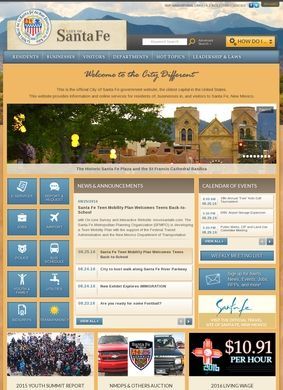
What can someone living in the New Mexico state capital settle online before ever setting foot in a municipal office? Going by how the City of Santa Fe runs its website, quite a lot. Water and utility bills get paid through the site, trash and recycling pickup schedules are posted in plain terms, and transit riders pull up timetables without a phone call. A Customer Service Management tool, the city CRM, lets a resident file a problem and then track it rather than wondering whether anyone on the other end heard.
The layout mirrors the shape of a working municipality, and Santa Fe keeps the whole thing from collapsing into one undifferentiated wall of links. Public Works, Finance, Community Development, Fire, Police, and Public Utilities each hold their own pages, so a question about a building inspection lands somewhere different from a question about fire code. That separation is the difference between a site a person can navigate and one that buries the answer under a dozen identical blue links.
Running the everyday through one portal
The resident-facing side does the heaviest lifting. Bill payment, transit details, recreation sign-ups, and refuse schedules all sit within a click or two of the front page. Trash and recycling information is spelled out so a household knows which bin goes out and when, transit schedules are published for riders who plan their week around the bus, and the recreation programs give families something to sign up for beyond the errands.
A summer pilot called Fare Free Sundays waives transit fares one day each week, a concrete perk a rider can plan a Sunday around, and affordable housing resources hold a place of their own instead of being buried three menus deep. The spread is wide enough that most routine household business has somewhere to go.
It is practical, and Santa Fe aims it squarely at people who just want a task done and gone. A city site that makes the boring stuff findable has done most of its job.
Paying bills and flagging problems
Two tools handle most of the daily traffic. The utility bill payment page handles the errand every household repeats each month, and the CRM turns a gripe about a missed collection or a dead streetlight into a tracked ticket with a number attached to it. Parking ticket payment lives here too, which spares a trip downtown just to clear a citation. For a city the size of Santa Fe, folding these into one place keeps the portal from turning into something people give up on after the second dead end.
The reporting loop stands out from the rest: a complaint you can follow is a complaint you trust actually got filed.
Programs for youth and for seniors
The site does not stop at plumbing and paperwork. Senior services and youth programs each get their own footing on the Santa Fe site, and recreation programming fills out what the city puts in front of residents at both ends of the age range. The even hand given to both groups says more than any single feature, since it points to a site meant for the whole population instead of the loudest slice of it.
A parent hunting for a summer program and an older resident looking for support both land somewhere obvious, which is more than a lot of city sites manage.
Neither group has to know the name of a department to find what it needs, and that is the quiet test a public site either passes or fails.
Permits, contracts, and the public record
Businesses get a genuine section here, not a token link. Santa Fe walks an owner through business license applications, building permits, and zoning questions, and it spells out contract solicitations for anyone wanting to bid on city work alongside current employment openings. A plain explanation of how to do business with the city is exactly what a first-time vendor with no idea where to start needs to find, and it is there in language a non-specialist can follow.
The employment listings and the vendor path share a logic. Santa Fe treats the people who want to work for the city and the companies that want to sell to it as audiences worth guiding, and that posture runs through the whole business section instead of stopping at a single application form.
Community life gets real airtime too. Tourism content threads through to Tourism Santa Fe, parks and open space information is published for anyone planning a day outdoors, and the events calendar carries specifics rather than vague promises. One entry lays out a Fourth of July celebration at Franklin E. Miles Park with a 400-drone Sky Elements show, fireworks, and live entertainment, a level of detail that tells a family whether the evening is worth the drive across town. That level of particularity is a good sign on a civic calendar.
A generic "join us for the holiday" line gets scrolled past; a named park with a drone count and a lineup is a listing a resident actually acts on. The parks and open space pages do the same quieter work for anyone looking to spend an afternoon outside without a plan.
The governance layer is where the site quietly earns respect. Meeting agendas post ahead of time, so a resident who wants to weigh in on a decision can read what is coming instead of learning about it after the vote. The full municipal code is open to anyone who wants to read the actual rules instead of a summary of them, which matters for a landlord, a builder, or a neighbor arguing over a fence line.
Alert Santa Fe pushes emergency notifications when something goes wrong across the city, from a fast-moving fire to a water main break. Accessibility and ADA compliance information is spelled out in plain language. Scheduled constituent meetings with the Mayor sit alongside all of it, a signal that reaching city government is treated as part of the job instead of a favor handed out now and then.
Pulled together, the City of Santa Fe site behaves like infrastructure. It is broad, it is sorted by department, and it keeps a resident's daily errands and a business owner's practical needs under one roof. The events calendar and the tourism links give Santa Fe a public face; the CRM, the permits, and the open municipal code give it teeth.
Few municipal sites manage both at once, and this one comes closer than the typical city site does. What holds it together is that almost every function points at a concrete action a person can complete, paying, reporting, applying, reading the rule, signing up, instead of stopping at a description of a service and a phone tree. A site that lets residents finish things is worth more than one that only explains them.
Plenty of the errands people drive across town to handle would close faster from a kitchen table, once ten minutes go into learning where Santa Fe put them instead of where the counter used to be.