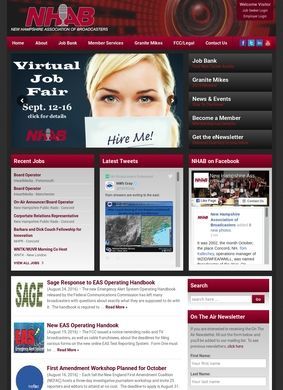
There is a legal hotline built into this organization for one narrow purpose: helping radio and television stations untangle broadcast-specific regulatory problems. That single detail tells you who the New Hampshire Association of Broadcasters is really for. This is a voluntary statewide trade group whose members are the over-the-air stations operating across New Hampshire, and the site reads like it was assembled by people who field member questions all day, not people chasing a general audience.
Advocacy and compliance resources
Most of what the organization does falls into a few practical buckets. There is advocacy, meaning grassroots lobbying at both the state and federal level on the rules that govern broadcasters. There is education, covering seminars and a continuing education reimbursement program that helps members offset the cost of staying current. And there is a steady stream of compliance reference material: Emergency Alert System guidance and documentation, FCC contact information, regulatory resources, and a feed from the CommLawBlog. That last cluster is the kind of thing a station engineer or general manager actually needs on a Tuesday afternoon, and gathering it in one spot is the right call.
Scholarship programs for future broadcasters
The scholarship side surprised me a little, since trade associations often treat that as an afterthought. Here it gets real room. The NHAB Student Broadcaster Scholarship and the Families in Broadcasting Scholarship both run as named programs, which points to a group thinking about who fills broadcasting jobs a decade out instead of who pays dues now. The New Hampshire Association of Broadcasters extends that pipeline elsewhere too, through virtual job fairs and a job board listing current openings in broadcasting around the state.
Inside the member toolkit
Beyond advocacy and scholarships, the New Hampshire Association of Broadcasters stocks a deeper shelf of working tools. Members can reach the NCSA Resource Center and its downloads, an Antenna Newsletter, and a database of social media contacts for the state's congressional delegation, which is a clever practical touch for anyone who needs to organize outreach quickly. The New Hampshire Association of Broadcasters also runs an ABIP program and a set of EEO organization resources that include career descriptions for the broadcasting sector. None of this is flashy. It is the documents and contact lists that make compliance and political engagement less of a scramble.
Publishing newsletters for members
The organization also publishes member newsletters, the "On The Air" title alongside the Antenna Newsletter, so a regular cadence of information goes out instead of a static page that was filled once and abandoned. For a small-state association, keeping that going takes effort, and two distinct publications suggest membership communication is treated as a job, not a checkbox. The reimbursement program tells a similar story, because money set aside for member growth says more than a calendar of one-off seminars ever could.
Recognition through awards and symposiums
Recognition and gathering events round out the picture. The annual Granite Mikes Awards honor work across the state's stations and include a Broadcaster of the Year designation, the sort of peer recognition that counts in a tight professional community where everyone knows everyone. The name plays on New Hampshire's Granite State nickname against the broadcast microphone, giving the awards a regional identity a generic excellence prize would not carry. There is also the Northeast Regional Broadcast Engineering Symposium, which extends past New Hampshire's borders and shows the engineering side of the trade gets its own forum rather than being folded into general programming.
Who this listing really serves
One thing worth flagging for anyone arriving from outside the industry: this is not a consumer resource. It will not tell you which station to listen to or how to file a complaint about programming. The entire operation is pitched at the stations themselves and the people who run them, from the legal hotline down to the EAS paperwork. For the New Hampshire Association of Broadcasters, that focus is the point. A station manager in Manchester or Keene, a broadcast engineer, a student weighing a broadcasting career, or a journalism program tracking scholarships will get far more from this entry than a casual visitor would.
As a business directory listing, the New Hampshire Association of Broadcasters entry carries little third-party reputation data. A search turns up no aggregated ratings on the usual review platforms, which is typical for a member-only trade association rather than a consumer-facing business. The lack of public reviews does not undercut the organization's standing; it reflects who the audience is.
The mix the New Hampshire Association of Broadcasters offers covers the real obligations of running a licensed station. Regulatory help, lobbying weight, training money, talent recruitment, and professional recognition all sit under one roof. The CommLawBlog and FCC resources handle the legal anxiety. The scholarships and job board handle the headcount problem. The Granite Mikes and the engineering symposium handle morale and technical depth. Few state-level associations keep all of those threads active at once.
What lingers after clicking through is how specialized every link is. No padding, no general-interest filler, just the working apparatus of a state broadcasting trade group: a hotline, scholarship applications, EAS documents, a job board, and an awards roster. The New Hampshire Association of Broadcasters knows exactly who it serves and builds the whole thing around that one audience. That precision is either the most useful thing about it or completely beside the point, depending entirely on whether you hold a broadcast license in the state.