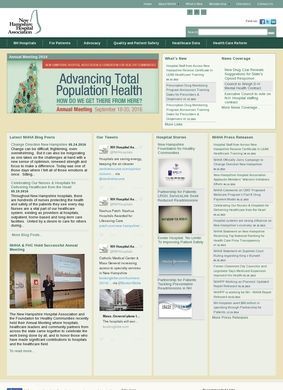
Every hospital in New Hampshire has a single voice in front of the state legislature, and that voice is the New Hampshire Hospital Association. The site frames its work around a narrow purpose: it represents member hospitals, the health systems they belong to, and the communities those institutions serve. You do not land here looking for a doctor or a clinic. You come here because you want to understand what the hospitals themselves are arguing for, and what pressures they are under.
Advocacy and legislative tracking
The clearest part of the New Hampshire Hospital Association operation is the advocacy work. NHHA tracks legislation, develops policy positions, and pushes those positions on behalf of its members during regulatory and legislative cycles. The bill-tracking function is what makes the rest possible: a hospital cannot lobby on twenty bills at once, so the association does it collectively. The priority areas are spelled out plainly, and they read like a list of the actual problems facing the sector. Access to care. Behavioral health. Emergency preparedness. Workforce sustainability. Price transparency. Quality and patient safety. Rural health. Hospital reimbursement. Anyone who follows healthcare policy will recognize these as the fault lines hospital systems argue over year after year.
Priority areas in healthcare policy
Behavioral health and rural health stand out as the two areas where a small state really shows its hand. New Hampshire has a lot of geography and not a lot of hospitals, so a rural facility losing a service line is a regional event, not a footnote. The New Hampshire Hospital Association placing rural health alongside reimbursement and workforce in the same breath is honest about how those issues feed each other. A rural hospital that cannot hire nurses and cannot get paid enough for the care it delivers is the same story told three ways.
Rural health in New Hampshire
There is genuine output here, which is worth saying because plenty of trade-group sites are little more than a mission statement and a board roster. The New Hampshire Hospital Association publishes reports, fact sheets, and an annual report, and it runs a newsroom carrying healthcare news relevant to members. The annual report is the document that lets an outsider judge whether an association is doing anything, since it is where a year of advocacy gets totted up. Having one, and surfacing it, is a reasonable sign that the group treats accountability as part of the job.
Reports, fact sheets, newsroom
The fact sheets are the more practical artifact. A fact sheet is what a hospital administrator hands a legislator, or what a reporter pulls a number from, and producing them is part of how an association translates member concerns into something a non-specialist can act on. Pair that with the newsroom and you get a steady stream of material that keeps positions current instead of frozen in whatever the last legislative session decided. The price-transparency thread is worth watching in that feed, given how much federal and state attention that topic has drawn.
Membership structure and tiers
Membership is structured into three tiers, which tells you something about how the New Hampshire Hospital Association sees its ecosystem. Hospital members are the core constituency. Endorsed partners and corporate members fill out the rest, which is the standard way a trade association brings in the vendors and service firms that orbit the hospital world. Listing all three categories openly lets a prospective member see exactly where they would fit.
The calendar centers on the 2026 NHHA/FHC Annual Meeting, with award nominations attached. A yearly gathering with awards is the social and recognition side of the New Hampshire Hospital Association: it is where members meet, where the year's work gets acknowledged, and where the network that makes collective advocacy possible forms in person. The award nominations reveal what kind of work the organization values and who in the membership is setting the standard others follow.
Education rounds out the offering, aimed squarely at member hospitals on compliance, quality improvement, and workforce development. This is the part of the New Hampshire Hospital Association that delivers day-to-day value to a member that may not care much about any single bill. Compliance support and quality-improvement guidance are things a hospital can use immediately, and they give the membership fee a practical justification beyond lobbying. The workforce piece ties back to one of the named priority areas, and the association treats it as both a policy fight and a hands-on initiative, which is a sensible way to handle a problem that needs work on both fronts.
Workforce sustainability initiatives
Workforce sustainability shows up so often across the site that it is clearly the issue the New Hampshire Hospital Association is most preoccupied with right now. It appears as a priority area, as a coordinated initiative, and as a strand of the education programming. That repetition is not padding; it is the organization telling you through emphasis where it thinks the real fight is. Staffing shortages have dominated healthcare for years, and a state association leaning this hard into the topic is reading its own members accurately.
A search for third-party ratings or public reviews of the New Hampshire Hospital Association turns up nothing on the usual platforms. That is not unusual for a trade association whose audience is institutional rather than public, and it does not change what the published material already shows. The site carries enough primary documentation, named priority areas, an annual report, and a named annual meeting to let a researcher form a judgment without relying on outside ratings.
If there is a limitation to flag, it is that almost everything here speaks to the supply side of healthcare, to the hospitals and the people who run them, with patients mentioned as beneficiaries more than as a direct audience. That is a definition of scope, not a flaw. A member of the public looking for help with a bill or a complaint about a specific hospital will not find that here, and should not expect to. The New Hampshire Hospital Association is an instrument of its members and is candid about that.
For a researcher, a journalist, or a policy staffer, the priority areas tell you what the sector cares about, the fact sheets give you sourced material to quote, and the newsroom keeps positions current. The workforce material is where the New Hampshire Hospital Association is putting its weight, and following that thread gives a clear sense of what the state's hospitals are most focused on heading into the next legislative cycle.