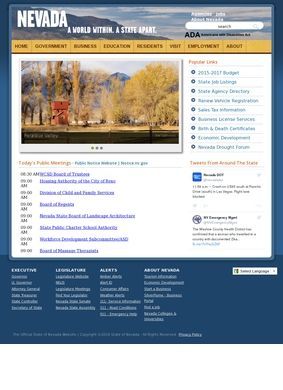
Someone has just moved to Reno and needs three things before the week is out: to register to vote, to check whether the state is holding money in their name, and to find the right agency for a business license. Those errands normally mean three separate searches and three unfamiliar websites. NV.gov exists to collapse that into one starting point, the official front door to the State of Nevada government, and on the plain question of whether it gets a newcomer pointed the right way, it does the job.
Nevada was the 36th state admitted to the union, and its government runs the full apparatus one would expect of a state that size. The value of the portal is organisational. It gathers the scattered machinery of a state into a single index and lets a resident, a job seeker, a visitor, or a business owner find their lane fast.
Three branches under one roof
The clearest strength of NV.gov is that it maps the whole of state government instead of a slice of it. The Executive, Legislative, and Judicial branches each have a route in, and from there the site links out to the individual agencies and departments a person actually needs: the Governor's Office, the Attorney General, the Secretary of State, and the rest of the roster that keeps a state running. Most portals of this kind pick a lane, either the political top layer or the transactional services, and quietly drop the other. This one holds both.
Most people do not know which office handles their problem, and that is exactly why the structure counts. A resident chasing a records question rarely knows whether it belongs to the Secretary of State or somewhere else entirely, and NV.gov spares them the guesswork by putting the branches and the agency links in plain sight. It is a signpost more than a service counter, but a good signpost saves real time.
The three-branch framing also quietly teaches civics to anyone paying attention, since seeing the courts, the legislature, and the executive laid out side by side is a reminder of how the state is actually put together.
Public safety gets its own visible place in the layout. The Department of Public Safety, Emergency Management, and the Highway Patrol are all reachable through NV.gov, which is the kind of grouping that only proves its worth when something has gone wrong and a person is looking for the correct agency in a hurry. Emergency information buried five clicks deep is useless information. Keeping these agencies near the surface is a decision that costs nothing on a calm day and matters enormously on a bad one, and NV.gov gets it right.
Quick links for residents, business, and visitors
Below the branch structure sits a band of quick links, and this is where NV.gov earns most of its daily traffic. Job listings, resident services, business services, and educational resources all get their own entry, so the site works for the person hunting a state job as readily as for the parent looking up a school programme. The design assumption is sound: different visitors want very different things, and the portal sorts them at the top instead of forcing everyone through the same funnel.
The business services strand deserves a specific nod, because starting or running a company in Nevada touches several agencies at once, and a first-time owner benefits from a single index that lines those routes up. Educational resources sit alongside for students and educators, and resident services cover the everyday government business that most people would otherwise dread tracking down.
None of this is reinvented. It is organised, and organisation is exactly what a person wants from a portal at the moment they need it. That the whole set is reachable from NV.gov without a login or a runaround is the quiet win, and it is the difference between a resident finishing an errand and a resident giving up halfway.
Voter registration and elections
Election material is front and centre, which is the right call for a state portal. NV.gov carries voter registration and election information directly, so a resident can confirm their status or start the registration process from the same place they handle everything else with the state. Plenty of people only touch a government site during an election cycle, and having that path obvious instead of buried is a small mercy for the once-a-year visitor.
It also puts the neutral, official source ahead of the noise a search engine would otherwise surface, which for anything election-related is a genuine benefit.
Unclaimed property and veteran services
Two features stand out for how concretely useful they are. An unclaimed property search lets residents check whether the state is holding money owed to them, which is the sort of tool people share with friends because it occasionally pays off.
Alongside it, NV.gov links veteran benefits and services, giving former service members a defined route to what they are entitled to. Neither is glamorous. Both answer a real question a real person turns up with, and both are the sort of service that would be maddening to hunt for if the portal did not gather them in one place.
Tourism from Las Vegas to Lake Tahoe
The portal does not treat the state purely as a bureaucracy. Tourism information runs through NV.gov as well, covering Las Vegas, Lake Tahoe, and the wider Nevada landscapes that bring visitors in the first place. It is a sensible inclusion. A government site that only ever speaks to residents ignores a large part of who lands on it, and folding travel guidance into the same portal keeps NV.gov useful to the tourist planning a trip and the local checking a licence on the same afternoon.
The pairing feels a little unusual on a government domain, yet it fits a state whose economy leans so heavily on the people who come to see it.
Accessibility and a fair verdict
One area NV.gov takes seriously is digital accessibility. The portal links dedicated sub-sites for it, adahelp.nv.gov for ADA assistance and ada.nv.gov for Nevada digital accessibility, which signals that the state treats reachability for disabled users as its own workstream instead of a checkbox at the end of a redesign. There is also a Climate Innovation Plan surfaced among the offerings, a policy strand a curious resident can read up on without hunting through a department archive. Putting a plan like that where an ordinary visitor can find it is a small act of transparency that many official sites skip.
The honest limit is the nature of the thing. NV.gov is an index, and the depth lives on the agency sites it points to. Click into most of these areas and the real work happens somewhere downstream, on the Secretary of State's system or the Department of Public Safety's own pages. A portal like this succeeds or fails on whether its links are current and its structure is legible, and on both counts the layout holds up, though a visitor should expect to be handed onward more often than served in place.
So the verdict is measured. As a place to begin, NV.gov does what a state portal should: it tells a resident, a business, or a visitor where to go, and it keeps the highest-traffic errands within easy reach. Judge it as a first stop and it is a good one. Judge it as a place that finishes the errand outright rather than pointing elsewhere, and some of the shine comes off, because completing the task in place was never what this particular front door was built to do.