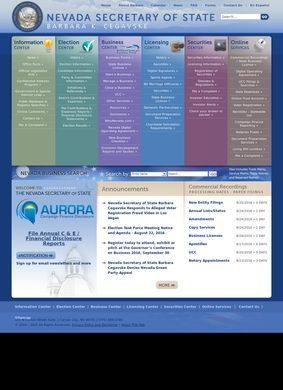
SilverFlume is the online portal where a new Nevada company files the paperwork that brings it into legal existence, and it is run by the Nevada Secretary of State. That single tool covers the exact moment a business becomes real in the eyes of the state, and it sits near the centre of what the office does for the commercial side of Nevada.
Registering and running a Nevada business
Business filings are the workload most people associate with the Nevada Secretary of State, and for good reason. The office is where corporations, limited liability companies and other entities register, file the periodic paperwork that keeps them current, and maintain the standing that lets them trade. A company's legal life in the state runs through the Nevada Secretary of State from the day it forms to the day it dissolves, which makes this one agency unavoidable for anyone doing business under a Nevada name.
The value of consulting it is straightforward. This is the authoritative source for whether an entity exists, who is on record for it, and whether its filings are up to date, and there is no second opinion that outranks the register itself. Unlike an entry in a business directory, which reflects only what a company chooses to publish about itself, this record reflects what the company has formally told the state.
That is why lawyers, lenders and rival companies all check with the Nevada Secretary of State before they act, since a name confirmed here is a name confirmed for legal purposes.
SilverFlume and entity filings
The SilverFlume portal is the front door for most of that work. Through it a business can form a new entity, submit the ongoing filings that keep it in good standing, and manage the records the state holds against its name, without posting forms back and forth. For anyone starting or maintaining a Nevada company, the Nevada Secretary of State is the mandatory stop, and SilverFlume is how the office has moved that duty online and into one login instead of a stack of paper.
The portal also carries the routine annual and periodic filings that keep an entity active, so a company comes back to the same system year after year to stay in good standing rather than reintroducing itself each time.
UCC filings and searches
Alongside entity registration, the Nevada Secretary of State handles Uniform Commercial Code filings and the searches that go with them. A lender recording a security interest against a borrower's assets files a UCC statement here, and anyone checking whether such a lien already sits against a business or its equipment runs a UCC search through the same office. It is procedural, unglamorous work, and it is exactly the sort of authoritative record a state office exists to keep, since a private database would carry none of the same legal weight.
For a small-business owner or a title researcher, being able to run that search directly with the Nevada Secretary of State, with no intermediary in between, is a practical convenience as much as a legal safeguard.
Notaries, voters and candidates
Past the business register, the Nevada Secretary of State carries a set of duties that touch ordinary residents directly. Two stand out from the rest: the commissioning of notaries and the running of elections through a dedicated division. Both are functions a private company could never provide, because both depend on the authority of the state standing behind them.
These are the parts of the office a person is most likely to meet without ever forming a company, whether they are getting a document notarised, registering to vote, or standing for office themselves. Each of those is a moment where an ordinary resident needs the state to certify something formally, and the Nevada Secretary of State is the office that does the certifying.
Commissioning notaries
A notary public in the state is commissioned by the Nevada Secretary of State, which means the office sets and administers the process that lets a person witness and certify signatures on legal documents. For the notaries themselves, and for everyone relying on a notarised signature to hold up later, that commissioning authority is what gives the stamp its force.
Consulting the office is how a notary applies, renews, or confirms that a commission is valid. Because a notarised document can carry legal consequences years down the line, the fact that the commission traces back to one state authority is what lets a bank or a court rely on the stamp without a second thought.
How the Elections Division works
The Elections Division is the part of the Nevada Secretary of State that most residents will encounter, even those who never file a business form in their lives. It handles voter registration information, publishes official election results, and manages candidate filings, so the machinery of a Nevada election, from a candidate declaring to the final count being posted, runs through this office.
Campaign finance disclosure filings sit here as well, the reports that record who funded which campaign, and those are the paperwork behind any serious look at money in state politics. When a result or a filing is disputed, the Nevada Secretary of State holds the official version.
Licensing and the state's records
A third strand of the Nevada Secretary of State covers licensing and record-keeping that does not slot neatly under either business or elections. The office administers certain professional and commercial licensing, and it holds state records and archives that the public can consult. These are the quieter functions, the ones a resident may only need once, but they are the reason the office doubles as a formal library of the state's official documents.
An official document, or a piece of the state record a researcher needs confirmed, leads back to this same office as the custodian to approach first. The same principle runs through everything the Nevada Secretary of State does: it is the authoritative keeper of a defined class of public record, whether that record is a company's registration, a notary's commission, an election result or a campaign finance report. Between SilverFlume, the UCC system, the notary commissions and the Elections Division, several distinct public functions resolve to this one office, each reachable as its own filing or search track.