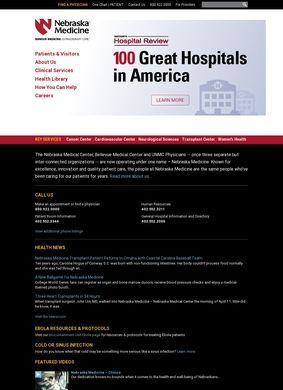
Forty-plus facilities across the Omaha metro and the wider state, all tied to the University of Nebraska Medical Center: that is the scale The Nebraska Medical Center presents when someone lands on its site. The clinical front door leads into primary care alongside a long bench of specialties, so a routine checkup and a complex referral both have a clear path forward.
Specialty services and clinical departments
The clinical list is deep without padding. Heart and vascular care, women's health, orthopaedics, neurological care, dermatology, eye care, and gastrointestinal clinics all have their own sections. Emergency and immediate care are covered for the moments when waiting is not an option. Virtual and telehealth visits round it out for people who would prefer not to drive across the city for a follow-up, and The Nebraska Medical Center treats that option as a standard part of care. Each area is described in enough practical detail that a reader can tell whether their need fits before picking up the phone.
Proton beam therapy for cancer treatment
Two areas stand out from the general roster. The cancer care section includes proton beam therapy, a precise form of radiation that comparatively few centers in the country are equipped to deliver. Listing it plainly tells a patient researching options that the equipment is there, on site, and ready for use.
Transplant services at an academic center
Transplant services are the other heavyweight. This is the kind of work that only a full academic medical center tends to sustain, because it draws on surgical teams, long-term follow-up, and research all at once. The pages here connect those threads to the day-to-day reality of becoming a patient, including how a referral moves through the system.
Clinical trials access
Tying these programs to the rest of The Nebraska Medical Center is a visible research footprint. Clinical trials access is offered openly. For patients with conditions where a study may be the better route than standard treatment, that open access is a concrete advantage. The academic affiliation shows up in what the institution can put in front of a patient.
Patient tools and portal features
Beyond the clinical departments, the site works hard as a practical instrument. The "Find a Doctor" tool lets a visitor search physicians and book online, which removes a real point of friction for anyone who dreads phone trees. Pairing the physician search with scheduling in one place is sensible design.
One Chart patient portal
The One Chart patient portal handles the ongoing relationship: records, messages, and the administrative trail that follows any course of treatment. A companion mobile app for iOS and Android extends the same access to a phone, so test results and appointment details travel with the patient. For a system this large, keeping those threads in one account is the difference between manageable and chaotic.
Health education and support resources
Supporting material fills in the rest. Health education resources cover specific conditions and lifestyle topics, patient stories are posted alongside billing and insurance information, which is often the murkiest part of any medical encounter. Volunteer opportunities are listed for people who want to give time to the institution. None of it feels like filler; each piece answers a question a real visitor would bring.
How does the site help you find care?
The structure of the site mirrors the structure of the organization. A patient can enter through a symptom, a specialty, a specific doctor, or a location, and every one of those routes leads somewhere useful. That kind of multiple-entry design is harder to build than it looks, and The Nebraska Medical Center handles it without making a visitor feel lost. The locations section in particular does quiet work, mapping the 40-plus facilities so a patient can match a service to the nearest building.
Independent reviews of The Nebraska Medical Center across Google and health-rating platforms are spread across the individual facilities instead of pooled under one banner, which is typical for a system this size. The volume is substantial and the overall picture is positive without being uniform, as one would expect from dozens of clinics operating across a metro area.
The everyday needs, a primary care visit, a dermatology consult, a GI workup, share an address with the rare and demanding ones, proton therapy and organ transplant among them. That range is the strongest case for The Nebraska Medical Center over a more narrowly focused practice. The site reads as honest about what it is: specialty pages describe procedures and conditions in measured language, the tools do what they say, and the academic backbone is stated as fact rather than implied.
One thing worth flagging for first-time visitors: the sheer scale means the homepage carries a lot at once, and orienting takes a minute. The search tools shorten that learning curve. Once a patient knows to start with "Find a Doctor" or the locations map, The Nebraska Medical Center opens up quickly, and the proton beam and transplant programs sit only a click or two from the front page.