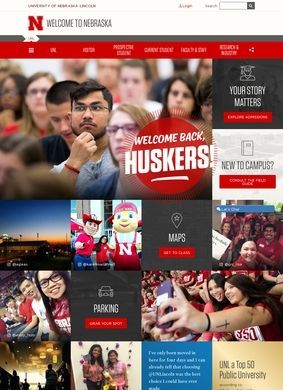
The University of Nebraska, in its flagship campus at Lincoln, is the public research university that anchors the state's higher-education system, founded in 1869 and now a member of the Big Ten. The Lincoln campus runs nine academic colleges, and the spread tells you a lot about who the place serves: Arts and Sciences and Engineering sit alongside Agricultural Sciences and Natural Resources, Architecture, Business, Education and Human Sciences, Fine and Performing Arts, Journalism and Mass Communications, and a College of Law that grants the JD. That last point matters because it means the same institution covers a freshman taking general-education courses and a professional student preparing for the bar.
Nine colleges serving diverse academic interests
Degree coverage at the University of Nebraska runs the full ladder. There are undergraduate programs, graduate and doctoral tracks, the professional law degree, and online courses for students who cannot be on campus. One feature I found genuinely useful for prospective students is the Explore Center, which gives one-on-one academic advising to people who arrive undeclared. Plenty of large universities leave undecided students to drift through a catalog; having a named office whose job is to talk them through options is a practical thing. It also signals that the institution expects a fair number of arrivals to change direction, which is honest about how undergraduate study tends to go.
Undeclared students get dedicated advising support
The University of Nebraska sits inside Lincoln, the state capital. The campus is surrounded by government offices and businesses, which means internship and public-sector work is accessible in a way it simply would not be at a rural campus. The cultural and civic life of a capital city comes with enrollment, without any extra effort.
Research strengths in plant sciences, engineering, business
Research at the University of Nebraska leans into a few areas where the institution has long invested. Plant sciences and turf management are real specialties here, which fits a land-grant heritage in an agricultural state, and the work extends into broader life sciences. Engineering and business round out the strongest research output. None of this is generic prestige language; these are fields where the university has built faculty depth and facilities over decades, and that focus shapes what a graduate student can expect to find in terms of labs and advisers.
The teaching record shows up in numbers too. More than 6,200 students were named to the Dean's List in a recent term, a figure that signals scale as much as achievement, since you need a very large enrollment to produce a list that long. The University of Nebraska also turns out Fulbright Scholarship recipients on a consistent basis, which is a fair external marker of how its strongest undergraduates and recent graduates compete nationally. Enrollment itself runs into the tens of thousands across undergraduate, graduate, and professional study, and that volume is part of what makes the breadth of nine colleges sustainable.
Some of the attention the University of Nebraska draws beyond its own state lines comes through people who passed through it. Johnny Carson graduated in 1949, and the painter Aaron Douglas took his BFA in 1922. Two names cannot stand in for an entire alumni body, but they do hint at a reach across very different fields, from late-night television to the visual art of the Harlem Renaissance. For a prospective student, alumni like these are less a recruiting pitch than a quiet reminder that a degree from here has carried people a long way in fields the campus still teaches.
The non-academic side of the University of Nebraska is substantial. The university libraries system is the research backbone. The campus also holds the Lied Center for Performing Arts and several museums, giving students and visitors cultural venues without leaving the grounds. The Lied Center in particular pulls in touring productions that would otherwise require a trip to Omaha or Kansas City, which is a genuine advantage of a flagship campus in a mid-sized capital.
Athletics is where the public image concentrates. The Huskers compete in NCAA Division I across the usual range of sports, and the volleyball program is the standout: it set the world attendance record for a women's sporting event, a fact that says something real about how the state turns out for its teams. Football tends to dominate outside coverage, but the volleyball record is the more striking data point, and it reflects a fan base that fills very large venues for women's sport in a way few campuses manage.
Comparing Lincoln to the Omaha sister campus
For someone weighing the University of Nebraska against another in-state option, the natural comparison is the University of Nebraska Omaha, a sister campus in the same system. Omaha pulls toward a metropolitan, commuter-friendly profile with strengths in fields like information science and public administration. Lincoln is the research-heavy flagship with the law school, the land-grant agricultural mission, the Big Ten membership, and the deep athletics tradition. Anyone choosing between them is really choosing between a big-city campus geared to working students and a comprehensive research university that wants you living in and around college life. For a student after doctoral research, a law degree, or the full Division I experience, Lincoln is the one to consult first.