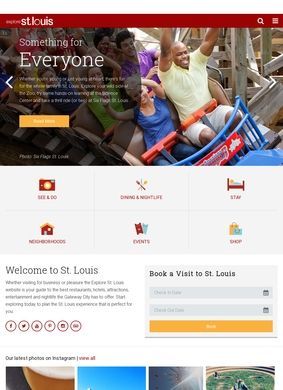
Day trip itineraries that pair a morning at the City Museum with an afternoon in a wine-country town an hour out of the metro give a fair sense of what Explore St. Louis is built to do: it treats the visit as a sequence of decisions and tries to make each one easier. Explore St. Louis is the destination marketing organization for the St. Louis region, the official Convention and Visitors Bureau, and the site reads like one. It is organized around questions a traveler or a meeting planner is actually asking, and it answers them with directories rather than slogans.
How the site organizes visitor decisions
The structure splits cleanly along the lines of how people use a city. Plan Your Trip holds the neighborhood guides, the curated itineraries, and listings of guided tours. See and Do is the broad bucket: arts and culture, sports, shopping, wellness, and outdoor activities, which is a wider net than a lot of city tourism sites bother to cast. Dine and Drink is more granular than expected, breaking out a restaurant directory alongside separate guides for breweries and bars, coffee shops, and even food trucks. That last one is a small thing, but it tells you someone curating the Explore St. Louis site thinks about how a visitor's day actually unfolds, more than where they sleep and what museum they hit.
Lodging options and event scheduling
Stay covers the predictable range, hotels through bed and breakfasts and on to camping, which is a useful reminder that the region the bureau represents extends past the downtown core. The Events calendar is the part that earns repeat visits. It runs continuously across arts exhibitions, live music, food festivals, and the sporting calendar, and a calendar like that only holds value if someone keeps it current. For a visitor deciding whether a given weekend is worth the trip, that running schedule does more work than any amount of descriptive prose about the city.
Meeting planners and convention services
What separates Explore St. Louis from a straightforward leisure-travel site is the second audience it openly addresses. Meeting planners and convention organizers get their own track, built around America's Center Convention Complex, with venue information and group services laid out as dedicated planner resources. This is Explore St. Louis doing its core institutional job: filling hotel rooms and convention floors, beyond pointing tourists toward the Arch. The leisure content and the meetings content sit side by side without one feeling like an afterthought, and that balance is harder to pull off than it looks.
Tools for different trip scales
The dual mandate also explains the depth of the practical tooling. Trip itineraries and neighborhood spotlights are aimed at the individual traveler, while the planner pages assume someone moving a few thousand attendees through downtown. Explore St. Louis operates under the umbrella of the Metropolitan St. Louis Convention and Visitors Commission, and the public site is essentially the front door for both halves of that remit. A visitor browsing for a long weekend and a planner scouting a 2027 conference are both meant to find their footing here, and the navigation mostly delivers on that.
Social media channels
Social reach is broad: Facebook, Twitter, YouTube, Pinterest, Instagram, and TikTok all carry the Explore St. Louis brand. For a tourism authority, that spread is less about vanity and more about meeting travelers on whichever platform they already trust for trip inspiration. A short reel of a neighborhood or a brewery does the persuading that a paragraph cannot, and Explore St. Louis seems to understand which channel suits which message.
Neighborhood guides and district spotlights
Where the site is most convincing is in the neighborhood-level detail. A traveler who has only heard of the Gateway Arch can use the Explore St. Louis neighborhood guides to find the districts that match what they came for, whether that is a stretch of galleries, a corridor of restaurants, or a quieter outdoor escape. The spotlights function as connective tissue between the high-level pitch and the practical act of choosing where to spend an afternoon. They are the reason Explore St. Louis works as a planning tool and not a marketing portal, and they are what first-time visitors should dig into before anything else.
What a bureau site cannot tell you
It is worth being honest about the limits of a site like this. A bureau site is promotional by design; nothing here is going to tell you which restaurant disappointed last month or which festival ran late. The listings cast a wide, inclusive net because that is the bureau's job, so a traveler still has to apply their own filter, cross-checking individual venues against the kind of independent commentary a marketing site will never carry. That is not a flaw so much as the nature of the format, and Explore St. Louis is upfront enough about what it is that the gap is easy to work around.
Regional consolidation in one place
The breadth is the genuine selling point. Few visitor resources try to hold leisure planning, dining at the food-truck level of granularity, a live events calendar, lodging from hotels to campsites, and a full convention-services operation in one place. Explore St. Louis does, and it keeps the two audiences from tripping over each other. You can find regional consolidation in a general business directory, but rarely with this much specificity behind it. The result is a reference that rewards the planner and the weekend traveler in roughly equal measure, which is what a regional tourism authority ought to produce.
Strengths of the resource
Explore St. Louis gathers the moving parts of a trip into one navigable place, keeps the events side current, and treats the convention crowd as a first-class audience rather than a footnote. The neighborhood guides and itineraries pay off fastest, and the dining and events sections are deep enough to justify a second look closer to travel dates. A search turns up almost no independent ratings or reviews of the Explore St. Louis resource itself, which is normal for a CVB site. The published content is thorough enough that the absence of outside commentary does not leave much unanswered.