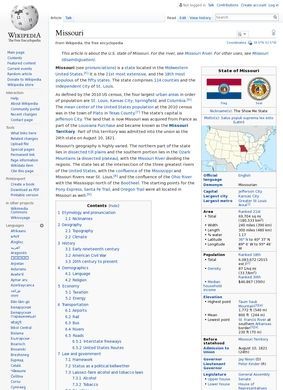
Someone trying to settle a quick fact about Missouri, say which city is biggest or when statehood happened, usually wants a single page that answers it without making them piece things together from a dozen tabs. The Wikipedia Missouri article does that work in one sitting. It opens with the core figures a reader tends to need first: Jefferson City as the capital, Kansas City as the largest city at a population of 509,297, a statewide count of 6,270,541, and a total area of 69,704 square miles that puts the state 21st by size and 18th by population. Those numbers sit near the top, which means the casual lookup is resolved before a person ever scrolls.
Missouri's history from statehood to the Civil War
What keeps the page useful past that first glance is how much it carries underneath the summary. The history runs in a clear line. Wikipedia Missouri starts with the etymology, tracing the name back through the Missouri River to the Missouria people, and notes the pronunciation question that has long divided residents. From there it moves through the Mississippian mound-building cultures of the ninth to fourteenth centuries, French colonial footholds at Ste. Genevieve in 1735 and St. Louis in 1764, and the state's admission to the Union on August 10, 1821 as the 24th state. The treatment of the Missouri Compromise of 1820 and the entry as a slave state is handled directly, and the Civil War material covers its peculiar status as a border state torn by guerrilla fighting.
That continuity, where each era leads into the next, is the part that separates a real reference from a stack of disconnected facts. A reader can start at the Mississippian period and follow a single thread all the way to the present without the page ever losing the plot, which is harder to pull off than it sounds for a subject with this much ground to cover.
Geography, climate and tornado risk
The geography coverage does the job for anyone who needs the physical lay of the land. The Wikipedia Missouri page walks through the Ozark Mountains, the glaciated plains across the north, and the Bootheel jutting south, then accounts for all 114 counties plus the independent city of St. Louis. It lists the eight bordering states by name, which is the sort of detail people actually come looking for: Iowa, Illinois, Kentucky, Tennessee, Arkansas, Oklahoma, Kansas, and Nebraska. The climate paragraph gives the humid continental classification, the record high of 118 degrees in 1954, the record low of minus 40 in 1905, and the state's place in Tornado Alley, with the 2011 Joplin EF-5 tornado and its 158 deaths cited as the grim reference point.
From reconstruction to Ferguson protests
The modern history does not stop at the comfortable distance of a century ago. Coverage extends through post-Civil War industrialization and into 21st-century events, including the 2014 Ferguson protests. I appreciate that Wikipedia Missouri does not quietly skip the harder recent chapters, since a state page that ends its narrative at 1900 tells you very little about the place as it stands now. The government section keeps pace too, naming Governor Mike Kehoe and laying out the eight-member congressional delegation split six Republicans to two Democrats, which is the kind of current-affairs anchor a reader checking on the present will want.
Music, brewing and higher education
Culture gets fair room as well, and it is one of the more rewarding stretches of the page. Wikipedia Missouri credits the state as a seedbed for ragtime, Kansas City jazz, and St. Louis blues, which is a genuinely large claim to American music made without overselling it. Anheuser-Busch's headquarters gets a mention, and the higher-education picture covers the University of Missouri, Washington University, and Saint Louis University.
None of this reads like padding. Each entry connects to something a person might be researching, whether that is a music origin, a major employer, or where to study. The music section of Wikipedia Missouri in particular is the kind of thing a state page often handles badly, reducing a deep cultural history to one or two famous names, but here the three traditions are given their due as distinct American forms with roots in distinct Missouri cities.
Research tools across many languages
For practical reach, the page is published in 198 languages, which matters far more than it might first appear for a subject this internationally searched. The export, print, and citation tools sit within easy reach, so a student building a bibliography or a writer needing a clean printable copy is not left hunting. These are small features, but they are the ones that turn a reading page into a working one, and Wikipedia Missouri handles them without fuss. The language breadth is also a quiet signal of how thoroughly the subject is documented, since a state article that exists in nearly two hundred editions has clearly drawn sustained attention from editors well beyond the United States.
Checking the sourcing behind the numbers
If there is a fair caution, it is the familiar one for any crowd-edited reference: figures like the 2025 population estimate and the named officeholders are accurate to the moment they were entered, and a careful reader should glance at the citations behind the numbers that matter to them. That is less a flaw than the nature of the format. The heavy footnoting on Wikipedia Missouri makes this easy, since most of the substantive claims here point back to a source you can follow. The structure invites checking.
Depth is the real strength on display. Wikipedia Missouri does not treat the state as a tourism blurb or a list of superlatives. It reads like a serious entry that respects the reader's time, front-loading the figures, then giving the history, geography, climate, government, and culture enough room to be genuinely informative. A reader who arrives knowing nothing leaves with a working grasp of the place, and a reader who arrives with a specific question tends to find it answered with a citation attached. The balance between summary and detail is well judged across Wikipedia Missouri, and that consistency is what keeps people returning to it as a first stop.
How does Wikipedia Missouri compare to mo.gov?
Set against a state-run option like the official Missouri government portal at mo.gov, the two serve different needs and it is worth being honest about which wins where. The state site is the place to go for live services, current statutes, tax forms, and the freshest official population releases, and for those tasks it has no real substitute. But for a single page that ties history, geography, music, demographics, and government into one readable account with sources behind each claim, Wikipedia Missouri is the more efficient starting point, and most readers who land here for context rather than transactions will find it does the job they came for.