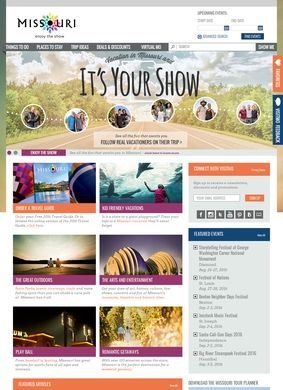
Visitmo.com leads with a quiz called "Find Your M-O," which sorts travelers into fifteen personas before it suggests anything. You pick Outdoor Mo, or Family Fun Mo, or Foodie Mo, or Sports Mo, or Culture Mo, and the site adjusts what it puts in front of you. It is a small framing trick, but a sensible one. Instead of dumping a flat catalog of attractions on a first-time visitor, the Missouri Division of Tourism asks what kind of trip someone is after and works backward from the answer. A road tripper and a parent traveling with young kids are not looking for the same weekend, and the quiz treats that difference as the starting point, not an afterthought bolted on at the end.
Finding your travel style with personas
Underneath the persona layer, the site is built around itineraries. The Missouri Division of Tourism publishes multi-day routes that string together state parks, historic sites, and food-focused drives, so a planner can take a pre-assembled trip and adjust it instead of building one from scratch. That is the part that makes itineraries worth having. Anyone can list landmarks. Sequencing them into a believable two or three days of driving, eating, and stopping is harder, and it is where the Missouri Division of Tourism, with a wide view of the whole map, has an advantage over a single attraction promoting only itself.
Pre-built itineraries for multi-day trips
The strongest material sits in the spotlight sections, where the Missouri Division of Tourism names specific things to do instead of speaking in generalities. There is a run of beer trails. There is the Route 66 corridor, which cuts across the state and gives the site an obvious narrative spine to hang stops on. There are barbecue destinations, which is fair game given Missouri's standing in that argument, and there are the cave systems, which are easy to overlook if you only know the state by its cities.
Spotlight sections highlight specific destinations
Two features get more weight than the rest, and deservedly. The Katy Trail, a 240-mile rail-trail, is the kind of asset that justifies a dedicated push, since it is long enough to anchor an entire trip for cyclists and walkers all on its own. The Gateway Arch in St. Louis carries the marketing on its own and shows up where you would expect. Pairing a single iconic landmark with a sprawling outdoor route is a smart spread: it gives the casual visitor a recognizable anchor and gives the more committed traveler a reason to stay longer.
Katy Trail and Gateway Arch
The "Things to Do" section organizes everything into art and history, family fun, food and drink, outdoors, and shopping. These are plain buckets, and that is the point. A visitor scanning for one category can get to it without wading through the others. The categories also map cleanly onto the persona quiz, so the two systems reinforce each other instead of pulling in different directions, which is more coordination than these portals usually manage.
Organizing activities by visitor interest
The audience the Missouri Division of Tourism is aiming at comes through clearly from the content mix. Families get their own track. Adventure travelers and road trippers get the trails and the Route 66 material. Food and beverage tourists get the barbecue and beer trails. Sports fans and culture-and-history visitors each get a lane. It is a broad net, but it is cast deliberately, with real destinations behind each interest, not a single page trying to be everything to everyone.
Targeted content for different travelers
A Travel Resources section sits alongside the itineraries and holds additional planning materials, which is where a trip moves from browsing to logistics. The seasonal newsletter signup runs throughout, and the #ThatsMyMO social campaign is stitched into the site as well, pulling user-generated and shared content into the marketing. Those are standard moves for a tourism portal, and the Missouri Division of Tourism uses them the standard way: as a means of keeping a casual visitor in contact after the first session ends.
Information and referral model
One thing worth being honest about is the boundary of what this site does. There is no booking engine and no e-commerce. You cannot reserve a room, buy a ticket, or pay for a tour here. The Missouri Division of Tourism is an informational and marketing platform that points outward, sending visitors to the actual attractions and destinations to handle the transaction. For some travelers that extra hop is a mild annoyance, since they would prefer to plan and book in one place. For the agency it is the correct scope. A state tourism body that tried to run a reservation system would be competing with the businesses it exists to promote, and the referral model keeps it neutral.
That neutrality shapes how the recommendations read. Because the Missouri Division of Tourism is not selling the inventory it describes, the spotlight content does not have the tilt of a single operator pushing its own product. The beer trails, the cave systems, the barbecue stops, and the Katy Trail are presented as parts of the state worth seeing, not as line items in a checkout. A traveler who treats the site as a starting map and then books elsewhere is using it exactly the way the Missouri Division of Tourism designed it.
Recommendations without commercial bias
The persona quiz deserves a second look, because the choice of fifteen distinct visitor types is unusually granular for this kind of tool. Many tourism sites settle for three or four broad categories. The Missouri Division of Tourism splitting the audience into Outdoor Mo, Family Fun Mo, Foodie Mo, Sports Mo, Culture Mo, and a string of others lets the recommendations land closer to what a given visitor wants. The risk with that many options is that the differences between adjacent personas blur, but the upside is recommendations that feel chosen rather than generic. On a trip-planning site, that specificity is the whole value.
What holds the site together is the connection between its parts. The quiz feeds the categories, the categories feed the itineraries, and the itineraries feed the spotlight destinations like the Arch and the Katy Trail. The Missouri Division of Tourism has built a chain a visitor can follow from a vague urge to travel down to a concrete day-by-day plan, then handed off the booking to the destinations themselves. The Travel Resources section catches whatever logistics the itineraries leave open, and the newsletter and #ThatsMyMO campaign keep the door open for a return visit.
For trip planning specifically, the Missouri Division of Tourism gives a visitor a reason to start here rather than with a generic search. The personalization is more than cosmetic, the spotlight content names real and varied places, and the itineraries do the assembly work most travelers skip. Someone planning a Missouri trip will leave the site with a route, a short list of stops, and a clear next step, then go elsewhere to lock in the dates. The trade is plain: the Missouri Division of Tourism does the inspiration and the sequencing, and the visitor finishes the booking on someone else's page.