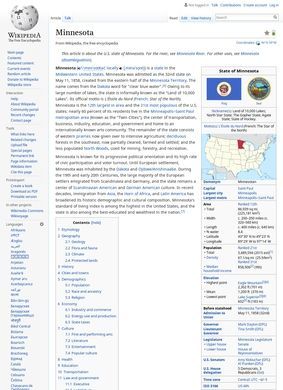
Someone trying to get a grip on Minnesota usually arrives with a narrow question: how cold does it really get, what drives the economy now that the mines and lumber camps are quieter, what is the deal with all those lakes. The Wikipedia Minnesota article meets that arrival point well, because it opens with the framing facts and then keeps drilling down into the specifics a casual question tends to spawn. You can land on Wikipedia Minnesota knowing nothing and leave with a working mental map of the state.
State facts and geographic scale
The page starts where a reference should, with the basics. Minnesota entered the Union on May 11, 1858, as the 32nd state, and the name itself comes from a Dakota word meaning clear blue water or cloudy water, which the article notes without overcomplicating the disagreement. From there it sets the scale: roughly 86,936 square miles, the 12th-largest state, bordering Canada to the north along with Wisconsin, Iowa, North Dakota, and South Dakota. The "Land of 10,000 Lakes" tag gets a precise footing, since the text counts 11,842 bodies of water larger than ten acres. That is the sort of move I appreciate in a reference entry, taking a marketing nickname and pinning an actual number to it.
Landscape shifts across the seasons
Geography gets real room here. The Wikipedia Minnesota page walks through prairie in the south and west, boreal forest in the north, and the wetlands that stitch the two together, and it is honest about the continental climate, where temperature swings are wide and winters are not a rumor. Anyone weighing a move or planning a trip gets a clear sense of what the land and the weather do across the seasons. The diversity of ecosystems is treated as a single connected system rather than a list of habitats, so you come away with a sense of how the land actually works instead of a checklist of biomes.
A history marked by conflict
The historical section is where the Wikipedia Minnesota entry shows its depth. It reaches back to Native American settlement in the Woodland period, around the 11th century BCE, then moves through French voyageur exploration in the 17th century. The Dakota War of 1862 is covered as the consequential event it was, not glossed over to keep the tone comfortable. That willingness to hold a hard chapter in plain view is part of why the page reads as a record instead of a promotional sketch.
From logging to modern industries
From there the narrative follows the work that built the state: logging, iron mining on the ranges, and the railroads that tied it all together, then the later pivot toward technology and healthcare. The economic arc is traced as a sequence of real industries, so a reader can see how a place defined by timber and ore became one anchored by clinics and corporations. Wikipedia Minnesota keeps the cause and effect legible, which is harder than it sounds when you are compressing two centuries into a few screens. Each phase hands off to the next, so the shift from extraction to services reads as a story instead of a before-and-after snapshot.
Demographics get the same grounded treatment on Wikipedia Minnesota. The 2020 Census put the population near 5.7 million, ranked 22nd nationally, and the entry flags that the state holds the largest Somali and Hmong populations per capita in the country, alongside a white population recorded at 77.5 percent. It pairs that with the older Scandinavian and German heritage, so the cultural portrait carries both its long roots and its newer growth in the same frame.
Government leaders and state symbols
Government is laid out cleanly: Saint Paul as the capital, Governor Tim Walz of the DFL, a bicameral legislature, and Senators Amy Klobuchar and Tina Smith. The Wikipedia Minnesota article even catches the small distinctive detail that the state motto, "L'Etoile du Nord," is the only U.S. state motto in French. Those touches are what separate a serviceable summary from one that rewards a longer read. A reader checking who currently holds office leaves with names and party affiliations rather than a vague gesture at a two-party legislature.
Named companies driving the economy
On the economy, Wikipedia Minnesota moves past generalities into named institutions. Mayo Clinic in Rochester and Medtronic anchor the healthcare and medical-device strength, and the state's roster of Fortune 500 companies signals why finance and services now sit beside the older agriculture and iron ore. The framing is concrete enough that someone researching the regional job market gets specific footholds, not vague reassurance about a diversified economy.
City coverage rounds it out. The Twin Cities of Minneapolis and Saint Paul are identified as the 16th-largest U.S. metropolitan area, and the Wikipedia Minnesota page gives space to Rochester, Duluth, and Saint Cloud so the state does not collapse into a single metro in the reader's head. Duluth on Lake Superior and Rochester as the Mayo town each get their own profile, and the page lets them stand apart. For anyone trying to understand where the population and the work actually sit, that distribution tells half the story.
Citations paired with internal links
Wikipedia Minnesota is also built like the rest of the encyclopedia, which is to say it carries the apparatus that makes a claim checkable. Embedded maps and photographs sit alongside the prose, and the references and citations let a reader trace a figure back to its source instead of taking it on faith. The internal links are dense, so a mention of the Dakota War or the iron ranges or the DFL becomes a doorway into a fuller article. That linking structure is the quiet strength of the page; you can use it as a launch point and follow the threads as far as a question takes you.
If there is a limit worth naming, it is the one common to any single overview entry: breadth comes at the cost of depth on any one topic. The treatment of the Dakota War, the mining economy, or the Hmong and Somali communities is a doorway, not the room. Someone who needs the full account of any of those will follow the links outward, which is exactly how the Wikipedia Minnesota page expects to be used. As a starting reference Wikipedia Minnesota is thorough, current on its officeholders and census figures, and steady in tone. The numbers are specific, the history is unflinching, and the structure is built for a reader who keeps clicking.
What Wikipedia Minnesota does best is hold the whole state in proportion. The lakes get their count, the climate gets its honesty, the economy gets its named companies, and the harder history gets its space without being softened. A reader who wants the etymology and a reader who wants the Fortune 500 roster are both served by the same page, and neither has to dig for it. The article keeps its facts dated wherever a date does real work, the 1858 statehood, the 2020 Census, the 1862 war, so the timeline never blurs. By the end of a read, the 11,842 lakes and the 86,936 square miles stop being trivia and start feeling like the shape of an actual place.