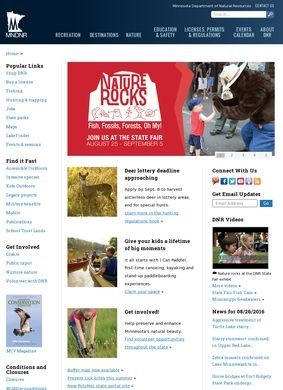
Minnesota residents who hunt, fish, or own land will find themselves on the Minnesota Department of Natural Resources website sooner or later. The site is organized around what people actually come for: doing something outdoors and needing the paperwork, the map, or the rule that goes with it. If you fish a lake near the cabin, hunt deer in November, or want to know whether a stretch of shoreline can be built on, the answer or the form usually lives here.
Licenses and permits for outdoor activities
The licensing system is the part most residents touch first. The Minnesota Department of Natural Resources issues and renews licenses and permits online for hunting, fishing, trapping, watercraft, ATVs, snowmobiles, and off-highway vehicles. Pushing all of that through one electronic system saves the trip to a registrar and keeps a person's records in one place, useful when a license needs renewing the night before a season opens. The agency sets the regulations behind those licenses too, so the rules and the means to comply with them sit on the same site instead of being scattered.
Maps and data tools for planning
Where the site really earns repeat visits is its mapping and data tools. The Minnesota Department of Natural Resources lake finder pulls together water quality readings, fish survey results, and public access points for individual lakes, which is genuinely useful before you decide where to launch a boat. There are land ownership layers and public land locators that tell you who owns what and where you are allowed to walk, hunt, or camp. I have found this kind of public-land mapping to be the difference between a wasted morning and a productive one, and it is the sort of resource a private outfit would charge for. The hydrologic data, dam safety records, and groundwater information serve a more technical audience, builders, well drillers, local officials, but they are open to anyone who needs them.
Division-based content organization
The agency is built out of divisions, and the Minnesota Department of Natural Resources website mirrors that structure in a way that helps you find the right desk. Forestry covers timber sales, wildfire suppression, and forest health monitoring. Fisheries handles stocking, lake and stream surveys, and the licensing tied to them. Wildlife sets hunting regulations, manages habitat, and runs population surveys. Waters takes on groundwater protection, dam safety, hydrologic data, and shoreland management. Each division publishes the practical material that comes out of its work, so the content reflects what these offices actually do rather than a generic summary of a mission.
State parks and trails management
Parks and trails get a section of their own, and it is a deep one. The Minnesota Department of Natural Resources manages 75 state parks and 8 state recreation areas, along with more than 4,000 miles of trails for hiking, biking, snowmobiling, and off-road vehicle use. That breadth is something a visitor planning a weekend will appreciate, because the park pages, trail listings, and seasonal conditions all funnel back to one source. A family looking for a campsite and a snowmobiler checking which trails are groomed are using the same site for very different reasons, and both get what they need.
Conservation programs for private landowners
Beyond recreation, the Minnesota Department of Natural Resources runs voluntary conservation programs aimed at private landowners, including the Reinvest in Minnesota program, the Riparian Conservation Easement program, and the Sustainable Forest Incentive Act. These are the quieter side of the agency's work, where someone who owns woodland or land along a stream can enroll in a program that protects habitat in exchange for incentives. The site is where a landowner learns whether they qualify and how to apply, and that information is not always easy to find elsewhere.
The educational side rounds things out. There are resources on outdoor skills, invasive species identification, and youth programs, the last being particularly relevant in a state where hunting and fishing pass down through families. Invasive species pages do double duty, teaching identification while nudging boaters and anglers toward the habits that keep a problem species out of the next lake. The Minnesota Department of Natural Resources also publishes the Minnesota Conservation Volunteer magazine, a long-running outdoor and natural history publication that gives the agency a voice beyond regulations and forms.
Where should you start your search?
One thing worth keeping in mind is that the Minnesota Department of Natural Resources is a working agency with regional and area offices spread across the state, and not every question is best answered by clicking through pages. Plenty of specific situations, a boundary dispute, an unusual permit, a wildlife conflict, are handled by a particular office or staff person, and the website is partly a directory pointing you toward the right one. Treating the site as the front door rather than the whole building is the realistic way to use it.
As an information resource, the Minnesota Department of Natural Resources covers an unusually wide range without losing depth in the process. The data tools are working utilities, and the regulatory content is authoritative because the agency writing it is the one that enforces it. Government websites rarely attract third-party ratings, and a search turns up nothing useful on that front, which is expected, not a cause for concern. The volume of material can be its own obstacle; a first-time visitor hunting for one specific rule may need to dig, since the same breadth that makes the site valuable also makes it large. That is a fair trade for having the licensing, the maps, the regulations, and the program details under one roof.
For an angler or hunter planning a Minnesota season, this site is the first place to go: buy or renew the license, then open the lake finder for the water you have in mind and check the latest fish survey before loading the truck. Those managing woodland or shoreline should look up the conservation easement and forest incentive programs on the Minnesota Department of Natural Resources site, and if a property's eligibility is unclear, contacting the nearest area office directly is the fastest path forward. Weekend visitors are better served starting from the state parks and trails pages, where conditions and reservations come together. Given how much of outdoor life in Minnesota runs through this one agency, the Minnesota Department of Natural Resources site ends up being a bookmark that gets used.