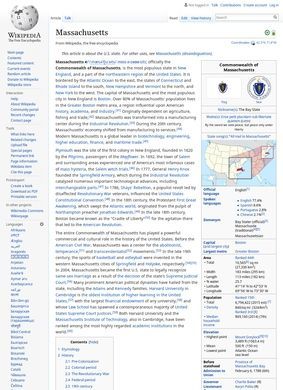
At the very top of Wikipedia: Massachusetts sits an infobox that does a lot of work before a reader scrolls a single line of prose: state population near 7.1 million, a footprint of roughly 10,555 square miles that ranks the state seventh-smallest in the country, and a median household income of $99,900, the highest of any state. Those numbers set the tone for what follows: a reference page that front-loads the data and then explains it. For anyone wanting a fast, accurate picture of the state, that ordering pays off.
History from pre-colonial times to present
What gives Wikipedia: Massachusetts its weight is how far back the history runs and how much of it is genuinely consequential, not filler. The article opens with the Algonquian-speaking peoples present before European arrival, then moves through the Plymouth Colony of 1620 and the Massachusetts Bay Colony of 1630. The Salem witch trials of 1692 get their place. So does the state's part in the origins of the American Revolution, with Lexington and Concord named directly. The thread continues into industrialization and on to modern markers, including the 2004 legalization of same-sex marriage.
A reader can follow the state from pre-colonial settlement to the present without leaving the article, and each turning point links out to its own dedicated entry for anyone who wants to go deeper. That cross-linking is one of the things Wikipedia: Massachusetts does better than a printed encyclopedia could.
Geographic regions and their distinct features
The geography section does something useful: it breaks a small state into parts that actually feel distinct. Coastal plains, Cape Cod, Central Massachusetts, the Connecticut River Valley, and the Berkshires are treated as separate regions, which is closer to how residents talk about the place than a single outline of the state would be. Maps accompany the text, and the links let a reader jump to any of those regions for more detail. Wikipedia: Massachusetts goes deep here precisely because the state's geographic variety is substantial and the article does not flatten it.
Economic shifts across centuries
The economic history is told as a sequence of shifts, not a static snapshot, and that is the right call for a place whose fortunes have changed so completely. It starts with agriculture and fishing, runs through the textile mills that defined the nineteenth century, and lands on the present concentration in biotechnology, financial services, and artificial intelligence. That arc explains a lot about why the income figure in the infobox sits where it does, and Wikipedia: Massachusetts does not leave the two facts disconnected. The page treats the economy as something that happened over time, which is more honest than presenting the current sectors as if they appeared on their own.
Government structure and current leadership
Government gets a similarly factual treatment. Governor Maura Healey and lieutenant governor Kim Driscoll are named, along with the bicameral General Court and the Massachusetts Supreme Judicial Court. This is material that goes stale fastest on any reference page, since officeholders change, and it is worth a reader noting that titles can shift between an election and the moment the page is read. Wikipedia: Massachusetts carries the standard apparatus to keep this current, but no encyclopedia article is immune to the gap between an event and an edit.
Verifying demographics with cited sources
The demographics figures are specific enough to verify against their cited sources, which is the point of citing them at all. Population sits at roughly 7.1 million, sixteenth nationally. English is given as the primary language at 75 percent. The median household income reappears in context. These are the numbers a student, a journalist, or someone considering a move would want, and Wikipedia: Massachusetts presents them plainly with sourcing attached, not asserted and left to stand alone.
The education material is where Wikipedia: Massachusetts makes its boldest claim and mostly backs it. The state is described as ranked first nationally for its public school systems, and the entry points to Harvard University and MIT, both in Cambridge, alongside a broader mention of the state's many other colleges and universities. The page links out to those institutions, so the claim about education does not float free; a reader can follow it to the supporting articles. A ranking like "first nationally" always invites the question of whose methodology produced it, and that is the one place where clicking through to the citation matters more than taking the headline at face value.
Culture rounds the article out with state symbols, the professional sports teams, and the state's long record of progressive social movements. It is a lighter section than the others, which feels proportionate. Wikipedia: Massachusetts does not try to inflate the cultural material to match the depth of the history, and the restraint reads as editorial judgement rather than a gap in coverage.
On structure, Wikipedia: Massachusetts does what the better long articles on the site do: it puts the summary infobox up top, organizes the body into the sections a reader expects, threads citations through the claims, and links generously to related entries. Maps and infoboxes break up the text. The whole thing is free to read with no registration, and it exists in many languages through the project's multilingual network, so a non-English reader is not locked out of the same material.
How Wikipedia maintains and updates the article
The maintenance model is worth being clear-eyed about, because it cuts both ways. Wikipedia: Massachusetts is written and revised by the volunteer editor community under the Wikimedia Foundation. That openness is why the page can stay reasonably current and why its breadth is possible at all, and it is also why a careful reader treats the numbers as starting points and checks the citations behind anything load-bearing. The page surfaces those citations precisely so that checking is possible, which is more than many reference pages bother to do.
Read end to end, Wikipedia: Massachusetts is a strong general reference: deep on history, sensible in how it splits the geography, and unusually concrete on the economic and income figures. For a quick orientation it holds up well, and for a research starting point the dense cross-linking is the main draw. The open question is the same one that hangs over any heavily edited entry on a state with a changing government and a contested education ranking: how current are the officeholder details and the "first nationally" schooling claim at the moment a given reader arrives? The only honest answer is to follow the citations and check the edit history on the most time-sensitive lines.