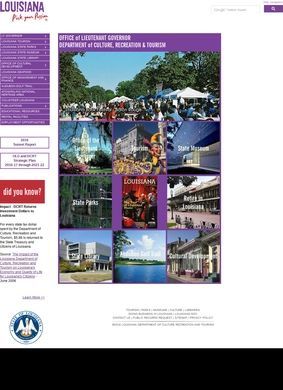
Someone planning a weekend at a Louisiana state park, a nonprofit chasing an arts grant, or a researcher trying to track down an archaeology permit all land in the same place: the Louisiana Department of Culture, Recreation & Tourism, the state agency that gathers these functions under one roof. The site is the public face of an agency run out of the Office of the Lieutenant Governor, and the breadth of what it handles is the first thing that becomes clear once you start clicking through the divisions.
State parks and outdoor recreation
The recreation side is probably the most immediately useful to an ordinary visitor. Louisiana State Parks runs reservations for parks and historic sites, manages outdoor recreation, and oversees the Poverty Point World Heritage Site, which is one of the more significant prehistoric earthwork complexes in North America. Beyond camping and day trips, the parks office also administers recreational trails and hands out outdoor recreation grants, so the same division that books a campsite is also the one a local government might approach about funding a trail project. That dual purpose, serving casual visitors and institutional applicants at once, runs through almost everything the Louisiana Department of Culture, Recreation & Tourism does.
Tourism promotion through ExploreLouisiana
Tourism gets its own division and its own consumer-facing portal at ExploreLouisiana.com, which is where the festival and event promotion lives. The state's welcome centers fall here too, along with marketing grant programs aimed at the businesses and communities that drive travel spending. It is a clean split inside the Louisiana Department of Culture, Recreation & Tourism: the parks office handles the land itself, while the tourism office handles getting people to come see it and spend money while they do.
Cultural programs across multiple offices
The cultural work is where the Louisiana Department of Culture, Recreation & Tourism covers far more ground than the name implies. The Office of Cultural Development covers arts grants, the cultural districts program, historic preservation, and the tax incentives tied to it, plus archaeology permits and CODOFIL, the council that supports French-language programs across the state. That last piece is a genuine reflection of Louisiana's history, and it sits alongside the preservation and archaeology functions in a way that makes the division feel coherent rather than a grab bag. A historic property owner, a French teacher, and an archaeologist would each find their own entry point here.
The State Library of Louisiana adds another layer to the Louisiana Department of Culture, Recreation & Tourism. Books are only part of it; the library also runs research databases and the Talking Books and Braille Library for residents who cannot read standard print. Meeting room rentals round out the practical offerings, so the library functions as a place to work in as much as a place to consult. The Louisiana State Museum operates on a similar logic across its locations in New Orleans, Baton Rouge, and Natchitoches, and it rents out space as an event venue, which keeps the museums functioning as living parts of their cities.
From seafood to heritage areas
What pushes the Louisiana Department of Culture, Recreation & Tourism past a tidy six-division structure is the cluster of programs that do not fit neatly into any one office. Louisiana Seafood promotion is here, which makes sense for a state where the industry is both an economic engine and a cultural marker. Volunteer Louisiana coordinates national service programs, Keep Louisiana Beautiful drives environmental and anti-litter initiatives, and the agency manages the Atchafalaya National Heritage Area, the federally designated stretch of basin country that needs ongoing stewardship. These are the kinds of programs that often get scattered across unrelated agencies in other states, and consolidating them under one department gives the whole operation a wider reach.
The range of people the Louisiana Department of Culture, Recreation & Tourism is built to serve explains why the site has to work this hard. Residents booking parks, tourists planning trips, cultural institutions and nonprofits applying for grants, and businesses seeking permits or marketing support all funnel through the same agency. That is a demanding audience to satisfy from a single site, and the division-based structure is the agency's answer to it. Each office has enough autonomy that a grant applicant skips past the camping rules entirely, and a camper never has to scroll through archaeology permit language.
For anyone trying to understand how Louisiana organizes its public-facing culture and recreation work, this is the authoritative starting point. The Louisiana Department of Culture, Recreation & Tourism connects the World Heritage earthworks at Poverty Point, the French-language council, the seafood board, and the state museums to the same lieutenant governor's office, and the site makes those connections visible. The grant programs and permit processes are the parts a casual visitor will never touch, but they are the reason institutions across the state keep this agency on speed dial. A trail grant, a tax incentive, and a campsite reservation all trace back to the same source.