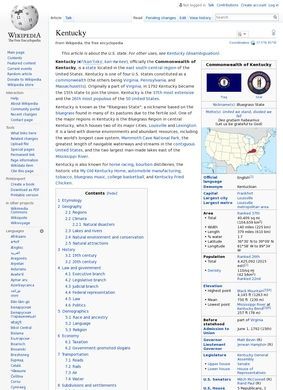
Roughly ninety-five percent of the world's bourbon comes from one state, and Wikipedia: Kentucky lays that fact out alongside the geology and economics behind it, which is a fair measure of what this page is built to do. It is a single reference article covering the U.S. state of Kentucky, with sections that move from the cave systems of the south to the Toyota and Ford plants that anchor a chunk of the modern economy. The whole thing is free, sourced, and organized so a reader can jump to whatever part they came for without wading through everything else first.
Beyond bourbon and the Derby
What comes through in Wikipedia: Kentucky is how it treats the obvious tourist shorthand, the Derby, the bourbon, the fried chicken, as one slice of a much larger picture. Yes, Churchill Downs and the Kentucky Derby get their place, and so does the origin of Kentucky Fried Chicken. But those sit next to a serious accounting of coal mining, the Thoroughbred breeding industry concentrated in the Bluegrass region, tobacco, and a healthcare and medical sector that rarely makes the postcards. A reader who arrives expecting only horses and whiskey leaves with a working sense of how the state earns its living.
Five regions and Mammoth Cave
The geography section is concrete in a way that helps. Kentucky is landlocked, home to about 4.6 million people, and split into five distinct geographic regions, and Wikipedia: Kentucky explains those divisions instead of just naming them. Mammoth Cave National Park appears here as the longest known cave system in the world, the Ohio and Mississippi rivers get their due as the borders and arteries they are, and the fact that seven states press up against Kentucky tells you a lot about why its culture sits where the South, the Midwest, and Appalachia overlap. The page gives you the physical stage before the human story.
Timeline from statehood to today
The history coverage is where Wikipedia: Kentucky goes deepest. The timeline starts with Native American settlement around 9500 BCE and moves through European exploration, statehood in 1792 as the fifteenth state, the divided loyalties of the Civil War era, and the industrial shifts of the twentieth century. There are specifics rather than vague gestures: the 1900 assassination of Governor William Goebel, for instance, is the sort of detail that anchors a section and gives a curious reader a thread to pull on. A general encyclopedia entry can easily flatten centuries into a paragraph of dates, and this one resists that impulse.
Local government structure
Government and administration get similar care. Kentucky's 120 counties are an unusually high number for a state its size, and Wikipedia: Kentucky notes the consolidated city-county arrangements that run Louisville (Louisville Metro) and Lexington (the Lexington-Fayette Urban County Government), with Frankfort as the capital. For anyone trying to understand why Kentucky's local politics looks the way it does, that structural detail is more useful than a list of officeholders. The demographics section backs it up with population figures, urban and rural splits, racial composition, and migration patterns, which is the raw material you need to think carefully about a place, beyond just naming it.
Bluegrass music and college basketball
The cultural material reads as informed and not promotional. Bluegrass music is given its roots, the basketball rivalry between the University of Kentucky and the University of Louisville is treated as the genuine cultural force it is in the state, and the Derby is placed at Churchill Downs in Louisville with enough context to make sense of why it matters beyond a single afternoon in May. Education and infrastructure round things out with an overview of the public university system and the road and transit networks, the unglamorous parts that a thorough reference article should still cover.
Checking the sources behind the facts
This is where Wikipedia: Kentucky justifies being treated as a starting point for real work. The article carries citations to academic, governmental, and journalistic sources, and the external links and references section is built to send you onward. If you read something here that you need to use, you can trace it to where it came from, and that is the difference between a fact you can cite and a fact you merely encountered. Footnoting matters more for a state article than people tend to assume, because so much of the data, population counts, economic figures, county-level structure, changes over time and needs a date and a source attached to it.
Weighing depth against breadth
The breadth is a genuine strength, though it brings the usual trade-off. Wikipedia: Kentucky covers geology, four centuries of history, a multi-sector economy, demographics, and culture in one place, so it cannot match the depth of a book devoted to any one of those subjects. The economy section will tell you bourbon production dominates and that auto manufacturing and coal are major players, but a researcher who needs the financials of the Thoroughbred industry will use this page to find the next source, not to end the search. Wikipedia: Kentucky is honest about that role by structuring itself around references that point past its own edges.
Keeping an even-handed tone
It is worth noting that the writing stays even-handed across topics that could easily tilt. Coal mining and its economic weight are presented plainly, the bourbon industry's near-monopoly on world supply is stated as a figure rather than a boast, and the cultural touchstones are described without the breathless tone a tourism board would use. For a subject that carries a lot of romance, the restraint is welcome. Wikipedia: Kentucky also fits naturally into a broader information workflow: if you found this listing through a business directory search, the article is exactly the kind of stable, citable reference that justifies a click.
How to use this page
If you are a student starting a paper, a journalist who needs the lay of the land before a Kentucky assignment, or a curious reader who wants more than the Derby-and-bourbon cliche, Wikipedia: Kentucky is a sound first stop. Begin with the section that matches your question, read the claims that interest you, and follow the inline citations out to the academic and government sources for anything you intend to rely on. The article is the map; its references are the roads. Plenty of state pages promise comprehensiveness and deliver a two-paragraph overview of the obvious landmarks. Wikipedia: Kentucky delivers both the broad picture and the means to go further, and it remains useful the third or fourth time you come back to it with a different question.