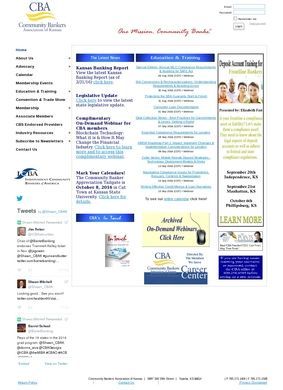
Advocacy sits at the dead centre of the Community Bankers Association of Kansas. It lobbies state and federal lawmakers on behalf of the state's community banks and runs its own political action committee to bankroll that work, which tells you the group is built first as a pressure organisation and only second as everything else it does. That ordering is worth keeping in mind, because it explains why the strongest parts of the membership are the ones a bank benefits from without lifting a finger.
The membership is the community banks of Kansas themselves, in small rural towns and in cities alike. The Community Bankers Association of Kansas has represented that constituency for decades, and its reason to exist is plain enough: a single community bank, especially a small one, has almost no voice in a state capitol or in Washington on its own. Pooled together, member banks get one. That pooling is the actual product, and everything else the Community Bankers Association of Kansas offers hangs off it.
What the association delivers to a member falls into a few clear buckets, and each is worth taking on its own terms, because the Community Bankers Association of Kansas bundles them into one membership and asks a bank to value the whole.
What membership brings a Kansas community bank
The offering runs wider than lobbying. The Community Bankers Association of Kansas wraps advocacy, training, peer support, and networking into one membership, so a bank weighing the annual dues is really weighing all of it at once.
Some of it is unique to the group. Some, like the webinar library, arrives through national partnerships the association has plugged into, which is how a state body keeps a catalogue this size without building every piece itself. A member is really buying access to a network and a back office it could never staff on its own.
Advocacy and its political action committee
The political work is the anchor. Grassroots lobbying puts member bankers directly in front of legislators on the issues that hit community banks hardest, and the CB PAC gives the Community Bankers Association of Kansas a fundraising vehicle to back candidates who understand the sector.
For a rural bank that will never hire its own lobbyist, membership in the Community Bankers Association of Kansas is the single most concrete thing the dues buy. It works at both the state and the federal level: the rules that squeeze a small bank come from Topeka and Washington both, and much bank regulation is written with large institutions in mind and then dropped whole onto small ones.
The catch, inherent to any political action committee, is that a member has to trust the association's political judgement to line up with its own; a bank whose priorities diverge from the leadership's gets less out of this arm than a bank that marches in step. Even so, for the sheer weight it brings to a legislative fight that a single rural bank could never wage alone, the advocacy work is the clearest thing the dues buy, and it pays off whether or not the bank ever logs in to anything else.
Education, webinars, and certification
Training is the deepest part of the catalogue. Through a partnership with the Community Bankers Webinar Network, the Community Bankers Association of Kansas offers more than 200 live and on-demand webinars, a serious library for a bank that cannot spare staff for travel to distant conferences. The live sessions let a compliance officer ask a question in real time; the on-demand archive means the same training is there before the branch opens.
A CBC Compliance Program tackles the regulatory load that falls heaviest on small institutions with no dedicated compliance department, and ICBA certification and professional development tracks give individual bankers a route to formal, portable credentials. That last point carries further than it looks: a young banker who earns an ICBA credential through the Community Bankers Association of Kansas takes it to the next job, so the training benefits the person as much as the institution paying for it.
For a two-officer bank in a small town, on-demand courses that staff can take at their own desks are arguably worth the membership by themselves. The Community Bankers Association of Kansas leans hard on this partnership model, which keeps the catalogue large, though sheer volume always raises a fair question about depth that is worth holding until the end.
Convention, directories, and the member compass
The association also runs the connective tissue of the sector. An annual convention and trade show, run by the Community Bankers Association of Kansas, puts members in one room once a year, where the hallway conversations and the vendor floor often matter as much as the sessions. Member and associate-member directories let banks find each other and find the vendors who serve them, and a networking platform the group calls member compass stretches that contact beyond the convention into something a banker can use the whole year.
Endorsed partner services add pre-vetted suppliers to the mix, so a bank shopping for a core system or an insurance product gets a shortlist the association has already screened instead of starting cold. None of this is glamorous work. For an isolated rural bank, though, a good directory and a live peer platform can be the difference between guessing at a vendor and calling someone across the state who has already run it for three years.
For a bank owner in a town of a few thousand, that grounded, been-there answer is worth more than any polished sales pitch, and the convention and directories exist mainly to make it findable.
Bankers Helping Bankers and the publications
Two more pieces round out the membership. A peer-support initiative the Community Bankers Association of Kansas brands Bankers Helping Bankers connects members so a banker facing a problem can reach someone who has already solved it, the informal counterpart to all the formal training. The association also publishes: the CBA Regulatory Dispatch keeps members current on the steady churn of rule changes, and In Touch Magazine carries the group's general voice and member news, while Community Banking Month initiatives push the sector out in front of the public once a year.
These are the quiet benefits, the ones a member uses almost without noticing, and they are where the Community Bankers Association of Kansas earns its keep across the long stretches between the big advocacy fights. A bank that reads the Regulatory Dispatch closely gets a running translation of what regulators are doing to it, which for a small shop with no in-house policy analyst is a real substitute for one.
None of these carry the drama of a lobbying win, but they are the daily texture of belonging to the group, and they are probably what keeps most members renewing year after year.
Whether all of this reaches the banks that need it most is the open question. The Community Bankers Association of Kansas casts itself as the champion of small rural banks and large urban ones at the same time, yet those two groups do not have the same capacity to use what is on the table.
A city bank can send someone to the convention, work the directories, and mine 200 webinars at leisure. A two-person rural branch already staring down a compliance deadline may struggle to draw on much of it beyond the advocacy it receives passively, whether it engages or not. The heaviest users of the Community Bankers Association of Kansas are, in all likelihood, the members who need it least.
The webinar library, the convention, the directories, all of it rewards a bank with the staff and the slack to use it, and the smallest members have neither in abundance. Nothing on offer settles whether the smallest banks, the ones the Community Bankers Association of Kansas most loudly claims to defend, get their money's worth out of everything past the lobbying, and that gap between the promise and the practical reach is the doubt a prospective member is left holding.