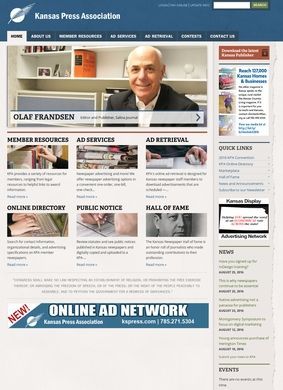
An executor in a small Kansas county has a legal notice to run, a probate that will not close until word of it appears in a newspaper the law recognizes, and the nearest paper is a weekly that prints on Thursdays. That errand, dull and mandatory, is one of the reasons the Kansas Press Association exists. The organization runs a statewide public-notice portal that pulls those legally required notices into one searchable place, turning a scattered obligation into a single point of reference.
The public notice is the unglamorous engine of a lot of what this body does.
The Kansas Press Association is the state trade group for newspapers, and by its own account it has been serving them for a hundred and fifty years. Underneath the sections and logins, the site is the shared back office of an entire industry in one state.
A hundred and fifty years is a long institutional memory, and it lands differently for a newspaper trade group than for most businesses, because the industry it represents has spent the past two decades shrinking. An association that predates the automobile and still runs the plumbing for its members has outlasted a good many of the papers it started with.
What it does for Kansas newspapers
Most of the site is built for members, meaning the papers themselves. The Kansas Press Association pools functions that a single small-town weekly could never run alone: coordinated advertising, awards, a directory, and a member portal that gates the working tools behind a login.
Two of those functions sit behind the Become a Member and Member Portal tabs. The portal is a login wall, so the day-to-day tools stay invisible to a casual visitor, which is normal for a trade body but does mean the public sees only the lobby, not the offices.
The logic is old and sound. One paper in Osborne or Garden City has little sway on its own; two hundred acting together have a great deal. The Kansas Press Association is the mechanism that lets them act together.
For a working newspaper, the value here is less any single tool than the fact that all of it lives in one place. A publisher can enter a contest, buy into a statewide ad campaign, publish a public notice, renew membership, and read the trade's own news without leaving the site. That consolidation is the quiet argument for a state press association in the first place, and it is why a paper down to two staff still keeps paying dues.
Advertising and public notices in one place
The commercial heart of the operation is ad placement. An advertiser who wants to reach the whole state does not want to phone every paper in it, and the Kansas Press Association runs a marketplace and ad-retrieval tools that let a campaign be bought across many titles at once. The ad-retrieval side is the delivery mechanism, moving finished ad files to the papers that will print them. For the papers, that is revenue they could not chase individually; for the buyer, it is one invoice instead of dozens.
The public-notice portal sits next to it and does the civic version of the same trick. Government bodies, lawyers, and executors are required by law to publish certain notices, and the portal collects them where a citizen can search rather than hunting through back pages. It is a genuine public utility hiding inside a trade association's website.
There is a live argument nationally over whether such notices belong in newspapers at all, since governments would often prefer to post them on their own sites for free. Keeping the notices with the papers keeps a check outside the government's own control, and it keeps a revenue stream flowing to the papers, so the portal is doing civic and commercial work at once.
Awards, the Hall of Fame, and the convention
Recognition is the other big member-facing function. The Kansas Press Association runs Best Of competitions, a Hall of Fame, and an annual contest tied to its convention, the sort of programs that give working journalists something to compete for and a reason to gather once a year.
These awards are easy to be cynical about from outside, a trade handing itself trophies. Inside a shrinking industry they do real work, marking standards, giving small papers a benchmark, and putting a night on the calendar when the people who do this job are in one room. The convention doubles as the training and networking that a lone rural publisher rarely gets otherwise.
The annual contest gives the convention its spine. Papers enter their best work, judges rank it, and the Best Of and Hall of Fame results hand out reputation in a business where reputation is most of the currency. For a young reporter at a county weekly, a state award is a line that travels.
The parts open to everyone else
A trade association is usually a closed shop, but the Kansas Press Association leaves several doors open to the public. The newsfeed carries actual news items, some of them local Lawrence-area stories, so the front of the site behaves a little like a paper in its own right. It is a modest feature, and it will not replace a reader's own local paper, but it gives the homepage a pulse instead of a directory's stillness.
The online directory is useful to outsiders too. Anyone trying to find a specific Kansas paper and its coverage area can locate it through the Kansas Press Association listing without knowing where to look first. For researchers, PR people, and job seekers, that directory is the single most practical thing on the site.
First Amendment advocacy and the Kansas Publisher
Advocacy is where the Kansas Press Association reaches past its membership into public life. The site quotes the First Amendment outright and runs a blog devoted to it, which for a press group is the mission stated plainly: open records and open meetings, the legal ground journalism stands on.
That advocacy is the part with the widest relevance. Kansas, like every state, has open-records and open-meetings laws that only work when someone is willing to fight for them, and a statewide press body is the natural party to carry that fight when a single paper cannot afford to. When a government tries to close a record or a meeting, a coordinated group is often the only organized voice pushing back.
There is also a publication, the Kansas Publisher, produced by the Kansas Press Association, along with the group's own reporting on the trade. For someone inside Kansas journalism, that is industry news at home; for an outsider, it is a window into how the state's newspaper business talks to itself.
The honest limit is audience. Almost everything the Kansas Press Association does is aimed at a few hundred newspapers and the people who need to place a notice or an ad with them. A general reader wandering in will find a competent, utilitarian hub and little to linger over, since the working parts live behind a member login.
Judged as what it is, the site does its job. A Kansas publisher gets a working office in miniature, and someone chasing a public notice gets the one portal built to hold it. Beyond that narrower audience, the site is a well-kept industry portal, doing exactly what a trade group's site should do, and not much more.