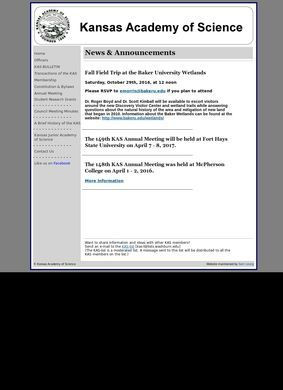
Members of the Kansas Academy of Science can send their own photographs of science across Kansas into an "Everyday Science" section printed in the association's journal, a small human touch tucked inside an otherwise formal scholarly operation. It is a fitting way into what the group is: a working professional body for people who study the state's natural world, with room for the ordinary snapshot alongside the peer-reviewed paper.
The Kansas Academy of Science is an official scientific association devoted to advancing science across Kansas. Its members are professional scientists, educators, and students, and the site is built to serve all three at once rather than to court a general audience. Membership in the Kansas Academy of Science spans career researchers and schoolchildren alike, which shapes almost everything the organisation puts out.
Publishing and the annual meeting
The centrepiece of the calendar is the Annual Meeting, a gathering that has run long enough to reach its 158th edition. That number alone says the Kansas Academy of Science has kept this tradition alive across generations of Kansas scientists. A meeting with that much continuity is where members present work, compare findings, argue over method, and keep the association's community intact from one year to the next.
An annual meeting that has survived that long does more than fill a weekend. It is the fixed point a scattered membership organises around, the reason a botanist in the west of the state and a fisheries biologist in the east end up in the same room once a year. For a graduate student, presenting at the Kansas Academy of Science meeting is often a first taste of standing up in front of working professionals, and that early exposure is worth as much as the feedback itself.
The Transactions journal
Publishing is the other half of the mission. The association publishes a peer-reviewed journal, the Transactions of the Kansas Academy of Science, known as TKAS. This is the formal record of research tied to the state, the place where members set findings down on paper and where the scholarly authority of the organisation actually sits. For a professional scientist or a graduate student, a journal like TKAS is often the reason to belong. It gives Kansas-focused research a dedicated home instead of scattering regional work across national titles where it can sink out of sight.
Regional science journals do quiet, necessary work that the big national titles skip. A study of a Kansas prairie stream or a local insect population may never make a headline journal, yet it is exactly the sort of record that gets pulled out decades later when someone needs a baseline. Publishing it under the Transactions of the Kansas Academy of Science banner keeps that knowledge findable and tied to the place it describes, which is a real service to the state's science.
The Everyday Science feature and the KAS Bulletin
Inside that journal sits the "Everyday Science" feature, open to members submitting science-related photographs taken around Kansas. It loosens an otherwise rigorous publication, letting a member contribute an image without writing a full paper, which is a genuinely welcoming move for students and amateurs finding their feet. A photo of a local bird, a rock formation, or a prairie in bloom becomes a small published contribution, and that low bar to taking part is a smart way to keep newer members involved between the bigger commitments of a full study or a conference talk.
Alongside the journal, the Kansas Academy of Science issues the KAS Bulletin, a members' newsletter carrying the day-to-day news a formal journal never would. Between the two, a member gets both the archival record and the running update, covering the full span of what a working association needs to circulate.
Funding and younger scientists
Money is where the Kansas Academy of Science moves from talk to support. The association runs a grants programme aimed squarely at the people who most need backing early in a career, when a few hundred dollars can decide whether a project happens at all.
Student and educator grants
Two funding streams stand out: student research grants and K-12 educator grants. The first puts money behind young researchers whose projects might otherwise stall for want of it. The second reaches into schools, backing the teachers who introduce science to children long before any of them reach a university lab.
That second stream is the more unusual choice. Plenty of scholarly societies fund research, but fewer put resources directly into K-12 classrooms, and the Kansas Academy of Science treating educators as part of its own constituency says something about how broadly it reads its mission.
The academy's junior division
For younger participants there is a whole division of its own, the Kansas Junior Academy of Science. This Junior Division brings students in as scientists in their own right, giving the association a pipeline that runs from schoolchildren up through working professionals. A body that maintains a junior wing is plainly planning past its current membership, growing the next generation of Kansas scientists instead of only serving the present one.
Set beside the grants, the Junior Academy shows an organisation spending real effort on the front end of a scientific life, where a bit of encouragement and a small amount of funding often decide whether a student carries on.
That range of membership is the thing to hold onto. The Kansas Academy of Science counts professional scientists, educators, and students among its ranks, and the offerings map cleanly onto each group: the journal and the meeting for the researchers, the classroom grants for the teachers, and the Junior Academy for the students. Few associations manage to serve a tenured biologist and a high-school science fair entrant from the same organisation without one group feeling like an afterthought, and the way this one splits its programmes suggests it takes all three seriously.
The site keeps its housekeeping visible too. The Kansas Academy of Science maintains Council Meeting Minutes and a historical archive of the association's past activity, so the record of how it governs itself and what it has done stays open to any member who cares to look. That archive is where the long run of the Annual Meeting and the journal is documented edition by edition, sitting beside the minutes of the council that steers the whole association from one year to the next.