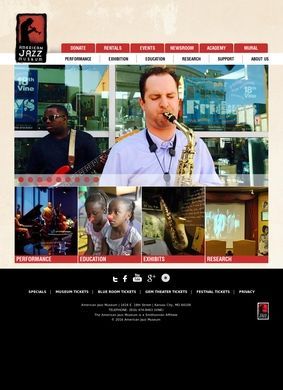
A jukebox of jazz classics sits somewhere on the premises, and it tells you something about how the place thinks. At the American Jazz Museum on 1616 E 18th St, exhibits do not hang names on a wall. They give you Louis Armstrong, Ella Fitzgerald, John Coltrane, Duke Ellington, and Charlie Parker through memorabilia, interactive components, and multimedia you can sit with, and that combination of artifact and sound is what makes the visit stick. The museum occupies the Historic 18th and Vine Jazz District in Kansas City, Missouri, which is part of the point: this is jazz documented on the ground where a good deal of it was made.
Live performances and educational programs
Founded in 1997, it describes itself as the nation's leading institution dedicated to expanding the influence, awareness, and appreciation of American jazz. That is a large claim, and the website backs it with more than a static collection. Permanent and rotating exhibits give returning visitors a reason to come back. The programming runs well past the gallery doors, with the "Jammin' at the Gem" subscription series putting live performances in the historic Gem Theater and a calendar of one-off benefit concerts alongside it. The institution functions as a working music venue and an archive at once.
Kansas City Jazz Academy instruction
The education side is where the operation shows its seriousness. The Kansas City Jazz Academy, run under the American Jazz Museum banner, teaches middle and high school students, including a five-day summer intensive. That kind of youth instruction is the unglamorous work that keeps a tradition from becoming a museum piece in the bad sense. A coloring page for a child and a master class for a teenager belong to the same mission, and the site treats neither as decoration for the other. Pairing a working academy with a gallery is a harder model to run than either one alone, and the website presents both as ongoing commitments rather than seasonal add-ons.
Digital resources for remote access
For people who cannot travel to Kansas City, the digital shelf is fuller than expected from a regional museum. There is a virtual Google Tour, a digital exhibit, curated Spotify playlists, and printable coloring pages and activity sheets. None of that replaces standing in front of Charlie Parker's saxophone, but it gives a teacher in another state something concrete to use and gives a casual fan a way in before making the drive. Multilingual access across English, Spanish, Dutch, Arabic, and German is a genuinely unusual touch for an institution this size. It points to an audience the American Jazz Museum is trying to reach beyond its own metro area, and the breadth of those five languages reads as a deliberate choice, not a translation afterthought.
Visiting information and venue services
On practical matters, the American Jazz Museum handles the basics of a destination. A "Plan Your Visit" section covers hours, admission, and directions. The street address is plainly in the footer, and there are routes for venue rentals, group visits, membership, volunteering, and a gift shop. One gap worth noting: no direct phone number or general email is easy to spot on the homepage, and volunteer inquiries get pushed through email only. For a place that wants tour buses and out-of-town visitors, a phone number visible in under two seconds would remove a small friction point.
Visitor reviews across multiple platforms
The outside record is solid without being overwhelming. Tripadvisor carries north of 78 reviews and has given the museum a Travelers' Choice award, placing it in the top tier of rated properties. Yelp shows a similar 78 reviews alongside 188 photos, and that volume of visitor-shot images is its own quiet endorsement. People who leave bored rarely bother uploading pictures.
Expert ratings from travel guides
The expert tier is where it gets more interesting. A TripExpert score of 81 out of 100 pulls from Where, Fodor's, the Michelin Guide, and Lonely Planet, which is a respectable set of sources to have noticed a museum that does not sit in New York or Chicago. Employee reviews on Glassdoor and donor and volunteer feedback on GreatNonprofits round out the picture. For a nonprofit, that last category speaks to whether the institution treats the people keeping it running with any care, and favorable feedback there tends to reflect genuine organizational health rather than polished public relations. It is the sort of evidence a casual tourist never checks but a prospective member or donor should.
Assessing the museum's national reach
Taken together, this is a museum doing real work with receipts to show for it: living performance, youth education, a deep digital offering, and a location that means something. The sticking point is scale. The American Jazz Museum calls itself the nation's leading jazz institution, and the visitor numbers, while warm, read more like a well-regarded regional destination than a national flagship. Whether the American Jazz Museum can sustain that claim, or whether the gap between the mission statement and the actual footfall eventually forces a harder conversation about funding and reach, is not a question the website answers.