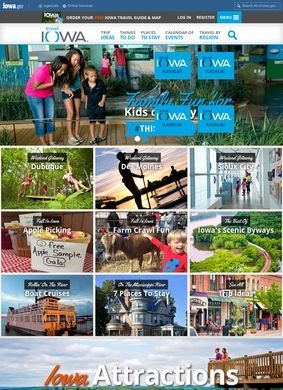
Iowa's official tourism website, run by the Iowa Tourism Office, Travel Iowa is built around three plain ideas: what there is to do, where to go, and how to organize the trip once you have a few destinations in mind. That structure is obvious within seconds of landing on the homepage, and it holds together as you click deeper.
Activities and regional destinations
The Things To Do section is the part most visitors will spend their time in, and it is broad without feeling padded. It covers agritourism, arts and entertainment, biking and trails, breweries, wineries and distilleries, family activities, history and culture, outdoor adventure, restaurants, scenic road trips, and shopping. There is a full event calendar attached, and whether a calendar is current or stale goes a long way toward deciding whether a tourism site is genuinely useful or just a glossy front door. A kept-current calendar turns the whole thing into a tool you check before a weekend; a neglected one quietly tells you the office stopped paying attention. From what the site presents, the calendar is a central maintained feature, which is exactly what you need from a state agency whose job includes keeping this information accurate year round.
Places To Go takes a different cut at the same state. Instead of sorting by activity, it splits Iowa into five regional travel areas: Capital Country, Driftless Area, Lakes and Land, Loess Hills and Beyond, and Storied and Scenic. I find this regional framing more honest than a flat list of cities, because it nudges someone toward the corner of the state that fits the kind of trip they actually want, whether that is river bluffs in the northeast or the lakes in the north. Each region becomes a container you can browse, which is sensible for a place where the draws are spread out and a visitor may not know the geography at all.
Planning tools for trip building
The planning side includes a road trip builder, a Passport discovery and stamp program, free downloadable travel guides, a newsletter, and a travel deals area. A road trip builder is a real commitment: it has to let you assemble stops into something coherent, and if it works well it is the single most valuable thing on the site. The Passport program is the more interesting bet. Stamp and reward schemes exist to get people physically into towns and attractions they would otherwise skip, and they tend to reward repeat visits over the course of a season, which is exactly what a state tourism office wants to encourage.
The downloadable guides and the newsletter are the quieter end of the same effort. Guides give a traveler something to read offline or print before a drive through areas where signal is patchy, and a newsletter is how the office keeps in touch with people who liked one trip and might take another. None of this is flashy, and that is fine. A tourism portal earns trust by being practical, and the tooling here reads as practical rather than ornamental. The open question is durability: a trip builder and a stamp program are only as good as the upkeep behind them, and a site can present an impressive feature that has quietly fallen out of date. The structure is there; whether every piece is actively maintained is something a visitor can only judge by using it.
Operator submissions feed the directory
Travel Iowa also opens a door to the supply side. It accepts event and business listing submissions from operators through what amounts to a lightweight business directory function, which means the calendar and the activity sections are partly fed by the businesses themselves. That is a smart way to keep coverage wide, though it carries the usual trade-off: a portal that leans on operator submissions has to police quality and freshness, or the listings drift toward whoever bothered to fill in the form. For a leisure traveler this is mostly invisible, but it is worth knowing that some of what you see is self-reported.
Accessibility information and itineraries
Two further touches deserve a mention. Travel Iowa publishes accessibility information, which a lot of tourism sites skip entirely and which genuinely changes whether a trip is feasible for some travelers. It also runs trip idea galleries, ready-made itineraries for people who want the planning done for them. Between the build-your-own road trip tool and the pre-built galleries, Travel Iowa covers both the traveler who wants control and the one who just wants a good weekend handed over, without forcing either down the other's path.
No consumer reviews for government portals
On outside reputation, a search for Travel Iowa turns up no meaningful third-party review count on consumer platforms, which is unremarkable for a government tourism portal. Visitors use it to plan trips, not rate it; the feedback loop runs through the office rather than public review threads.
Taken as a whole, this is what an official state tourism portal should be: a single hub that organizes a sprawling subject into activities, regions, and tools, and then gives operators a way to keep feeding it. The category coverage is wide, the regional model is a thoughtful way to handle a state most visitors do not know well, and the planning features go past the decorative. Travel Iowa is the central digital point for Iowa's tourism promotion, and the ambition of the road trip builder and the Passport program is the right ambition for the office to have.
Maintenance determines long-term value
What keeps the assessment honest is the gap between a site that is well structured and a site that is well tended. The architecture of Travel Iowa is hard to fault. But a stamp program with stale partners, a calendar trailing a season behind, a guide that still lists a closed attraction: any of those would erode the whole thing while the homepage still looked sharp. The published offering makes the right promises. Whether Travel Iowa keeps them is something the office earns through maintenance, not through a well-designed launch.