Iowa City carries a UNESCO City of Literature designation, the first ever granted to an American city, and the reason is tucked into the article you reach at this listing: the University of Iowa's Writers' Workshop, which has shaped American fiction for generations. That single fact tells you a lot about what the Wikipedia - Iowa entry does well. It does not stop at corn and county lines. It treats a state most outsiders file under "flyover" as a place with a literary life, a fair tradition going back to 1854, and a long bicycle ride across the whole width of it called RAGBRAI.
Geography and terrain
The backbone of the page is the kind of reference material people come looking for and rarely find gathered cleanly in one spot. Iowa covers 56,273 square miles, ranking 26th among the states, bounded on the east by the Mississippi River and on the west by the Missouri. The terrain gets its own attention, including the loess hills and the Driftless Area in the northeast, a pocket of land the glaciers missed. None of this reads as padding. It is the sort of geographic grounding that makes the rest of the article easier to place.
Population and ancestry
Demographic detail is where the Wikipedia - Iowa entry shows its appetite for precision. The 2020 population of 3.19 million puts Iowa 32nd nationally, and the page breaks the makeup down further: 82.7 percent non-Hispanic white, 6.8 percent Hispanic, 4.1 percent African American. Ancestry gets its own figures too, with German at 35.1 percent, Irish at 13.5, and English at 8.2. Numbers like these are easy to find badly reported elsewhere, so seeing them laid out with their proportions intact is useful to anyone writing a paper, settling an argument, or just curious.
From statehood to the Civil War
History runs as a clear timeline. The land passed through French Louisiana and a Spanish territorial period before the 1803 Louisiana Purchase, and statehood arrived on December 28, 1846, making Iowa the 29th state. The Civil War section notes that more than 75,000 Iowans volunteered, a figure that lands harder when you remember how thin the population was at the time. The article keeps its dates and its claims close together, which is what you want from a reference rather than a narrative.
Economy beyond agriculture
On the economy, the page resists the lazy shorthand that Iowa is only farmland. It traces the shift from a purely agricultural base to a mixed economy taking in manufacturing, biotechnology, and finance and insurance, while being honest that corn and soybean production still lead the country. The government section is similarly compact and useful: Des Moines as capital and largest city, 99 counties, Governor Kim Reynolds, four U.S. House seats, and the standard two Senate seats. A reader can answer most basic civics questions about the state without leaving the page.
How links connect Iowa to broader topics
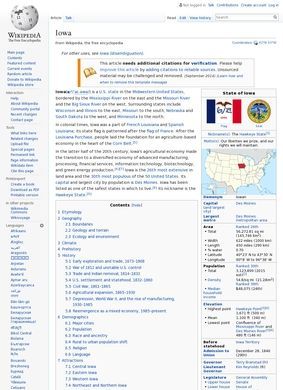
What gives the Wikipedia - Iowa article its real value is the way it is wired into everything around it. Hyperlinked citations sit beside the claims they support, infoboxes pull the headline figures to the top, and embedded maps put the borders and rivers in view. From almost any sentence you can jump to a deeper article, whether that is the Louisiana Purchase, a single county, or the Writers' Workshop itself. The Wikipedia - Iowa page works as a hub as much as a destination, and that is the difference between a static fact sheet and a reference you can follow somewhere.
Culture and tourism without hype
The culture and tourism material rounds it out without tipping into a travel brochure. The Iowa State Fair, the Amana Colonies, RAGBRAI, and the literary scene in Iowa City all get coverage, described plainly enough that you can decide for yourself whether any of it is worth a trip. Because this is a collaboratively edited reference, the usual caveat applies: it is a strong starting point and a map to primary sources, not the final word, and the cited footnotes are there precisely so you can check the heavier claims yourself.
Where the overview ends
One honest limit is worth naming. An article this broad can only go so deep on any one thread, so a reader chasing the specifics of Iowa's caucus system or the detail of its biotech corridor will need to follow the links outward. That is by design, and the Wikipedia - Iowa entry is candid about being the overview layer in a larger structure. It does the overview job about as well as the format allows.
Starting your research here
The Wikipedia - Iowa article is a solid first stop when the goal is orientation rather than depth. Read the lead and the infobox for the shape of things, then follow the citations outward to whichever thread you care about, whether that is the 1846 statehood record, the caucus history, or the University of Iowa's literary programs. The page will not answer every question, but it points clearly to where those answers live.