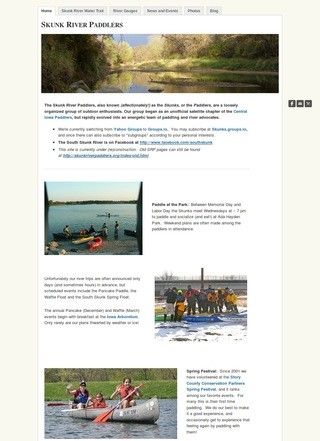
Skunk River Paddlers lobbied for and installed an ADA-compliant canoe and kayak launch dock at Ada Hayden Heritage Park. That single fact does more for the club's credibility than any About page could, because it describes physical work done on behalf of the public, not a meeting held or a mission statement voted on. Skunk River Paddlers serves canoeists and kayakers in and around Ames and Story County, Iowa, and the club's website is mainly a connection point between that local crowd and the South Skunk River Water Trail.
Website structure and river gauge data
The site is plain and easy to follow: News and Events, About SRP, River Gauges, Iowa Paddling Resources, Photos, a Blog. The river gauge data is what I found genuinely useful. Water level decides whether a stretch is worth running on any given weekend, and having it on the same page as the trail information saves the usual hunt across government hydrology sites. The Iowa Paddling Resources section and the FAQs are there for people newer to the sport or new to the area who want to know where they can put in safely.
Club activities throughout the year
Programming is where the club feels alive. Paddle at the Park runs as informal Wednesday evening meetups at Ada Hayden Heritage Park from May through September, low-commitment enough that you can show up, get on the water, and meet people without committing to anything formal. When the kayaks get put away, Skunk River Paddlers points members toward Winter Hikes on Sundays and Thursdays through partner organizations, so activity does not simply stop with the cold. The club also co-sponsors the Great Ames Adventure Race, held the first Sunday after Labor Day each year. A weekly drop-in, a handful of off-season hikes, and one bigger annual event is a sensible spread for a volunteer group whose membership ebbs and flows with Iowa seasons.
Stewardship work recognized by county conservation
Story County Conservation names Skunk River Paddlers as a primary volunteer group that maintains the South Skunk River Water Trail and organizes river clean-up workdays. A county conservation body vouching for the club's stewardship is more meaningful than any self-description, because government agencies do not casually lend their name to groups that do not show up. Skunk River Paddlers is the kind of organization that handles the unglamorous part of keeping a river paddleable, and that work stays invisible until it stops happening.
Contact methods and response timing
The only way to reach Skunk River Paddlers through the site is a Gmail address, skunkriverpaddlers@gmail.com. No phone number, no mailing address. For a volunteer club this is not unusual. Nobody staffs a phone line for a group that meets on Wednesday evenings in summer, and a personal email run by whichever member handles correspondence is how most small organizations like this actually work.
Reaching the club before an outing
Where it gets tricky is the time-sensitive nature of what Skunk River Paddlers offers. Showing up at the right place at the right time is most of the value, whether that is a meetup at a particular park, a race on a specific Sunday, or a clean-up workday. Someone with a quick logistical question the night before an outing, where exactly to park, whether the event is still on after heavy rain, has one channel with no published response window. The county-conservation relationship implies there are other ways to reach the people involved, but the site itself does not surface them.
How reputation appears online
On reputation there is little to weigh, and it would be dishonest to pretend otherwise. No consumer review platforms turn up ratings or counts for Skunk River Paddlers: no Google reviews, no Yelp, no Facebook star ratings. What does turn up are references in county government and conservation contexts, which is arguably the more meaningful kind of mention for a stewardship-focused club.
A paddling group that maintains a public water trail is not the type of entity that accumulates star ratings the way a restaurant or a contractor would, so the absence of that data says little about whether Skunk River Paddlers does good work. It just means the usual scorecard does not apply here. If you found this listing through a business directory, that context is worth keeping in mind: the club's public footprint is deliberately civic rather than commercial.
Blog and photos need current updates
The blog and photos sections are the soft spots. Current blog posts and recent outing photos would do a lot to show the club is active at the moment, with ongoing outings, and not coasting on a historical record. Those are exactly the pages that go quiet first on a volunteer-run site when the people doing the actual work get busy with the actual work. A prospective member should treat the website as a map to the club rather than a complete picture of its current pulse.
Skunk River Paddlers has a real record behind it: the dock it built, the water trail it maintains, the county endorsement it earned. The river gauges and resource guides give the site practical utility beyond a simple events calendar. The one limitation is reach. A single Gmail address with no published response expectation is the only contact path, which means the practical question of how fast a newcomer gets a useful answer stays unresolved from the site alone. That gap does not undercut what Skunk River Paddlers has done over the years; it just leaves the club's current responsiveness as something a first email will need to settle.