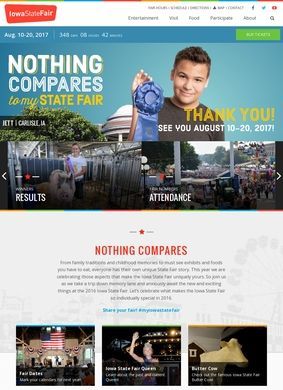
Inside a refrigerated glass case at the Iowa State Fair sits a life-sized dairy cow sculpted from roughly 600 pounds of butter. The fair has kept that Butter Cow tradition going long enough that the website treats it as a headline attraction, not a novelty. That single exhibit says a lot about what this event is: part agricultural exposition, part state ritual, part eleven-day food binge. The Iowa State Fair website covers all of those layers without forcing a visitor to dig.
Dates, location and fairground scale
The Iowa State Fair runs August 13 to 23, 2026, at the fairgrounds on East Grand Avenue in Des Moines, and the number the site leans on is more than a million visitors a year. That scale shapes the whole structure of the pages. There is no single thing to plan around, so the navigation is split into the practical (tickets, hours, a fairgrounds map, parking) and the experiential (Grandstand concerts, free stage acts, the carnival, the rodeo).
Buying tickets and finding deals
Tickets can be bought online, and a deals and discounts section gets its own space, which makes sense for an event that families attend in groups of four or six and need to budget for. The Iowa State Fair site also has a product finder tool so someone can track down a specific food vendor or stall before arriving, which is the sort of detail that turns the website into a planning tool instead of a poster for the dates.
Food vendors worth seeking out
The food coverage deserves its own note. Barksdale's State Fair Cookies get a named mention, the food-on-a-stick vendors are catalogued, and healthy options and value-priced items each have their own listings. The Iowa State Fair does not pretend everyone comes for fried dough. For an event where food is half the reason people show up, that level of specificity is the difference between wandering hungry and knowing exactly which corner sells the thing you drove two hours for.
Livestock shows and long-running contests
The Iowa State Fair began as an agricultural and industrial exposition, and the competition pages are where that heritage still does real work. Livestock shows, fair-time contests, show programs, and posted results all live here. The Bill Riley Talent Search gets its own billing, which a casual out-of-state visitor might skim past but means a great deal to Iowa families who treat it as a rite of passage. Publishing show results on the Iowa State Fair site gives the people who entered animals or projects the public record they came for.
Ways to volunteer or apply as a vendor
Beyond watching, the Iowa State Fair site makes plain how many ways there are to take part. Vendor applications, parade entry forms, volunteer positions, sponsorships, farmers market slots, kitchen classes, and national anthem auditions are all routed through participation pages. That breadth says something about how the Iowa State Fair operates. It is run partly by the community that attends it, and the website reflects that by giving a prospective volunteer or a first-time vendor a clear, well-signposted path of their own.
The grandstand entertainment lineup
The Grandstand and free stage scheduling rounds out the entertainment side. Concerts at the Grandstand are the paid draw, with VIP experiences for people who want more than a general seat, while the free stages and carnival rides keep the rest of the grounds busy for anyone not buying a concert ticket. The Iowa State Fair also lists the Elwell Family Park PRCA Pro Rodeo as a fixture, which adds a sanctioned sporting element to a lineup that already runs from livestock judging to live music.
Practical services for multi-day visits
Visitor services are handled with the seriousness the crowd size demands. Disability assistance is addressed directly, and camping and lodging options are laid out for people who travel in and stay near the grounds across multiple days. Group tours, parking information, and a vendor directory fill in the rest. None of this is glamorous content, but it is exactly the information a person needs when an event spans more than a week and pulls visitors from across the state and beyond. A fair this large that did not document camping and parking clearly would generate chaos, and the Iowa State Fair site seems to understand that.
Behind the fair queen tradition
The About section is where the Iowa State Fair lets its personality show. Alongside the Butter Cow, there is fair queen history, a trivia section, employment listings, and merchandise. It reads as an organization that knows its own folklore and is comfortable putting it on display next to the operational pages. The fair queen tradition and the trivia in particular point to an event that has accumulated decades of its own stories, and the Iowa State Fair site does not hide that institutional memory behind the ticketing flow.
One fair criticism of the experience: the sheer number of sections can feel like a lot at first. Someone arriving with a single question, say where to park or when a specific act plays, has to know which of the many top-level areas to enter. The product finder and the fairgrounds map both help cut through that, and the Iowa State Fair schedule of attractions is comprehensive, but the density is noticeable. A returning Iowan who already knows the rhythm of the fair will navigate it without thinking. A first-timer planning a single day could use a little more hand-holding at the top.
Summarizing decades of fairground tradition
Taken as a whole, the Iowa State Fair website mirrors the event itself: enormous, multi-layered, and built for a lot of different people doing a lot of different things in the same eleven days. A livestock exhibitor, a concert-goer, a vendor, a volunteer, and a family chasing food-on-a-stick are all served by distinct corners of the same site. The Iowa State Fair is one of the oldest and largest expositions of its kind in the country, and the pages carry that history without leaning on it as an excuse to skimp on the practical details. The fairgrounds map, the published competition results, and the named food vendors are the concrete specifics that make the bigger claim believable.
What lingers after browsing is how specific everything stays. The Iowa State Fair does not describe itself in the abstract. It points you to Barksdale's cookies, to a rodeo at Elwell Family Park, to a butter sculpture in a cooler, to a talent search with decades of history. The site keeps those items in front of you rather than burying them under mission language, and that is what makes it genuinely useful to the million-plus people who show up each August.