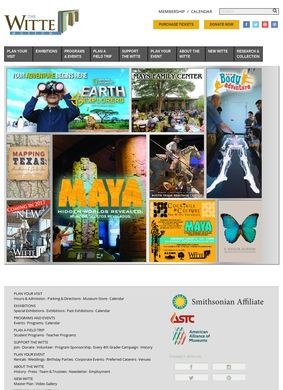
Near the corner of Broadway and Funston in San Antonio, The Witte Museum has been running since 1926, long enough that its permanent galleries carry accumulated weight, not curated polish. The Witte Museum bills itself as the place where nature, science and culture meet, and the permanent halls do back that up. The Naylor Family Dinosaur Gallery holds Cretaceous-era fossil material pulled from Texas soil, meaning the bones on display have a genuine regional origin, not generic casts shipped in to pad the floor plan. That distinction separates The Witte Museum from plenty of natural history institutions that rely on generic touring specimens.
From dinosaur fossils to native wildlife
The McLean Family Texas Wild Gallery extends the logic into living time, running more than 150 native Texas animals across habitat sets that map the state's distinct ecosystems. Moving from deep-time fossils to regional wildlife within a single building gives The Witte Museum a clear through-line: this is Texas natural history told from the Cretaceous to the present, without the feeling that two unrelated collections were stitched together by an administrator with a floor plan to fill. Families with young children can walk that arc in an afternoon and come away with something more coherent than a scan of unconnected curiosities. The strapline reads like marketing until you trace the path through the galleries, at which point it turns out to be a fair summary of how the curators have organized the material.
Centennial exhibit joins pterosaur showcase
Temporary shows are where a museum proves it is still thinking rather than coasting, and the current slate is credible. "Pterosaurs: Flight in the Age of Dinosaurs" extends the prehistoric material beyond the resident dinosaur hall, while "The Witte Museum: 100 Years" marks the centennial with an institutional retrospective. A milestone exhibit can easily become self-congratulatory, but a hundred years of continuous operation is a fact worth presenting on its own terms, and visitors who have come back across decades may find something of their own memory in it. Running one show that looks outward at extinct fliers and one that looks inward at the institution's own history is a reasonable pairing, and it shows The Witte Museum is still adding new reasons to return.
Programs extending beyond the museum walls
Youth educational camps, a volunteer program, a traveling exhibitions arm, and event and venue rentals all extend the institution well past a single ticketed walk-through. The Lower Pecos Rock Art Tours stand apart from everything else on that list: guided access to ancient rock art in the landscape is not something most city museums can arrange, and it pulls the reach of The Witte Museum out into the terrain it documents. Running those tours takes real coordination, and their presence says something about how seriously The Witte Museum takes the cultural half of its mission. Parents lining up summer plans will find the camps a practical option; researchers have the collections; anyone booking an event has the venue side.
Amenities for a full day visit
Day-to-day comforts are handled. A museum store and an on-site cafe mean a visit can stretch past lunchtime without anyone needing to leave. Free on-site parking removes one of the minor frictions that can quietly undermine a family outing, especially in a city where it is far from guaranteed. Online ticketing, CityPASS discounts, and membership programs for repeat visitors round out the practical layer. Locals who join as members work The Witte Museum into regular rotation, and the centennial timing gives that choice a bit of extra pull right now.
Affiliations behind the institution's credibility
The professional affiliations are worth pausing on, because they are not decorative. The Witte Museum is a Smithsonian Affiliate, a member of the American Alliance of Museums, and part of the Association of Science and Technology Centers. It also participates in Museums For All, the program that lowers admission for visitors using certain assistance benefits. That last one reflects a deliberate choice about access. The combined memberships place the institution within recognized professional networks, sparing it the need to vouch for its own standards, which is a meaningful distinction for teachers planning field trips or researchers after the collections.
Visitor reviews across major platforms
Tripadvisor carries upwards of 274 reviews with sentiments running in both directions, and Yelp shows a comparable volume alongside close to 1,300 visitor photos. The photo count tells its own story: people leave wanting to share what they saw, which is usually a decent proxy for whether the exhibits land. WeddingWire gives the venue side a strong showing, roughly 4.8 out of 5 across 20 reviews, so the event-rental business appears to keep its clients happy.
Employee feedback on glassdoor
The one figure that cuts the other way is Glassdoor, sitting around 2.9 out of 5 across 34 reviews, pointing to staff who are less uniformly satisfied than the visiting public. A prospective visitor should weigh that as context about workplace culture rather than a verdict on the galleries. Across visitor-facing platforms, the broad impression of The Witte Museum is positive without being unanimous, which is about what an honest look at any large attraction produces.
Reaching the institution is straightforward. The phone number and street address sit on the main site, a contact page is easy to locate, and the online ticketing portal is available for anyone who wants to plan ahead. None of that should be remarkable, yet enough attractions bury this information that it is worth noting when a place does not. Buying a ticket in advance is simple, and the site does not force anyone to phone ahead just to learn the basics.
Correcting a location filing quirk
One note for anyone navigating to this entry: it appears under an Indiana heading, but The Witte Museum is firmly in San Antonio, Texas. The address, the Texas-specific galleries, and the Lower Pecos tours all confirm the location. Treat the category label as a filing quirk; the building is in San Antonio.
Measured against the nearby San Antonio Museum of Art, the choice comes down to appetite. SAMA is the call for someone drawn to painting, sculpture, and a fine-art collection. The Witte Museum is the better fit for visitors drawn to dinosaurs, regional wildlife, ancient rock art, and the natural story of Texas, with children in tow or without. The depth of the permanent collections, the field tours, the centennial exhibit, and the free parking make it a strong afternoon in the city, and the professional credentials behind it give the recommendation real grounding.