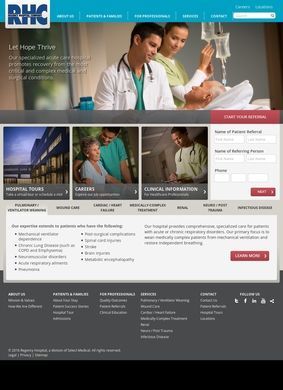
Regency Hospital Company runs a network of long-term acute care hospitals in the United States, the kind of facility that takes patients after the intensive care unit but before they are ready for a regular ward or home. That is a narrow and demanding corner of medicine, and the site is built around it from the first screen. The patients arriving at Regency Hospital Company are not recovering from routine surgery. They are people coming off catastrophic critical illness who still need close clinical supervision for weeks at a time.
Pulmonary care and ventilator liberation
The clinical scope is laid out in concrete terms, which is the part that gives the site its weight. Pulmonary care and ventilator liberation get top billing, meaning the work of weaning patients off mechanical ventilation, and that focus tells you a lot about who Regency Hospital Company is set up to treat.
Programs for complex illness recovery
Around that sit programs for medically complex and chronic critical illness, brain injury recovery covering stroke, aneurysm and trauma, broader neurologic conditions, infectious disease management, cardiac care after surgery or for medical reasons, wound care with advanced skin integrity work, and treatment for renal disorders. The stated aim is plain: restore a patient's ability to breathe, speak, eat, think and move on their own. Care is organized through interdisciplinary teams building an individual plan per patient, and Regency Hospital Company describes itself as a bridge between the ICU and whatever lower-acuity setting or home comes next.
Separate portals for patients and physicians
The site does not stop at describing services to families. It splits clearly into audiences and serves each one differently. Patients and caregivers get admissions information, facility tours, a MyChart portal for medical records, financial assistance details, and a community health needs assessment. Referring physicians and clinical professionals get their own track: published outcomes data, a patient referral route, credential verification, and a CareLink portal for coding and billing. That second track matters in this field because long-term acute care hospitals live or die on physician referrals, and putting outcomes data in front of those referrers is a sign Regency Hospital Company expects to be checked rather than taken on faith.
Clinical outcome benchmarks published
Five focus areas of early rehabilitation are flagged, and Regency Hospital Company publishes clinical outcome benchmarks alongside them. Publishing benchmarks is worth pausing on. Plenty of healthcare sites talk about quality in the abstract and leave it there. Putting numbers on a page that referring doctors can scrutinize is a different posture, and it suits an organization whose whole pitch is measurable recovery: getting someone off a ventilator either works or it does not, and the figures show which.
The rest of the structure is what you would expect from a multi-site operator. There is a "Locations and Tours" section gathering the individual hospitals, a news and blog area, an accreditations page, and current career listings. None of that is remarkable on its own, but together it reads like an organization that is actively running facilities and recruiting for them, not a shell page sitting dormant. Regency Hospital Company also appears in this business directory listing in a way that matches its site's actual scope, which at least confirms the category is right.
What makes contact information difficult to find?
Here the picture gets less tidy, and it is fair to say so. Contact information is not surfaced well on the landing page. The homepage carries no phone number and no street address, and a general company-wide contact form was not easily found. The "Locations and Tours" section is presumably where per-hospital phone numbers and addresses live, which makes structural sense for Regency Hospital Company given the number of sites, since there is no single number that fits every patient. Still, a visitor landing on the front page wanting to reach a specific hospital has to dig, and for families dealing with a relative in critical condition, a clearer path to a human would help.
Employee ratings show mid-range workplace satisfaction
On outside opinion, the available evidence comes almost entirely from employees rather than patients, and that distinction is worth stating up front. Glassdoor carries 116 employee reviews at 3.4 out of 5, with the US subset sitting slightly higher at 3.5 from 77 reviews. Indeed shows a larger pool, 404 reviews averaging 3.3. CareerBliss has only 2 reviews at 4.0, too few to read anything into. These are workplace ratings, so they speak to what it is like to work at Regency Hospital Company, not to how patients fared. A mid-3s score across hundreds of staff reviews is unremarkable for a hospital operator, neither a red flag nor a strong endorsement. Patient-experience ratings, the thing a family would actually want, did not surface in the search.
That absence is the honest center of any assessment here. The clinical claims are specific and the outcomes data exist on the site, but independent patient voices are missing from the picture, so a prospective family is largely taking the company's own published figures at their word. That is not unusual for long-term acute care, where patients are often too ill to leave reviews and decisions run through referring doctors, yet it does mean the credibility of Regency Hospital Company rests heavily on its accreditations and the benchmarks the company chooses to show.
The substance holds. Regency Hospital Company is a focused operator in a difficult specialty, with a clearly defined clinical mission, a serious referral apparatus, and the willingness to put outcome numbers in public where physicians can check them. For a doctor deciding where to send a ventilator-dependent patient, the professional-facing tools and the published benchmarks are exactly the right material, and Regency Hospital Company presents them without fuss. The weak spots are on the presentation side: front-page contact routing is buried, and the only third-party feedback that turned up covers employment, not care quality.
A referring clinician or a caregiver who knows to click into a specific location will find what they need, and the candor of publishing benchmarks counts in Regency Hospital Company's favor. A family arriving cold, hoping for a phone number and reassurance from other patients, will have to work harder than the site currently makes them. Independent patient experience data is simply absent, and that is a real limit on what can be confirmed from the outside. The published clinical infrastructure of Regency Hospital Company is credible on its face; the rest depends on conversations with the referring physician and a look at the specific local facility.