Back in 1983, Sandal Tree opened its first store inside the Hyatt Regency Maui with a single sandal style sold in four colors. That is a deliberately small start, and it says something about how the brand grew: one product, one resort lobby, then slowly outward across the islands. By its peak the chain had stores in Lahaina and Kaanapali on Maui, Koloa and Poipu on Kauai, Wailea and Kihei on Maui again, plus several spots in Honolulu, including locations on Ward Avenue and Kalakaua Avenue. The pitch was footwear you could not easily find at a mainland mall, sold under the tagline "Funwear for Your Feets," which is goofy enough that it probably worked on vacationers who had spent the morning at the beach.
From one Maui hotel to multiple islands
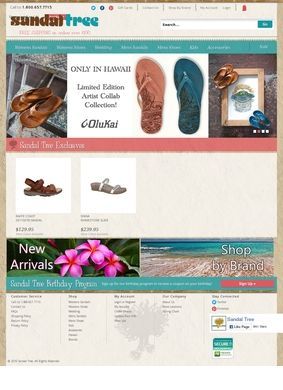
Anyone arriving at the Sandal Tree site expecting to browse those sandals will hit a wall immediately. The current page at the listed address shows a coming-soon placeholder and nothing else. No catalog, no store finder, no shopping cart, no hours. For a retailer whose whole appeal was the merchandise, an empty domain is close to the worst possible front door. If you came to buy a pair of sandals before a trip, you cannot, and the page gives you no path to a store that might still sell them. It is a name and a registrar's holding screen, and that is the full extent of what loads.
A resort-lobby start in 1983
That gap forces the rest of the picture to be assembled from elsewhere, and what turns up is not encouraging. Mapping services list multiple Sandal Tree locations as closed. The Lahaina store carries a historical phone number that the available listings on MapQuest and Yelp still display, but it sits right next to a closed status, so dialing it is a gamble. When a chain's storefronts read as shuttered across several services and the official site is a parked page, the honest read is a business that has either wound down or gone quiet without telling anyone online. The original expansion, from that one Maui hotel shop out to Kauai and the Big Island, only makes the contrast sharper: a brand that once stretched across the islands now points to nothing you can walk into with confidence.
Website shows only a placeholder
The footprint people left behind is modest. The Lahaina location on Yelp holds 13 reviews averaging 3.5 stars, a middling score on a small sample, the kind of rating you would expect from a resort-area shop that some shoppers liked and others found overpriced or cramped. There is also a Facebook page with 795 likes, a number that points to a store with a following at one point, though page likes are a soft measure and say little about whether anyone is minding the counter now.
Map services list locations as closed
Nothing surfaced on Google, Trustpilot, or the Better Business Bureau. A total absence on the bigger review platforms, paired with closed map listings, reads as confirmation rather than coincidence. A handful of Yelp comments and a dormant Facebook following are what a once-active local retailer leaves behind, not what an operating chain with active stores looks like today. For a brand that ran shops in resort corridors like Kaanapali, Poipu, and Waikiki's Kalakaua Avenue, that quiet is telling. High-traffic tourist locations generate fresh reviews constantly when a store is open; the trickle here points the other way.
What online reviews reveal
It is worth being fair about the era this brand belongs to. A footwear shop that opened in a Maui hotel in 1983 predates online retail entirely, and many small island businesses never made the jump to e-commerce or let their web presence lapse once foot traffic carried them. Sandal Tree may simply be one of those: a physical-first operation whose website was always an afterthought and is now just a name on a registrar's parking page. The "Funwear for Your Feets" tagline and the single-style, four-color debut both fit a small shop that ran on personality and location more than on slick marketing. That does not change what a visitor can do with it today, which is very little.
Absent from major review platforms
The live Sandal Tree page offers no phone, no address, no form, no hours. Everything usable comes from third-party listings that themselves flag closures. There is no point pretending a placeholder constitutes contact information; it does not, and a visitor is left to chase the brand across other sites with no guarantee the trail leads anywhere current. Even the one historical number tied to Lahaina comes wrapped in a closed label, which is about as discouraging as a contact detail gets. A traveler hoping to walk into a Sandal Tree on their next trip should treat any address they find as unconfirmed and call ahead, accepting that the call may go nowhere.
Can you still visit a Sandal Tree store?
If the underlying business were still clearly trading, the empty website could be weighed as a frustrating but fixable flaw, leaning on a decent-enough Yelp average and an established history. The trouble is that the closed-store picture undercuts that reading entirely. A 3.5-star average across 13 reviews is the sort of score you note and move past; it neither rescues nor sinks the Sandal Tree brand on its own. What sinks the visit, practically speaking, is that there is nothing live to engage with and good reason to think the doors are shut.
Comparison with active Hawaii retailers
Set against a still-operating Hawaii sandal seller such as Flip Flop Shops, which keeps real storefronts, posted hours, and a working site where you can see what is in stock, Sandal Tree comes off as a fond memory more than a destination. The 1983 founding and the spread of stores across four islands give it a genuine local-retail story, and the name will mean something to people who shopped it on a trip years ago. As a place to buy sandals today, though, Sandal Tree leads to a dead end. The evidence on hand, a parked site and closed listings across every major mapping service, does not support the conclusion that this is a working retailer, and the search is better pointed elsewhere.