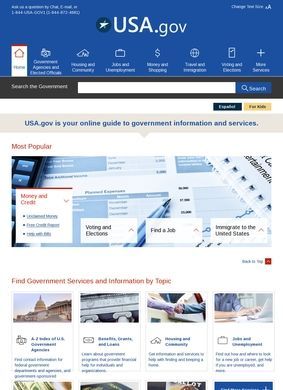
USAGov is the official web portal of the U.S. federal government, run by the General Services Administration and reachable at usa.gov. Its job is narrow and useful: point a resident or citizen toward the right agency, program, or piece of paperwork without making them guess which of hundreds of departments owns the answer. The portal does not process applications itself. It explains, sorts, and forwards, and most of the time that is exactly the help someone needs when they have no idea where to start. That self-imposed limit is worth understanding up front, because it shapes everything about how the site behaves and what it can and cannot do for a visitor.
Topic areas and routing
The content is organized into 23 broad topic areas, and the spread is wide enough to cover most reasons an ordinary person ever has to contact the government. Benefits and financial assistance sit alongside taxes, health insurance and medical support, housing assistance, immigration and citizenship, education and federal student aid, jobs and unemployment, military and veterans' services, travel and passports, voting and elections, disability services, disaster assistance, small business resources, legal issues, vital records, and scam and fraud prevention. That is a long list, and it reads less like a marketing menu and more like a faithful map of where federal responsibility actually lands. Few people will ever need more than two or three of those topics, but the point is that whatever a person needs is almost certainly there, sorted under a heading they can recognize.
Interactive tools for benefits and refunds
What makes the site genuinely usable is that it does not stop at categories. There are working tools behind the topics. A benefit finder walks someone through questions and surfaces programs they may qualify for, which is far more practical than a static page of links. There is a tax refund status checker, passport application guidance, and an unclaimed money locator that lets people search for funds they may be owed and never knew about.
Housing help resources round out the set. None of these are flashy, and that suits the audience: people arriving on USAGov usually want a clear next step, not a tour. The benefit finder in particular does the work that a citizen would otherwise do by reading through eligibility rules across multiple agency sites, which is precisely the kind of cross-referencing that defeats most people before they get an answer.
Agency directory by government layer
One of the steadier reasons to keep USAGov bookmarked is the agency directory. It lays out the structure of federal, state, local, and tribal government and connects each layer to the offices that handle specific matters. For anyone who has ever sat on hold trying to figure out whether a problem belongs to a state office or a federal one, this is the part that quietly saves time. It treats the question of "who do I even call" as a real problem worth solving, which a surprising number of government resources never do.
The directory matters most to people who do not already know how the system is wired. Someone who has worked around government their whole career knows that vehicle registration is a state matter and a passport is federal, but plenty of residents do not, and sending them to the wrong office wastes a morning. By spelling out the layers and tying them to concrete offices, USAGov spares people that detour. It is unglamorous infrastructure, and it is the sort of thing the portal is built to do well.
The directory also reflects the portal's honest position about its own limits. Because USAGov routes rather than executes, the value depends entirely on how current and accurate those connections stay. A directory like this is only as good as its maintenance, and a stale link or an outdated office name does more damage here than almost anywhere else on the site, since the whole promise is getting someone to the correct destination on the first try. When the destination has moved, the visitor is often worse off than if they had simply searched on their own, because they trusted the routing.
Spanish language portal
Spanish speakers get a full parallel version at espanol.usa.gov, a genuine counterpart to the main portal rather than a bare translated landing page. The depth is equivalent across both languages, which is the right call for a federal guide serving a country where a large share of residents handle official business more comfortably in Spanish. A portal that only worked in English would leave out exactly the people who most often struggle to navigate official channels, so the bilingual architecture is a structural decision as much as a policy one. USAGov also publishes plain-language explanations designed to avoid the jargon that makes government websites difficult for anyone, regardless of language.
Complaint filing and fraud prevention
USAGov also handles something most people do not realize the government provides a front door for: filing complaints, both against government agencies and against private companies. Pointing a frustrated consumer toward the agency that can act on a grievance is concrete help, and folding it into the same hub that covers benefits and passports keeps people from bouncing around a dozen unrelated sites to find the one office that can intervene. A person who has been scammed, overcharged, or stonewalled rarely knows which body has the authority to do anything about it, and this is where the routing model pays off. The scam and fraud prevention section extends this further, with guidance on how to recognize common schemes and where to report them, which is more practical than a general warning page would be.
Taken as a whole, the substance is strong and the scope is sensible. USAGov knows what it is, resists the temptation to overpromise, and keeps its tools aimed at practical outcomes. The breadth of the 23 topic areas, the working finders, the bilingual mirror, and the agency directory together make a credible case for being the first stop when government business looms and the path is unclear.
Maintenance as critical foundation
Where the portal lives or dies is in upkeep, and that is the doubt worth sitting with. A navigational hub carries an unusual burden: every promise it makes is a redirect, and a redirect that lands in the wrong place, or on a program that has changed its rules, quietly undoes the trust the rest of the site earns. Whether the benefit finder reflects current eligibility, whether the agency directory tracks reorganizations, whether each forwarded link still resolves to the office it names, those are the things that decide if USAGov is a reliable starting point or just a tidy index of where the government used to be. The whole design assumes constant, careful maintenance, and a visitor has no way to confirm from the page itself that the maintenance is keeping pace.