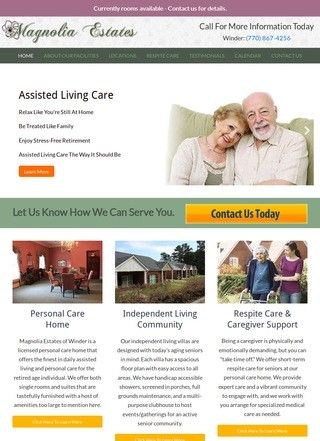
Finding a place for an aging parent usually starts with one hard question: can they keep some independence while still getting help with the things that have become difficult? That gap, the space between living fully on your own and needing hands-on care every day, is exactly what Magnolia Estates of Winder is built to cover. The community sits on Gainesville Highway in Winder, Georgia, and it has been operating since roughly 1990, which puts close to three decades behind it. Longevity like that tells you something a brochure cannot: people kept choosing it, and it kept its doors open.
Three levels of care under one roof
The structure of care here is the part worth slowing down on, because it answers most of the practical worries a family brings to the table. There are three tiers. Independent Living is for seniors who can still run their own day but want the security and the social side of a community: the floor plans are described as spacious, the showers are handicap-accessible, and units come with screened-in porches. In a Georgia summer, sitting outside without fighting bugs is its own quiet luxury, and screened porches make that possible.
Independent living with community support
Independent residents at Magnolia Estates keep their routines while gaining a safety net. Assisted Living steps things up with fully furnished single rooms and suites, plus support for bathing, dressing, medication, and mobility. Respite Care fills the third slot, short-term temporary stays for families who need coverage while a caregiver travels, recovers, or simply catches their breath. Few communities of this size carry all three under one roof, and Magnolia Estates does.
Assisted living and respite care options
What stands out about that spread is how it tracks a real person's decline over time. Someone can move in independent, shift to assisted care as needs grow, and the staff already know them. No second relocation, no starting over with strangers. The Magnolia Estates model leans into that continuity, and for adult children weighing options it removes one of the most stressful variables in the whole decision.
Daily services and resident safety
Beyond the housing tiers, the day-to-day services are spelled out clearly. Medication is administered by staff, meals are prepared on site with accommodation for special diets, and Magnolia Estates also runs structured activity programming so residents are not left to fill empty hours alone. The facility flags family communication support too, meaning relatives are kept in the loop rather than guessing how a parent is doing from a distance. Rooms carry practical extras: emergency response systems and WiFi access, the first for safety and the second so residents can stay connected to people who live far off.
Medication management and specialized meals
Special-diet accommodation sounds minor until it isn't. A resident managing diabetes, low sodium, or swallowing difficulties needs food planned around those limits, and a kitchen that handles it in-house spares the family a constant negotiation. The medication administration piece is similarly consequential, since missed or mistimed doses are one of the more common reasons an older adult lands back in a hospital. Having that managed by staff is a genuine safeguard.
Family-owned operation with personal attention
The community describes itself as family-owned, and the size implied by single rooms and individual suites points to a smaller operation than the large corporate chains. That cuts both ways. Smaller usually means more personal attention and staff who recognize every resident by name; it can also mean fewer amenities than a sprawling campus. For many families, the trade lands on the right side, especially when the alternative is a facility where a parent becomes a room number.
Reaching the place is refreshingly simple. A phone number, a street address, an email, and business hours all sit right on the landing page, with weekday hours running 8am to 4pm and weekend hours 9am to 2pm. No buried contact form, no chasing details across three clicks. For a category where families often have to dig just to learn whether a community even has openings, that openness reads as confidence.
Reputation and pricing across platforms
The outside reputation is mixed in an honest, believable way, which is more reassuring than a wall of flawless five-star marks. Magnolia Estates turns up across most of the senior-living platforms families actually check. Caring.com lists nine reviews, A Place for Mom shows six, SeniorAdvisor.com and US News Health both carry it with ratings, and SeniorSite logs eight reviews averaging 3.4 out of 5 on overall experience. Google, by way of Olera.care, puts it at 4.7 out of 5. Seniorly and FamilyAssets round things out with photos and pricing data, which helps families budget before they ever pick up the phone.
How ratings vary by review site
That 3.4 on one platform sitting next to a 4.7 on another is worth a moment of thought. It is not a contradiction so much as a reminder that senior-care experiences vary by resident, by year, and by which staff happened to be on shift. One number on A Place for Mom shows a proprietary score of zero, but that figure is built on zero reviews in the recent window, so it reflects a quiet stretch of new feedback, not a string of bad experiences. Read together, the spread points to Magnolia Estates as a solid, well-regarded community that has its strong reviews and its lukewarm ones, like nearly every honest care home does.
The pricing transparency through third-party aggregators deserves a mention too. Senior living is expensive and notoriously opaque, and families routinely tour a place before learning it sits thousands above their budget. When cost data is already out in the open on sites like Seniorly and FamilyAssets, a daughter or son can rule it in or out before investing an afternoon in a visit. That respects everyone's time.
Taken together, Magnolia Estates makes a strong case for families shopping for a parent who is still fairly independent but starting to need help with medications, meals, or mobility, particularly if continuity of care and a smaller, family-run setting matter more than resort-style extras. The Winder location puts Magnolia Estates within easy reach of the Athens and northeast Georgia corridor. A sensible next step is a phone call to ask about current availability, the difference in monthly cost between independent and assisted living, and whether a respite stay can work as a trial run before a longer commitment is made.