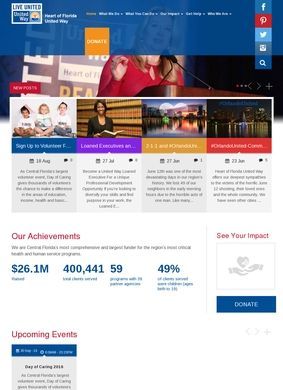
A single mother in Kissimmee loses her childcare subsidy, the rent is due in eleven days, and she has no idea which agency handles emergency assistance or whether she even qualifies. That tangle of half-known options is exactly the gap Heart of Florida United Way tries to close. Its 211 Information and Referral Line answers calls around the clock and points residents of Orange, Osceola, and Seminole counties toward the specific local programs that fit their situation, whether that is food, utility help, housing, or counseling. The value here is not a grand mission statement, it is the practical work of matching a person in trouble to the right phone number and the right office.
The 211 referral line and core services
Behind that referral line sits a fairly broad operation. Heart of Florida United Way organizes its work around four areas it calls Financial Stability, Education, Health, and Basic Needs, and the programs underneath those headings are concrete enough to judge. There is 988 Suicide and Crisis Lifeline support, which fills a hard gap in a region where mental health resources run short. There is Hurricane Recovery assistance, an obvious necessity in Central Florida, where storm season is a recurring fact of life and recovery help often arrives slower than the damage does. Veterans get a dedicated track through Mission United, which handles the kind of case management that a general help line cannot always provide.
Tax preparation and digital literacy programs
The tax and banking assistance is the part I find most quietly useful, because it addresses a problem that compounds in silence. Low-income households frequently leave refund money on the table or fall into the orbit of predatory check-cashing services, and free tax preparation paired with banking guidance can put real dollars back into a household budget. Digital Horizons, the digital literacy program, fills a related gap: plenty of services and benefits now assume a level of online fluency that older residents and recent arrivals simply do not have. Heart of Florida United Way treating digital access as a poverty issue is a sensible read of how exclusion works now.
Donor networks and giving options
On the giving side, the structure is more conventional but well built. Heart of Florida United Way runs several donor engagement networks, Women United, Emerging Leaders, and Business United, each aimed at a different slice of the community willing to commit time and money. Workplace giving campaigns remain a backbone of the funding model, and corporate volunteerism is coordinated alongside individual sign-ups. Online donations are straightforward to make. None of this is novel for a United Way affiliate, but the menu is complete, and someone who wants to help has clear ways in, from writing a check to organizing a company drive to showing up for a volunteer shift.
Spanish-language access for Central Florida
One detail worth flagging is the Spanish-language site at es.hfuw.org. Central Florida has a large Spanish-speaking population, particularly the Puerto Rican community that grew sharply after Hurricane Maria, and a parallel site rather than a buried translation widget signals that Heart of Florida United Way takes that audience seriously. For an organization whose entire purpose is connecting people to help, removing a language barrier counts as core function. A family that cannot read the English intake page cannot use the 211 line effectively, so the bilingual presence has direct operational value.
Financial ratings from independent evaluators
Transparency is where Heart of Florida United Way separates itself from the long tail of well-meaning but opaque charities. Heart of Florida United Way holds a Platinum rating from Candid, formerly GuideStar, which is the top tier and requires disclosing detailed data about goals, strategy, and measured results, beyond the balance sheet. It also carries a four-star rating from Charity Navigator, the other major evaluator that scrutinizes financial health and accountability. Earning strong marks from both at the same time is a meaningful credential, because the two platforms weigh somewhat different things, and a nonprofit that satisfies both is generally one that documents where its money goes and what it produces.
Inside the intermediary funding model
That documentation carries higher stakes for Heart of Florida United Way than for a single-issue charity, because the model is essentially intermediation. Donors give to Heart of Florida United Way, and the organization distributes funds and coordinates partner agencies instead of delivering every service with its own staff. That structure only works on trust, and trust is built on exactly the kind of reporting the Candid and Charity Navigator ratings reward. A potential donor who wants to know that a workplace pledge will actually reach the family in Kissimmee has external, independent confirmation to lean on, a level of proof few local nonprofits supply.
If there is a limit to what the website conveys, it is that the breadth can blur the specifics. A visitor sees four impact areas and a dozen programs, and the sheer range can make it harder to grasp how much of any one program actually operates at scale versus existing mostly as a referral handoff. The 211 line is clearly the front door and clearly substantial. Some of the named initiatives read more like coordinated partnerships than fully staffed Heart of Florida United Way services, which is normal for the model but not always spelled out. A reader trying to gauge depth in a particular area will likely need to call instead of relying on the page.
For the audience most likely to land here, the practical takeaway splits in two directions. A Central Florida resident in a bind should treat the 211 line as the single most useful thing on offer, a real-time, multilingual triage point that beats guessing which agency to call. A donor or a company evaluating where to direct charitable dollars gets a regional nonprofit with serious transparency credentials and a clear geographic focus on three counties it knows well, a concentration that tends to produce better outcomes than scattered regional giving.
My verdict leans positive but stays grounded. Heart of Florida United Way is a credible, well-run affiliate doing exactly the work its category demands, with independent ratings that back up the claim and a program list weighted toward genuine community needs rather than vanity initiatives. The bilingual commitment and the tax assistance push it above a baseline United Way operation. The caveat is modest: anyone needing one specific service should confirm its scope directly instead of assuming every listed program runs at full strength, since an umbrella organization inevitably varies in depth across its portfolio. For residents seeking help and for donors seeking a trustworthy local channel, Heart of Florida United Way is a sound choice, and the headquarters in Orlando anchors it firmly in the community it serves.