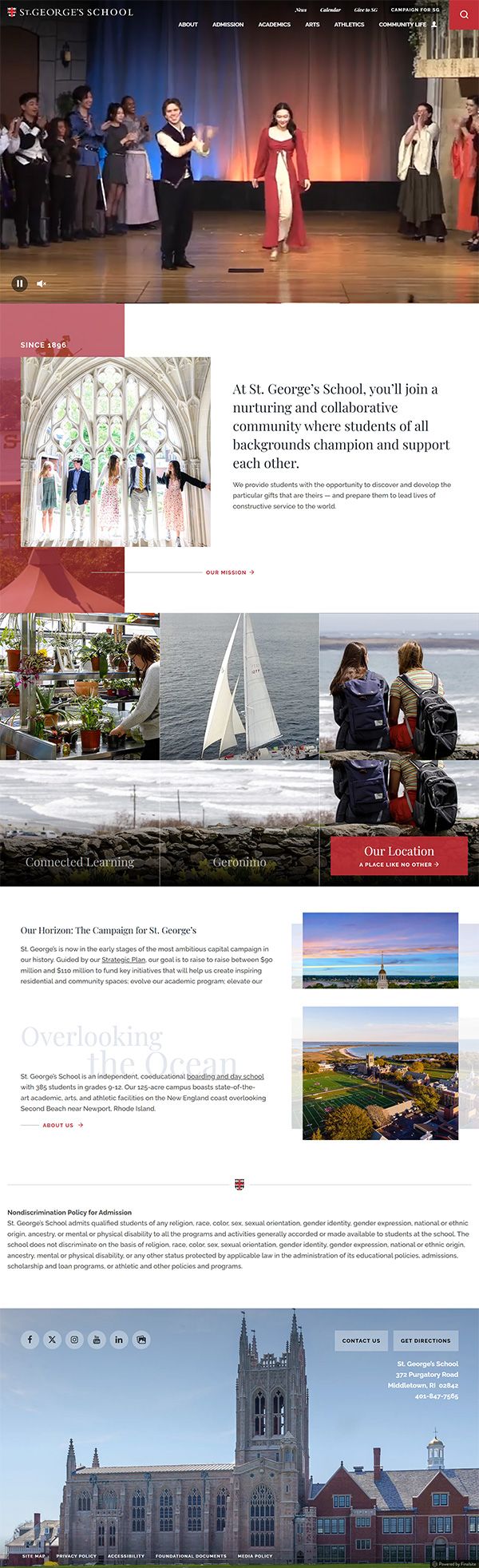
St. George's School is an independent, coeducational college-preparatory boarding and day school sitting on a 125-acre coastal campus in Middletown, Rhode Island, overlooking Second Beach near Newport. It enrolls around 400 students across grades 9 through 12, splitting them between a residential boarding program and a day option for families in the Newport and Middletown area. Founded in 1896, it has been accredited by the New England Association of Schools and Colleges and belongs to the New England Preparatory School Athletic Council. Private Boarding School: New England is the directory entry pointing to it, and the school behind that entry has a long, settled record.
Connected learning curriculum design
What the site lays out first is the academic shape of the place. Coursework is organized into three broad areas (Humanities, Language and Culture Studies, and STEM) and the school threads them together under a framework it calls Connected Learning, which is its term for teaching across disciplinary lines instead of in sealed subject boxes. For a school of roughly 400 students spread over four grades, that interdisciplinary approach is more plausible than it would be at a larger institution, since the class sizes that come with that enrollment make cross-subject work easier to actually run. Private Boarding School: New England presents a small, deliberately structured curriculum rather than a sprawling catalog of electives.
College counseling as core service
College counseling gets its own dedicated provision, which is the expected centerpiece for a school that defines itself as college-preparatory. The site treats it as a distinct service instead of an afterthought folded into general advising, and for families weighing four years of tuition, that counseling function is often the part they scrutinize hardest. A reader looking at the academic side gets a clear sense of where Private Boarding School: New England is steering its students.
Named venues for student art
The arts programming is more concrete than the usual blanket mention. Visual arts, music, and theater all run, and student work gets shown as well as made: the Hunter Gallery exhibits pieces, and a program called Sculpture on the Hilltop puts three-dimensional work out on the grounds. Naming specific venues like this means the school has built physical places for art to live, which is a different thing from listing "arts" as a line item. The visual and performing side looks like a real part of how Private Boarding School: New England runs its days, not a token elective slot.
Comparing athletics and live streaming
Athletics is where the coastal-prep identity shows most plainly. Teams compete at varsity and sub-varsity levels across a range of sports, and the school runs an athletics portal carrying schedules, results, and live streaming of games. That live-streaming detail is worth pausing on, because for a boarding school it answers a practical problem: parents who live far from Middletown can still watch their children compete. NEPSAC membership places the teams within the established New England prep competitive circuit, so the sports schedule is slotted into a known league structure instead of improvised season to season.
Coastal campus and facility claims
The buildings themselves are described as state-of-the-art academic, arts, and athletic facilities. That phrase is the vaguest thing on offer, the kind of claim every school makes, so it carries less than the specific named programs do. Still, the campus setting is its own asset that needs no embellishment: 125 acres on the Rhode Island coast, above Second Beach, within reach of Newport. Geography of that sort is not a marketing line, it is just where Private Boarding School: New England is.
Boarding versus day student tracks
The dual structure, boarding plus a day-student track, is one of the more useful facts in the listing. It means a family near Middletown can send a child to Private Boarding School: New England without committing to residence, while families farther afield get the full boarding experience on the same campus. Roughly 400 students total keeps the community small enough that the two groups are not running parallel schools; they share the grounds, the faculty, and the programs described above. For grades 9 through 12 specifically, that scale matters, since a four-year cohort of that size means each grade is intimate by design.
A century of institutional history
The age of the institution does real work here too. A school founded in 1896 has had well over a century to develop its traditions, its alumni network, and the relationships with colleges that feed back into the counseling function. None of that guarantees a good fit for any particular child, but it does mean Private Boarding School: New England is not an unproven venture. That kind of continuity is something families pay attention to when choosing where to place four formative years.
Accreditation and league memberships
The accreditation and league memberships round out the credibility picture. NEASC accreditation is the regional standard that places the academics against an external benchmark, and NEPSAC ties the athletics into a recognized association. Neither is a marketing flourish; both are memberships the school either holds or does not, and Private Boarding School: New England holds them. For a prospective family, those affiliations are the dry, verifiable facts that sit underneath the prettier campus photographs.
Final assessment of the school
The honest read on the offering is this. The academics are clearly structured and small in scale, the arts have named homes rather than vague mentions, the athletics are properly slotted into a regional league with the practical touch of live streaming, and the dual boarding-and-day model gives families genuine choice. The weaker notes are the generic facilities language and the fact that, like any school's own site, this is the institution describing itself in favorable terms. What Private Boarding School: New England gives a reader is a coherent, specific portrait of a long-established coastal prep school, strongest where it names actual programs and venues, and less persuasive where it reaches for the phrases every brochure uses.